
5 Mistakes to Avoid With Electric Gate Repair
Electric gate repair mistakes are rarely about choosing the wrong part. They’re about the sequence of steps skipped before that part gets ordered, which is why the same gates end up back on the service schedule within 90 days. The most expensive mistake isn’t what the homeowner does. It’s what the technician skips: the full cycle test after the fix, the only way to catch the secondary fault hiding behind the obvious one. If you’d rather not navigate any of this on your own, call Portcullis Gate Repair at (940) 412-7340 for a free estimate.
Key Takeaways
- The biggest repair failures come from skipping diagnostic steps, not picking the wrong brand.
- Replacing a burned control board without testing the entrapment loop first almost guarantees a repeat failure.
- Resetting obstruction sensors without recalibrating force settings creates a UL 325 safety violation.
- Ordering parts by brand name alone leads to incompatible substitutions, especially on FAAC and BFT operators.
- Voltage drop on long driveway runs is a silent killer of brand-new motors.
- Skipping permits on Los Angeles gate electrical work can void insurance coverage on an injury claim.
Mistake #1: Fixing the Symptom, Missing the Cause
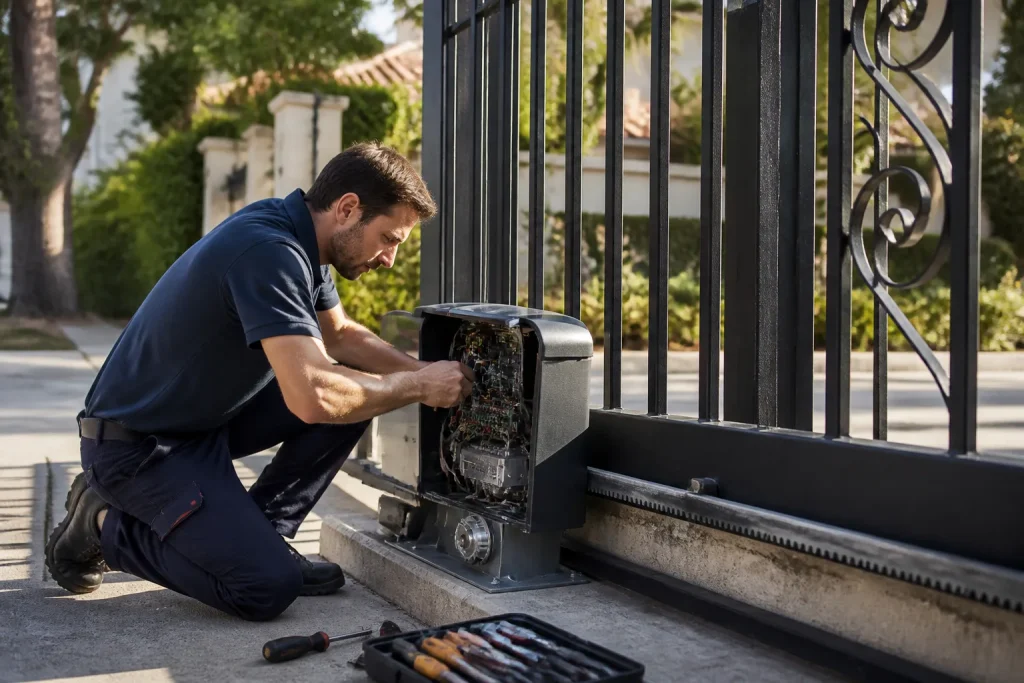
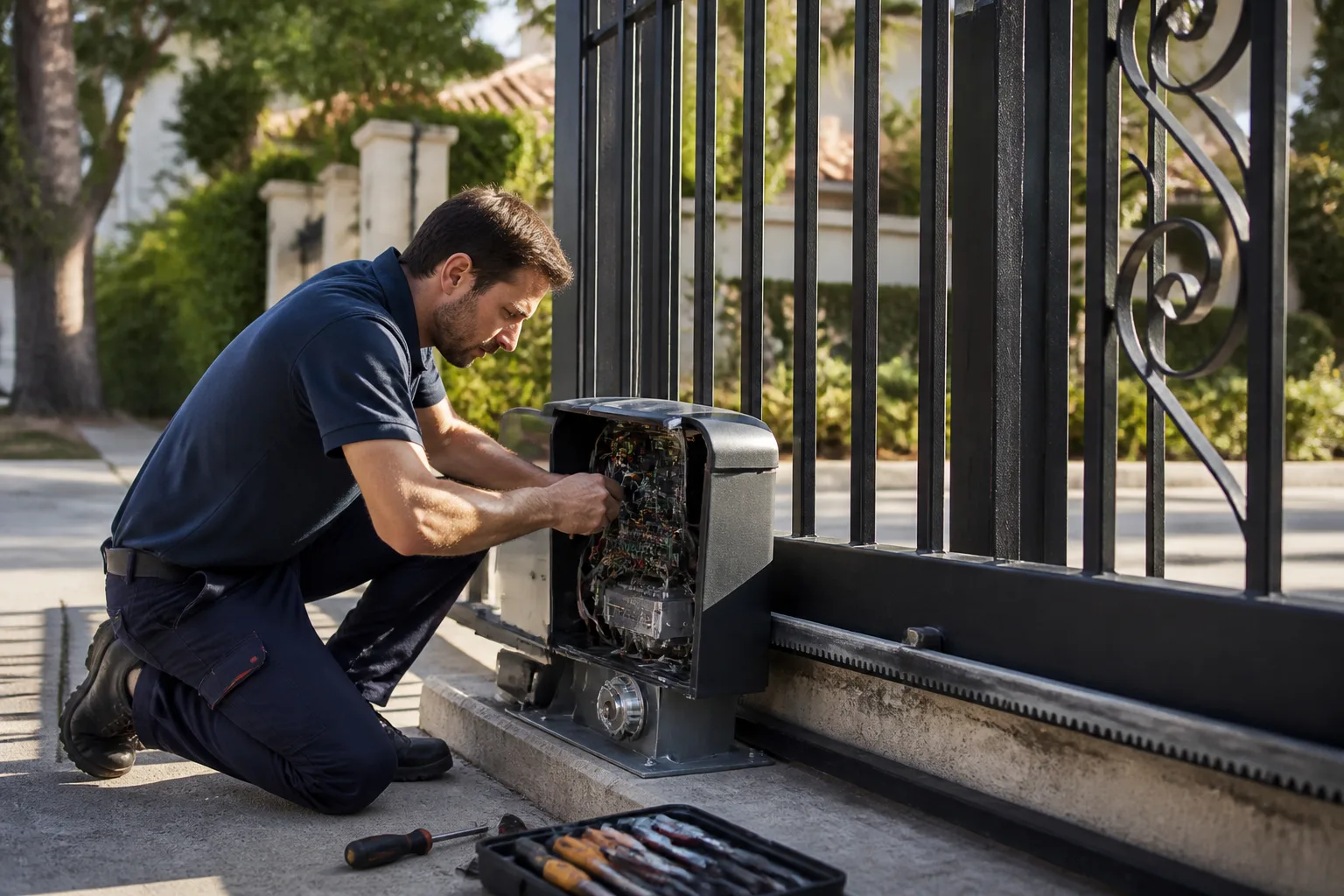
Here’s the pattern we’ve seen play out across Los Angeles more times than we can count. A gate stops opening. The homeowner calls someone out. The technician opens the control box, sees a scorched control board, swaps in a new one, tests the gate once, and drives off. The gate works for a few weeks. Then the new board burns out in the same spot. The homeowner is out another service call and another board, and they still don’t have a working gate.
What happened? The burned board was the symptom, not the cause. Control boards rarely fail on their own. Something downstream pulled too much current through them. In most cases it’s a failing entrapment loop: the buried or edge-mounted safety circuit that tells the gate to stop or reverse when something is in the way. If that loop is shorted or bleeding voltage to ground, it overloads the board over time. A new board without a loop test is just a slower version of the same failure.
The inexpensive fix is a full diagnostic pass before any part gets ordered: test the loop resistance, check the motor’s amp draw under load, verify the power supply is clean. That sequence takes an extra thirty to forty minutes. It’s the difference between a repair that lasts and a repair that returns in six weeks. This is exactly what the Electric Gate Repair in Los Angeles process at Portcullis is built around: find the actual fault first, then replace what failed because of it.
Mistake #2: Resetting Sensors Without Recalibrating Force
Every modern electric gate operator has obstruction sensors built in. When the gate hits resistance, those sensors tell the motor to stop or reverse. The problem is what happens when a gate gets knocked out of alignment or a sensor gets tripped repeatedly by debris: homeowners and some technicians reach for the quick fix of resetting the sensor and calling it done.
But the force setting, how hard the gate pushes before the sensor reacts, is separate from the sensor itself. If the gate was closing too hard and the sensor was fighting it, resetting the sensor without lowering the force setting leaves you with a gate that closes with enough pressure to hurt someone. That’s a UL 325 safety violation, the national standard for automatic gate operators. It’s also a serious liability issue in Los Angeles, where a gate-related injury on a rented property can turn into a lawsuit within weeks.
A trained technician tests force settings with a gate force gauge, which measures the actual pounds of pressure at the leading edge. That’s not a hammer-and-guess job. It’s calibrated, documented, and adjusted so the gate reverses on contact. We recalibrate every time we touch a sensor because the two systems work together. If the force setting is off, the sensor is just a bandage.
Mistake #3: Ordering Parts by Brand Name Instead of Part Number
This one is deceptively common. Someone opens a FAAC control box, reads “FAAC 415” off the casing, and orders a “FAAC 415 board” online. The board arrives. It doesn’t fit the wiring harness or the mounting studs. The gate is still down, and now there’s a restocking fee and another week of waiting.
Why does this happen? Because FAAC, BFT, and several other European gate-operator brands sell significantly different versions of the same model number in different markets. A FAAC 415 sold in Italy has a 230V power supply and different terminal assignments than the 115V version sold in North America. BFT operators have similar splits between European and US editions. The model number on the casing is a starting point, not a part number.
The actual part number lives on the board itself, typically printed on the PCB or on a small white label near the voltage input. It’s a longer string that includes the voltage rating and board revision. That’s the number you order with. Go to a supplier with that number and you get the right board the first time. Go with the brand and model alone and you’re gambling with the gate’s downtime.
This is one of the places where brand familiarity pays real dividends. Portcullis technicians carry service experience on nine major gate-operator lines including FAAC, BFT, LiftMaster, and Mighty Mule, so the person who shows up to diagnose already knows which revision your system needs without a trial-and-error order.
Mistake #4: Ignoring Voltage Drop on Long Driveway Runs
Here’s a scenario we saw in Encino a few months ago. A homeowner had a brand-new gate operator installed on a driveway that runs nearly 300 feet from the house panel to the gate. Six weeks later the operator started faulting under load, throwing error codes the homeowner had never seen. They called us assuming the new motor was defective. It wasn’t the motor.
The installer had run 14-gauge wire from the panel to the gate. At 300 feet with a motor drawing several amps at startup, 14-gauge wire drops enough voltage that the operator sees 105 volts instead of 120 when the motor kicks in. Modern operators have tight voltage tolerances. At 105 volts under load, the board faults and shuts down to protect itself. The gate works fine in the morning when the grid voltage is high, and faults in the afternoon when the neighborhood load drags it down. It’s a diagnostic nightmare if you don’t check wire gauge first.
The fix is ugly because it means pulling new wire, usually 10-gauge or 8-gauge depending on the run length and motor draw. That’s a trenching job, not a part swap. But it’s the only fix that actually solves the problem. If your gate faults intermittently and the operator is new, the wire in the ground is the first thing to check, not the motor. Voltage drop also matters in Los Angeles because summer heat raises resistance in buried conduit, making a marginal installation fail exactly when you most want the gate working.
Mistake #5: Skipping the Permit on Gate Electrical Work
In Los Angeles, certain gate electrical work requires a permit and inspection from the city’s Department of Building and Safety. New operator installations, electrical service upgrades at the gate, and any work that pulls new wiring from the panel typically fall under this umbrella. A straight operator swap, something that uses the existing wiring and just replaces the motor and controls, usually doesn’t. The line between these two categories isn’t always obvious, and the consequences for getting it wrong are real.
If a gate-related injury happens on a property where unpermitted electrical work was performed, the homeowner’s insurance carrier has grounds to deny the claim. That’s not a hypothetical. Insurance adjusters look for exactly this pattern after a gate injury claim. The unpermitted work becomes the hook they hang the denial on, and suddenly the homeowner is personally liable for medical bills and legal costs.
The safer path is to ask the question before the work starts: “Does this job need a permit, and who pulls it?” A legitimate gate company in Los Angeles will give you a straight answer. Portcullis handles permitting on jobs that require it and tells homeowners upfront when a job is a simple swap that doesn’t. For more on how this fits a full installation, see our Gate Installation in Los Angeles page.
When to Call a Pro
Some readers will read this and feel like they can handle a diagnostic pass themselves. Respect to that. But there are moments where the smart move is to bring in someone who does this every day. If your gate is an automatic operator with entrapment protection and you’re seeing repeated control board failures, call a pro before you order another board. If you have a long driveway with buried wire and intermittent faults, the wire check is a pro job. If you’re anywhere near the force calibration on a heavy gate, a force gauge and manufacturer specs are required, not suggested. And if the gate is part of a commercial property or a rental in Los Angeles, the liability exposure makes a trained technician the only sensible choice.
One of the most satisfying calls we’ve handled recently came from a homeowner in Sherman Oaks whose previous gate company had replaced the same control board three times in two years. We pulled the entrapment loop and found a splice that had been buried without a waterproof junction box. The loop was bleeding voltage into the soil. We replaced the splice, sealed it properly, and the board has been running clean for over a year now. Three boards died because one splice was left exposed. That’s the entire point of this post in one driveway.
Related services in Los Angeles: Gate Repair in Los Angeles and Electric Gate Repair in Los Angeles. Start at the Portcullis Gate Repair home page if you want a full picture of what we do.
The Bottom Line
The five mistakes here share one common thread: they’re all about skipping a step that comes before ordering a part. Skipping the loop test before buying a control board. Skipping force recalibration after a sensor reset. Skipping the part-number check before ordering a FAAC or BFT board. Skipping the wire gauge measurement on a long run. Skipping the permit conversation on electrical work. Every one of those skips saves thirty minutes at the front end and costs days or weeks at the back end.
Portcullis Gate Repair has operated as a Kingswell company since 2008, which means every job is held to the Kingswell Guarantee: a written price before any work starts, a real arrival window, a clean job site, and a written guarantee on the repair. The 365-Day Done Right Promise means that if a repair fails within a year, we come back and correct it at no charge. That’s not a promise we make lightly, and it’s the reason we don’t skip the diagnostic steps this post describes. If you’re in Los Angeles and want an electric gate fixed without the repeat-service cycle, call (940) 412-7340 for a free estimate. We answer with a live person, around the clock.
Frequently Asked Questions
Because the original cause of the first board failure was never found. In most cases, a failing entrapment loop or a wiring fault is pulling excess current through the board, and replacing the board without fixing the loop means the new board fails the same way. Call (940) 412-7340 and we’ll test the loop before spending a dollar on parts.
It depends on the scope. Straight operator swaps that use existing wiring typically don’t require permits. New installations, new electrical runs, or service upgrades at the gate usually do. The test is whether new electrical work is being performed beyond the operator itself. We’ll tell you upfront which category your job falls into and handle the permit if it’s required.
That’s a classic voltage-drop symptom. When grid voltage sags in the afternoon from neighborhood demand, a marginally-sized wire run drops the voltage at the operator below its fault threshold. The fix is heavier-gauge wire, not a new motor. Check the wire gauge before condemning the operator.
No. FAAC and BFT sell region-specific versions of the same model number with different voltage ratings and terminal assignments. You need the exact part number printed on the original board, not just the model number on the casing. Ordering by model alone frequently results in an incompatible board and more gate downtime.
Written by Dean Prescott, Owner at Portcullis Gate Repair, serving Los Angeles since 2008.
Need Gate Repair Help?
Call Portcullis Gate Repair - licensed & insured, here with fast after-hours help in Los Angeles.
(940) 412-7340