
Electric Gate Repair: Repair or Replace? How Los Angeles Homeowners Decide
Most electric gates in Los Angeles don’t die of old age. They die of parts obsolescence. A gate operator can be seven years old, run fine mechanically, and still be effectively unrepairable because the manufacturer stopped making the control board and there are no compatible replacements on the shelf. When that happens, the repair-or-replace decision makes itself. If you’d rather not sort through this on your own, call (940) 412-7340 and we’ll walk you through it in plain language.
The Part Nobody Talks About: Parts Sunset
Every gate operator manufacturer eventually discontinues the electronics that run the machine. The motor, the gears, the chain, even the remote controls often stay available for years. But the control board, the logic card, and the receiver module go out of production on a schedule the manufacturer sets, not on a schedule your gate follows. We call it parts sunset.
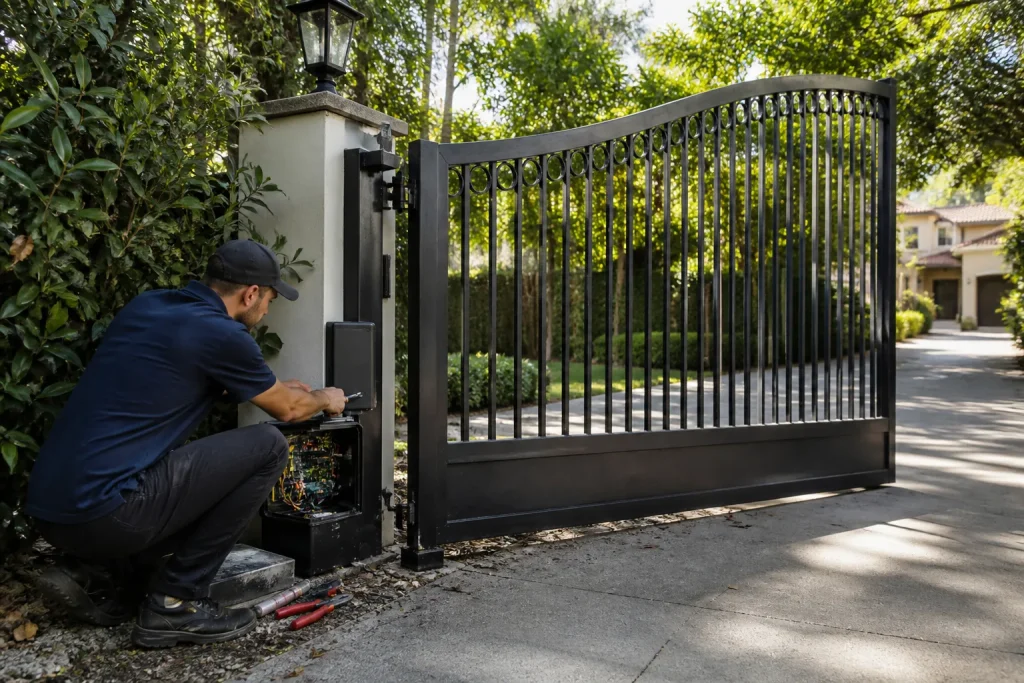
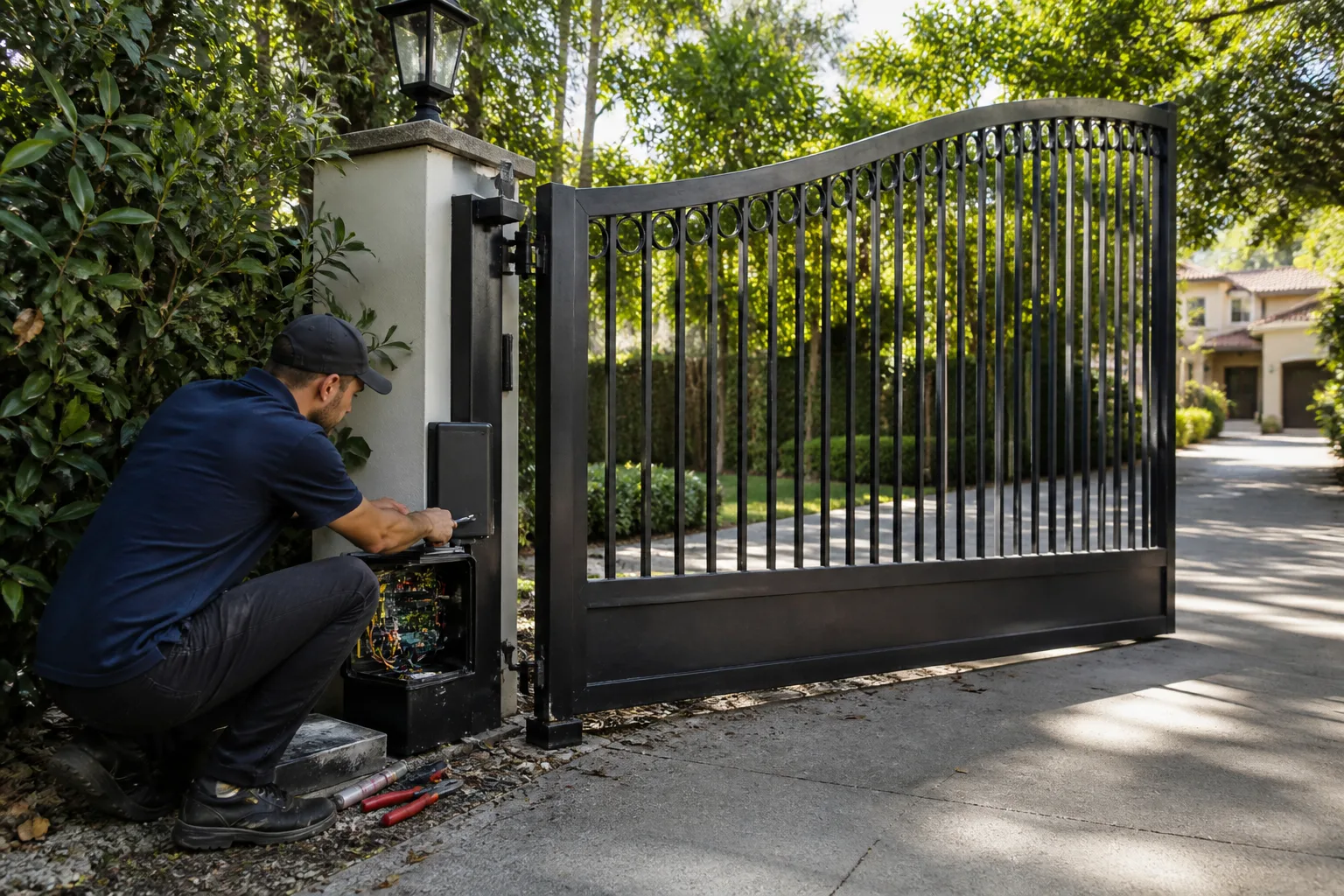
Here’s how it usually plays out in Los Angeles. A homeowner calls us because the gate stopped responding to the remote. We open the control box, find a fried relay or a dead capacitor on the main board, and call the distributor. Fifteen years ago, that call ended with a new board arriving in two days. Today, for operators built before roughly 2015, that call often ends with “discontinued, no replacement.”
That’s the moment the repair-or-replace conversation actually starts. Not when the gate is old. When the board is gone.
How to Check Where Your Operator Sits on the Timeline
You can look this up yourself before you ever call a technician. Take the model number off the side of the operator, usually a silver or white label near the power cord or on the inside of the plastic cover. Search the model number plus “discontinued” or “parts availability.” The manufacturer’s own parts portal will tell you whether the control board is still in production.
Some operators we still service regularly have boards available a decade or more after the unit shipped. Others, particularly early-mid 2010s Viking and DoorKing residential models, have boards that vanished from the supply chain years ago. Ghost Controls and Elite have been better about keeping board compatibility across model generations, but even they sunset boards eventually. The brand matters less than the specific model’s production timeline.
The 50% Rule: When Replacement Math Wins
Here’s a decision framework we walk Los Angeles homeowners through on every big repair quote. If a single repair exceeds 50% of a comparable new operator’s installed price, replacement almost always wins. Not because the old unit can’t run again, but because you’re putting serious money into a machine whose remaining life is unpredictable.
Let’s put real numbers on it. A typical swing-gate actuator swap in Los Angeles runs $450 to $850 parts and labor, depending on the operator brand and the post configuration. A new residential swing-gate operator, installed, typically lands between $1,600 and $3,200. So a $500 actuator on a 12-year-old operator is a reasonable repair. A $1,900 control board replacement on that same 12-year-old unit is not, because you’re now within striking distance of a brand-new operator with a fresh warranty.
The threshold is 50%, not 80%. Here’s why: once you’re past the halfway mark, you’re betting that nothing else on the old unit fails in the next two to three years. In our experience, that’s a losing bet in Los Angeles, where coastal moisture in Santa Monica and the Palisades, and inland heat in the Valley and Pasadena, both work on electronics and mechanical parts in different but equally unforgiving ways.
- Repair if: The failed part is mechanical (gear, chain, hinge, wheel) and the control board is still current and in production.
- Repair if: The total repair bill is under 50% of a new installed operator, and the unit is under 10 years old.
- Replace if: The control board is discontinued and no compatible retrofit exists.
- Replace if: A single repair exceeds 50% of a new installed price, even if the board is still available.
LA’s Seismic Angle: When Retrofitting Changes the Math
Los Angeles sits in earthquake country, and gate posts feel every shake. A gate is a big cantilevered weight hanging off posts set into soil and concrete. When the ground moves, the posts flex. Over decades of small quakes, that flexing loosens the post footings, cracks the concrete around the base, and knocks the gate out of alignment. The operator then works harder to move a gate that no longer swings true, which shortens motor life and eats gears faster.
If your gate posts already need reinforcement, the repair-or-replace decision shifts. Reinforcing posts typically means excavating around the footing, setting new steel or deeper concrete, and re-hanging the gate so it swings level. That’s a job that requires the gate to come down anyway. Bundling a new operator into a post-reinforcement job costs less than doing them separately, because the technician is already on site with the gate disconnected and the mounting surfaces exposed.
We tell homeowners in places like Sherman Oaks, Studio City, and the hillside neighborhoods of Silver Lake and Echo Park, where older homes often have shallow post footings, that if the post work is happening anyway, that’s the window to replace the operator. Spending $900 on a board for a unit bolted to posts that need $2,500 in structural work is rearranging deck chairs.
Insurance and the UL 325 Compliance Headache
UL 325 is the national safety standard for automatic gate operators. It governs entrapment protection: the sensors, edges, and force settings that keep a gate from crushing a person, a pet, or a car. The standard updates periodically, and operators built before the most recent revisions may not meet current requirements.
Here’s where it gets sticky for Los Angeles homeowners. Some HOA and homeowner insurance policies now flag electric gate operators older than 10 years as a liability if the unit lacks current UL 325 compliance. If a claim involves a gate injury or property damage, and the operator predates the current standard, the insurer may deny or reduce coverage on the argument that the homeowner maintained a known non-compliant device.
We pulled a Ghost Controls unit out of a garage over in Atwater Village last year. The operator ran fine, but the homeowner’s insurance renewal flagged it during an exterior inspection. The unit was 11 years old, built before the current entrapment-sensing requirements, and no retrofit kit was available for that model. The repair option was to replace the safety edges and add an external monitor, which would have cost within $200 of a new compliant operator. They replaced it.
If your operator is past the 10-year mark, it’s worth a call to your insurance agent to ask whether the gate is listed as an exposure on your policy. The answer sometimes makes the repair-or-replace decision for you.
The Phased Approach: You Don’t Replace Everything at Once
A lot of Los Angeles homeowners think electric gate replacement means ripping out the entire structure, the posts, the infill panels, the whole works. That’s rarely true. The operator, the gate structure, and the infill panels are three separate systems that wear on different timelines.
The operator is the motor, the control board, the arm or chain drive, and the safety devices. It lives in a metal or plastic box and wears out fastest. The gate structure is the steel or aluminum frame that carries the weight. It lasts decades with decent fabrication. The infill panels, the decorative bars or slats, can be replaced or repainted independently.
A phased approach works like this: replace the operator now, keep the existing gate structure and infill panels, and defer cosmetic or structural work until it’s actually needed. This is the most common path we recommend in Los Angeles, because it solves the functional problem, the security problem, and the compliance problem in one job, without forcing the homeowner to spend on a new gate they don’t need yet.
- Phase 1: Replace the operator, control board, safety edges, and remote system. Gate stays in place.
- Phase 2 (later, if needed): Reinforce or replace posts. Operator gets remounted at no re-wiring cost.
- Phase 3 (optional, years later): Refinish or replace infill panels. Operator unaffected.
This phased logic also keeps the repair conversation honest. If the operator is dead but the gate itself is straight and the posts are solid, replacing just the operator is a $1,600 to $3,200 job, not a $7,000 demolition. That’s a number that changes a lot of decisions.
When to Call a Pro
If you open the control box and see burnt components, melted wire insulation, or a board that’s been wet, stop. Those are high-voltage and fire-risk conditions. If the gate jerks, reverses mid-cycle, or the safety edges don’t stop the gate when you push on them, that’s an entrapment hazard, not a tuning issue. Call (940) 412-7340. A technician who works on electric gate operators daily will diagnose it in the field and give you the written price before any work starts.
Related services in Los Angeles: Gate Repair in Los Angeles and Electric Gate Repair in Los Angeles. If you’re weighing replacement, our Gate Installation in Los Angeles page explains what a full install covers.
The Bottom Line
The repair-or-replace decision for an electric gate in Los Angeles comes down to three questions. Is the control board still available? Does the repair bill cross 50% of a new installed operator? And does the gate meet current UL 325 safety standards for your insurance? Answer those three, and the path forward is usually clear. Ignore them, and you end up pouring money into a machine the manufacturer already walked away from.
Every Portcullis Gate Repair job gets a written price before any work starts and a written 365-Day Done Right Promise on the repair. If the repair fails inside that year, we come back and fix it at no charge. That’s the Kingswell Guarantee, and every independently owned Kingswell location is held to it. If you’re in Los Angeles and want a straight answer on whether to repair or replace, call (940) 412-7340 for a free estimate. A live person answers, 24 hours a day.
Frequently Asked Questions
Find the model number on the label inside the operator housing, then check the manufacturer’s parts portal or call their support line. If the control board shows “discontinued” and no retrofit is listed, the operator is at parts sunset, and future repairs will require custom work or full replacement. Call (940) 412-7340 and we’ll check it for you while you’re on the phone.
Most repairs we do fall between $180 and $850, depending on the part. A swing-gate actuator swap runs $450 to $850 parts and labor. A new installed operator typically runs $1,600 to $3,200. Every job gets a written price before work begins, so you’ll never face a surprise at the door.
Yes. The operator is a separate component from the gate structure and infill panels. In most cases we remove the old operator, mount the new one to the existing posts, wire it in, and set up the range limits and safety edges. Your gate stays exactly where it is. Call (940) 412-7340 for a free measure and a written quote.
It might. Some HOAs and insurance policies flag automatic gate operators older than 10 years as a liability exposure, especially if the unit lacks current UL 325 entrapment protection. If your insurer has flagged the gate, that’s often a strong argument for replacement over another repair. We can document the replacement for your insurer, including the UL 325 compliance status of the new unit.
Written by Dean Prescott, Owner at Portcullis Gate Repair, serving Los Angeles since 2008.
Need Gate Repair Help?
Call Portcullis Gate Repair - licensed & insured, here with fast after-hours help in Los Angeles.
(940) 412-7340