
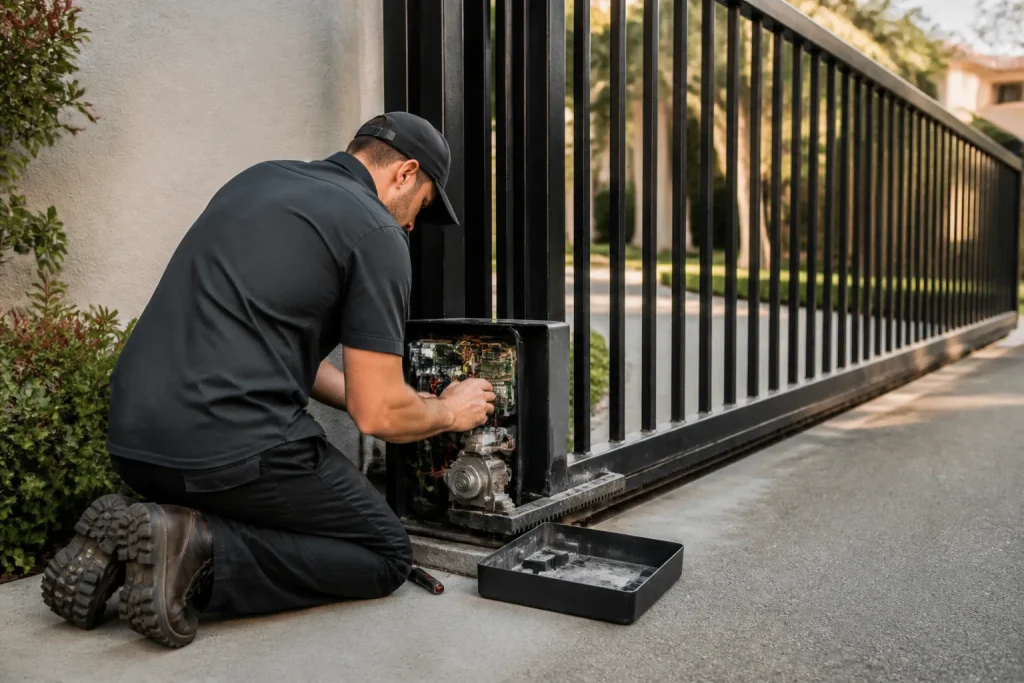
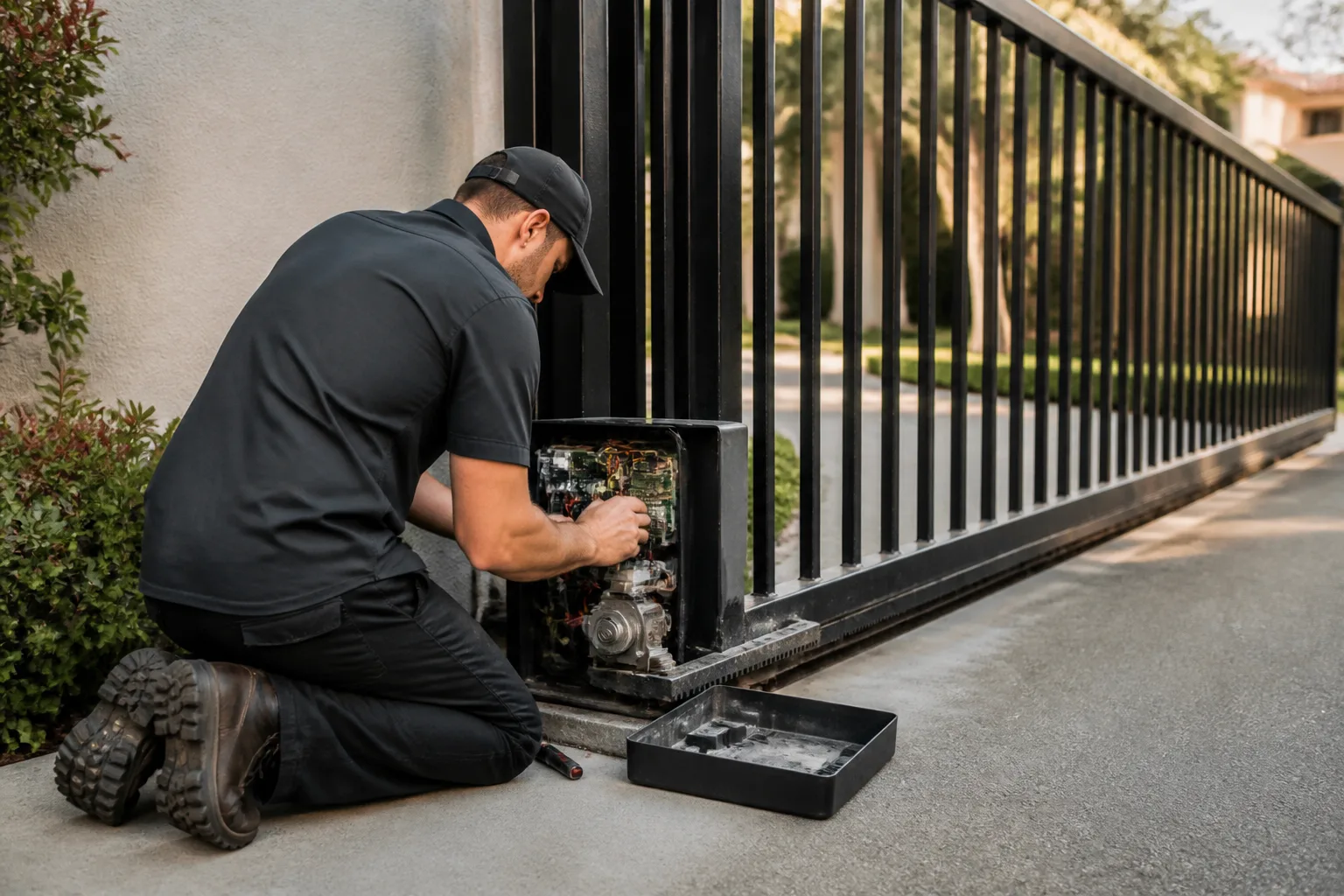
Ghost Controls Gate Repair in Los Angeles: A Homeowner’s Guide
Ghost Controls gate repair in Los Angeles usually comes down to one of three things: a dead backup battery, a solar panel that’s not charging, or an actuator that’s been asked to move a gate heavier than it was designed for. Most homeowners assume the worst, but in our experience, the fix is often under $100 and done in a single visit. If you’d rather skip the troubleshooting entirely, call Portcullis Gate Repair home at (940) 412-7340 and we’ll diagnose it for free.
Ghost Controls built its reputation on simple, DIY-friendly gate openers that work well on rural properties and solar setups. That same simplicity is why so many of them end up in LA’s hillside neighborhoods, from Mount Washington to Chatsworth, where running AC power to a gate post costs more than the opener itself. But here’s the part most guides skip: that simplicity cuts both ways. The system has fewer components than a LiftMaster or FAAC setup, which means when something goes wrong, the remaining components get blamed for failures they didn’t cause. We regularly see Ghost Controls boards and actuators replaced in Los Angeles when the actual problem was a $14 sealed lead-acid battery that hadn’t been checked in three years.
Why Ghost Controls Systems Are Everywhere in LA’s Hillside Neighborhoods
Ghost Controls, formerly GTO/PRO, designed its openers around 12-volt DC power and optional solar charging. That design choice matters in Los Angeles because plenty of hillside properties in Studio City, Laurel Canyon, and Baldwin Hills have gates sitting 100 feet or more from the nearest outlet. Running conduit and AC power to that gate post can easily add $1,500 to $3,500 to an installation. A Ghost Controls opener with a solar panel and battery sidesteps that cost entirely, which is exactly why homeowners and contractors keep choosing it.
The trade-off is that a battery-and-solar system needs more routine attention than a hardwired AC opener. The battery is a consumable, not a permanent part. In Los Angeles heat, sealed lead-acid batteries in gate operators typically last two to four years, not the five to seven you’ll see in cooler climates. When that battery dies, the gate behaves erratically: it opens partway, stops responding to remotes, or loses its limit settings every few days. Homeowners read those symptoms as a control board failure, and the next thing they know, they’ve paid $400 for a board swap that didn’t fix anything. We cover more of these misdiagnoses on our Gate Repair in Los Angeles page.
The Ghost Controls Diagnostic Sequence: Battery, Solar, Actuator
Before you replace anything on a Ghost Controls system in Los Angeles, run this three-step check in order. This is the same sequence our technicians follow, and it resolves the majority of no-open, slow-open, and intermittent-operation complaints without a parts replacement.
Step 1: Check battery voltage. A healthy Ghost Controls battery reads between 12.6 and 13.2 volts at rest. If it’s below 12.0 volts, the battery is failing or the charger isn’t working. This is the single most common Ghost Controls failure we see in Los Angeles, by a wide margin. The battery is usually a 12V 5Ah or 7Ah sealed lead-acid unit, available at most battery shops for $14 to $35. If the battery is swollen, warm to the touch, or more than four years old, replace it before doing anything else.
Step 2: Test solar panel output. Ghost Controls solar panels are rated for 10 to 20 watts depending on model. On a clear Los Angeles day, the panel should produce 17 to 22 volts open-circuit in direct sun. If it’s shaded by eucalyptus, covered in dust, or the panel surface has gone cloudy from UV exposure, output drops. A panel producing 12 volts or less won’t keep the battery charged. Spray it clean and retest before concluding the panel is dead. If the gate is fully shaded, a panel relocation or an AC trickle charger is the honest fix.
Step 3: Read actuator resistance. Ghost Controls actuators are mechanically simple, but they can develop internal wear. The resistance across the motor terminals should read within the range printed on the motor label, typically 1 to 5 ohms. An open reading means the motor has burned out. A reading that jumps around means worn brushes. The actuator, which is the motorized arm that physically pushes the gate open, is usually the last thing we condemn, not the first.
Why Ghost Controls Actuators Fail on Heavy Wooden Gates
Ghost Controls publishes weight ratings for its actuators, but those ratings assume a well-balanced gate with low wind resistance. A solid cedar or redwood driveway gate in Los Angeles can easily weigh 300 to 500 pounds, and hillside properties add their own complication: many gates are mounted on a slope, which means the opener works against gravity on every cycle.
Here’s the weight math that matters. Ghost Controls residential actuators are typically rated for gates up to 650 pounds and 16 feet in length. But a 400-pound solid wood gate on a slight incline can behave like a 550-pound gate on flat ground. Add wind loading, which is real in the Santa Clarita and Porter Ranch corridors, and the actuator is working far harder than the spec sheet suggests. We see Ghost Controls actuators on oversized wooden gates fail in three to five years in Los Angeles, versus eight to ten years on lighter steel or aluminum gates. If your gate groans on startup, moves slower in one direction, or trips the opener’s obstruction sensor when the temperature drops, the actuator is telling you it’s undersized for the load.
The fix isn’t always a Ghost Controls part. When a property’s gate weight or cycle volume has outgrown what Ghost Controls was designed for, we’ll say so plainly. A heavier-duty operator from Gate Installation in Los Angeles work, brands like FAAC, BFT, or Linear, often makes more sense than a third Ghost Controls actuator in five years.
The Reset Procedure That Fixes Most Erratic Behavior
Ghost Controls GTO and AC series openers store their limit settings and remote codes in memory. When the battery runs low or power is interrupted, that memory can corrupt, and the gate starts doing strange things: it reverses mid-cycle, forgets where the closed position is, or ignores every remote except the one taped to the wall. Before you buy a new control board, run the factory reset.
The reset is a physical procedure using the buttons on the control board, not a software menu. Here’s the sequence for most Ghost Controls GTO and AC series boards:
- Disconnect the battery (both terminals) and the solar panel.
- Press and hold the LEARN or LIMIT button on the board for 10 seconds.
- While still holding, reconnect the battery. Continue holding for another 5 seconds, then release.
- The board should beep twice, indicating the memory has cleared.
- Re-teach the remote controls and reset the open and close limits.
A word of caution: if you’re not comfortable working around a control board with live battery voltage, call a pro. A miswired battery terminal can short the board and turn a free reset into a $300 repair. We’ve run this reset on Ghost Controls openers across Los Angeles, from Eagle Rock to Woodland Hills, and it clears about half of the erratic-behavior calls without a single replacement part.
Wiring Problems That Mimic Board Failure
Los Angeles sun does a number on low-voltage wiring. Ghost Controls openers connect to the actuator, keypad, and safety sensors through thin-gauge, direct-burial wire. After five or six years of Southern California UV exposure, the insulation on that wire can crack, especially where it runs along the gate frame or exits the conduit at the gate post. Bare conductor meets damp soil or metal, and the resulting ground fault makes the board behave like it’s failing: random openings, blown fuses, remotes that work only when the gate is in a certain position.
The ground lug is the other common culprit. Ghost Controls boards use a chassis ground connection, and in outdoor Los Angeles installations that connection corrodes over time. We pulled one out of a garage over in Rancho Palos Verdes last month where the ground wire was completely green at the lug. The board was fine; the connection wasn’t. A wire brush, a new ring terminal, and some dielectric grease fixed it in 20 minutes.
When we arrive at a Ghost Controls repair in Los Angeles, the wiring gets the same inspection attention as the board. The board is rarely the problem.
When Ghost Controls Is the Right System to Keep, and When It’s Time to Move On
Ghost Controls is a genuinely good system for the right application. If your gate is lightweight, under 300 pounds, used fewer than 15 cycles a day, and runs on solar, Ghost Controls is hard to beat for simplicity and cost. The opener is affordable, the parts are easy to find, and the system doesn’t demand much maintenance beyond a battery every few years.
But Ghost Controls has limits. We recommend moving to a heavier-duty system when:
- The gate is solid wood and weighs more than 400 pounds.
- The gate cycles more than 20 times a day (common for shared driveways in Los Angeles multi-unit properties).
- The property needs advanced access control: keypad integration, intercom, or vehicle detection loops.
- The gate sits in a high-wind corridor, like the foothills above Glendale or the passes near Malibu.
If your Ghost Controls gate works fine but you’re adding a keypad or an intercom, the system can usually support it. But if you’re replacing the actuator for the third time in five years, the honest recommendation is that the gate has outgrown the opener. For a deeper dive on what a replacement involves, see our Electric Gate Repair in Los Angeles page.
A note on safety: Gate actuators move with real force, and the springs and hinges on a heavy gate store energy. If a Ghost Controls actuator is mid-cycle and the gate is binding, don’t put your hands anywhere near the hinge line or the actuator arm. Disconnect the battery first, then call someone who does this work daily.
What Ghost Controls Repair Costs in Los Angeles
Here’s what we quote for common Ghost Controls work in the Los Angeles area. These are real ranges, parts and labor, agreed in writing before any work starts:
- Battery replacement: $14 to $35 for the battery, plus a standard service call. Total: $100 to $180.
- Solar panel replacement: $75 to $180 for a 10-20 watt panel, plus installation. Total: $200 to $350.
- Control board replacement: $150 to $300 for the board, plus diagnostic and install time. Total: $300 to $550.
- Actuator replacement (single arm): $250 to $450 for the part, plus two to three hours of labor. Total: $500 to $850.
- Full opener replacement (Ghost Controls or comparable): $900 to $1,800 depending on gate weight, access, and whether we’re reusing existing wiring.
Every one of those prices is written down before a single bolt is turned. That’s not a pitch; it’s how we’ve worked since 2008. The Kingswell Guarantee binds every Portcullis location to the same standard: the price in writing, a real arrival window, a clean job site, and a written guarantee on the repair. If a Ghost Controls repair fails within 365 days, we come back and fix it at no charge. No invoice games, no callback runaround.
The Bottom Line
Ghost Controls gate repair in Los Angeles is usually simpler and cheaper than homeowners expect. Check the battery first, then the solar panel, then the wiring, and only then start thinking about the actuator or the board. The reset procedure clears most erratic behavior, and a $14 battery fixes more Ghost Controls gates than any other single part we carry on the truck.
If you’d rather have a technician handle the diagnosis, we’re happy to. Portcullis Gate Repair has been serving Los Angeles since 2008, and every one of our techs is background-checked, uniformed, and trained on Ghost Controls systems specifically. If you’re in Los Angeles and need help with a Ghost Controls gate, Portcullis Gate Repair offers free estimates. Call (940) 412-7340 and a live person will answer, any hour, any day.
Frequently Asked Questions
Most Ghost Controls repairs in Los Angeles run between $100 and $850, depending on the failed component. A battery replacement is typically $100 to $180 with labor, a board replacement $300 to $550, and an actuator replacement $500 to $850. Every Portcullis Gate Repair quote is written and agreed before any work starts. Call (940) 412-7340 for an exact quote, the estimate is free.
In most cases, yes. Battery replacements, resets, wiring repairs, and solar panel diagnostics are same-visit fixes. If the actuator or board needs to be replaced, we may need to order a Ghost Controls part, which adds one to three business days in Los Angeles. Call (940) 412-7340 and we’ll give you a straight answer on timing before you commit to anything.
A Ghost Controls gate that opens partway and stops is usually running on a weak battery. The low voltage prevents the actuator from completing the cycle, and the board interprets it as an obstruction. Check battery voltage first; if it reads below 12 volts, replacing the battery typically resolves it. If the battery tests good, the limit settings may be corrupted and a board reset will clear the problem. Call (940) 412-7340 and we’ll walk through the diagnostic with you over the phone.
Not usually. Ghost Controls actuators work well on lightweight gates up to about 300 to 400 pounds, but solid wooden driveway gates in Los Angeles often exceed that, especially on hillside slopes where the opener fights gravity. If your wooden gate is heavy and the actuator has failed more than once, the gate has likely outgrown the system. A heavier-duty operator from FAAC, Linear, or BFT is often the better long-term choice. Call (940) 412-7340 and we’ll give you an honest recommendation based on the gate’s actual weight, not a spec sheet.
Written by Dean Prescott, Owner at Portcullis Gate Repair, serving Los Angeles since 2008.
Need Gate Repair Help?
Call Portcullis Gate Repair - licensed & insured, here with fast after-hours help in Los Angeles.
(940) 412-7340