

Free on-site gate assessment - hinges, posts, and your LiftMaster or Nice gate operator checked before anything is quoted
The assessment is free and the quote is the invoice.


 Before
 After
After Before
 After
After Before
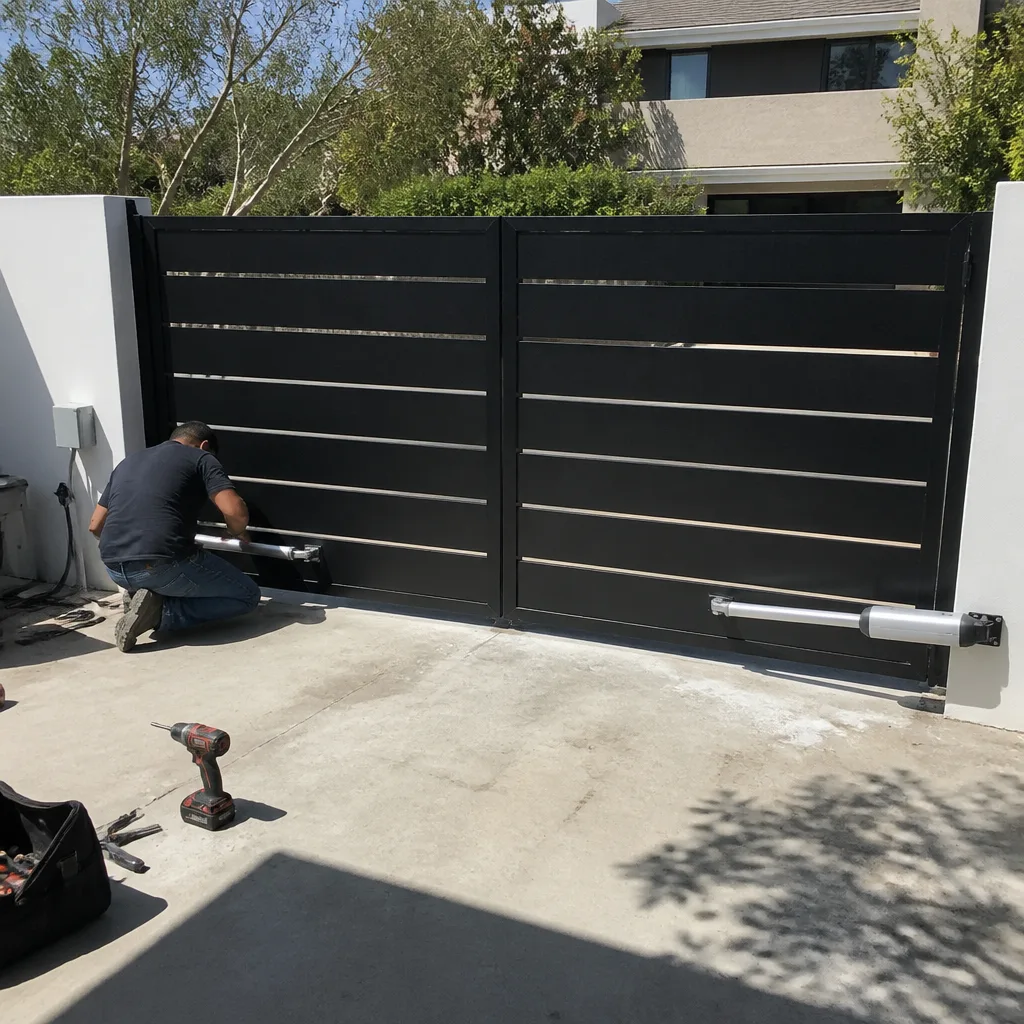 After
AfterGate Opens Partway and Stops
A gate that moves a few feet and then quits is almost always stopping on purpose. The operator has hit a limit, a load threshold, or an obstruction signal, and it shut itself down rather than force through it. That is actually the system working as designed – the problem is figuring out why it triggered.
In most cases, the cause is one of four things: a limit switch that has drifted out of position, an obstruction sensor picking up something that isn’t really there, a mechanical drag that’s making the motor work harder than its settings allow, or a dying battery in a battery-backup system that can’t sustain enough power to complete the full travel. None of these are emergencies in themselves, but a gate stuck partway open is a security gap, and a gate the operator keeps trying to force is on its way to a bigger repair bill. It’s worth getting it sorted promptly.
Why It Happens
1. Limit Switch Out of Calibration
Every gate operator has a limit switch – a sensor that tells the motor “this is fully open” and “this is fully closed.” When that switch drifts, gets bumped, or corrodes, the operator thinks it has already reached the endpoint before the gate actually gets there. The tell: the gate stops at roughly the same spot every time, and there’s no grinding, beeping, or hesitation before it quits. It just stops cleanly, as if it thinks it’s done.
2. Obstruction or Safety Edge Triggering
Most modern electric gates have a contact safety edge, a photo-eye beam, or both. If the edge is worn, the beam is misaligned, or there’s a spider web across the sensor, the system reads a phantom obstruction and reverses or halts mid-travel. You’ll usually hear the motor try, stop, maybe reverse slightly, and then go quiet. Check whether the gate consistently stops at the same point or at slightly different spots – a sensor issue tends to be inconsistent, while a limit issue is usually precise.
3. Mechanical Drag – Hinge, Wheel, or Track Problem
If the gate is binding on a bent track rail, a seized hinge, or a wheel that’s flattened from years of weight, the motor hits its torque limit and shuts down to protect itself. This one often comes with noise: scraping, a low grinding hum right before it stops, or a visible wobble as the gate moves. Look at the rollers and hinges while someone triggers the gate – you can usually spot the drag point from a few feet away. Do not keep cycling the gate if you can hear or see it straining; you’ll shorten the operator’s life.
4. Battery or Power Issue
Battery-backup operators draw extra current during the push to fully open, especially on heavier gates. A battery that’s down to 60 or 70 percent of its original capacity might look fine under light load but sag badly when the gate hits the steeper part of its travel. The symptom here is that the gate often makes it further on a warm day than a cold morning, because battery chemistry responds to temperature. If the gate seems worse first thing in the morning or after the power has been out, battery is a strong candidate.
What to Do Right Now
- Stop cycling it. Every time the operator forces the gate through a bind or a near-stall, you’re adding wear. One or two test cycles to observe the behavior is fine. After that, leave it alone until a technician can look at it.
- Note where it stops. Take out your phone and photograph or video the gate mid-travel, at the point where it halts. That footage is genuinely useful to a technician and takes thirty seconds to capture.
- Walk the travel path. Look for anything touching the gate – a sprinkler head that shifted, a vine that grew into the track, a post leaning slightly inward. Remove obvious physical obstructions if they’re safe to move. Don’t reach into the gate’s path while the operator is powered.
- Check the safety sensors. If your gate has photo-eye sensors mounted near ground level, look at the indicator lights. Most show a solid light when aligned and a blinking or absent light when blocked. Wipe the lens faces with a dry cloth. If the light steadies and the gate completes its travel, you found it. If not, stop there and call – sensor wiring and alignment are a two-minute job for a tech and an easy way to make things worse if you start bending brackets.
- Do not attempt to manually adjust springs, cables, or internal operator components yourself. Gate springs and cables are under significant tension. Even on a gate that appears stationary, these components can release suddenly and cause serious injury. If you suspect a spring or cable problem, keep clear of those components and call for a trained technician. Observing and describing the symptom is all you need to do on your end.
How We Fix It
When your local Portcullis Gate Repair technician arrives, the first thing they do is run the gate through its full cycle and watch it – not just read a code, but actually watch it move. From there, they’re diagnosing: is this a limit setting, a sensor, a mechanical drag point, or a power issue? Each of those has a specific fix.
A limit adjustment takes minutes. A sensor realignment or replacement is usually quick. A mechanical issue – a bent track section, a seized hinge, a worn roller – takes longer depending on what needs to come off the gate, but it’s a defined job with a defined scope. Before any of that work starts, you’ll have a written price. That’s not a courtesy; it’s how every Portcullis job runs, every time, under the Kingswell Guarantee.
If the repair is done and the gate fails again inside 365 days, we come back and fix it at no charge. That’s the 365-Day Done Right Promise, and it’s stamped on your invoice, not just mentioned on a website.
Most diagnose-and-repair visits for this symptom are completed in a single appointment. The relevant service is electric gate repair, and in some cases where the operator itself has failed, gate repair covering the mechanical components as well. Your technician will tell you exactly what’s needed before the work begins.
Frequently Asked Questions
A gate stuck partway open is a real security gap – your property is accessible in a way you didn’t intend. It’s not a fire-hazard emergency, but it’s also not something to leave open-ended for days. If the gate is stuck partway closed and is blocking vehicle access to your property, that’s a more urgent situation. Call (940) 412-7340 and a live person will pick up – we answer around the clock, including weekends and holidays.
That depends on where the gate stopped. A gate that’s resting in a halfway-open position is leaving your driveway or property accessible, which tends to feel more urgent once it’s dark outside. Beyond security, continuing to operate a gate that’s binding or near-stalling causes wear on the operator and can turn a simple repair into a more involved one. If it’s not affecting safety or security acutely, it won’t fall apart overnight – but a week of repeated cycling probably isn’t helping it. Call (940) 412-7340 and we’ll tell you honestly what the window looks like.
Your local Portcullis Gate Repair team handles repair calls on an urgent basis, and many are scheduled same day. Call (940) 412-7340 – a live person answers 24 hours a day – and they’ll tell you exactly what’s available in your area. We give you a real arrival window, not a four-hour guess, and we show up in it.
Yes – the written price comes before the first bolt is touched. That’s not a sales line; it’s how every single Portcullis job works, and it’s part of the Kingswell Guarantee your technician will leave with you in writing. If the scope changes for any reason, you’ll be told before any additional work starts. There are no invoices bigger than the quote you agreed to.
Get It Fixed
Call (940) 412-7340 – a live person answers any time of day or night, including holidays. Your local Portcullis Gate Repair team will schedule the visit, give you a real arrival window, and arrive with a written price before any work starts. Gates that open and close the way they should – that’s the job.
Written by Dean Prescott, Owner and Lead Technician at Portcullis Gate Repair, a Kingswell company in business since 2008.
What Our Customers Say
"Gate was dragging and screeching across the driveway. I figured I'd need a whole new setup. He adjusted the track and rollers and it was a fraction of what I expected. Honest work."
- Omar Haddad"Our intercom and gate motor both quit. They fixed the whole system in one visit and explained the warranty clearly. On time, polite, and tidy. Can't ask for more."
- Yvette Marchetti"Good repair on a sagging gate and a new hinge welded on. Took them a couple days to get the part in, but they told me that up front and it's been solid since."
- Hector Villanueva