
Last updated October 8, 2026
Free on-site gate assessment - hinges, posts, and your LiftMaster or Nice gate operator checked before anything is quoted
The assessment is free and the quote is the invoice.
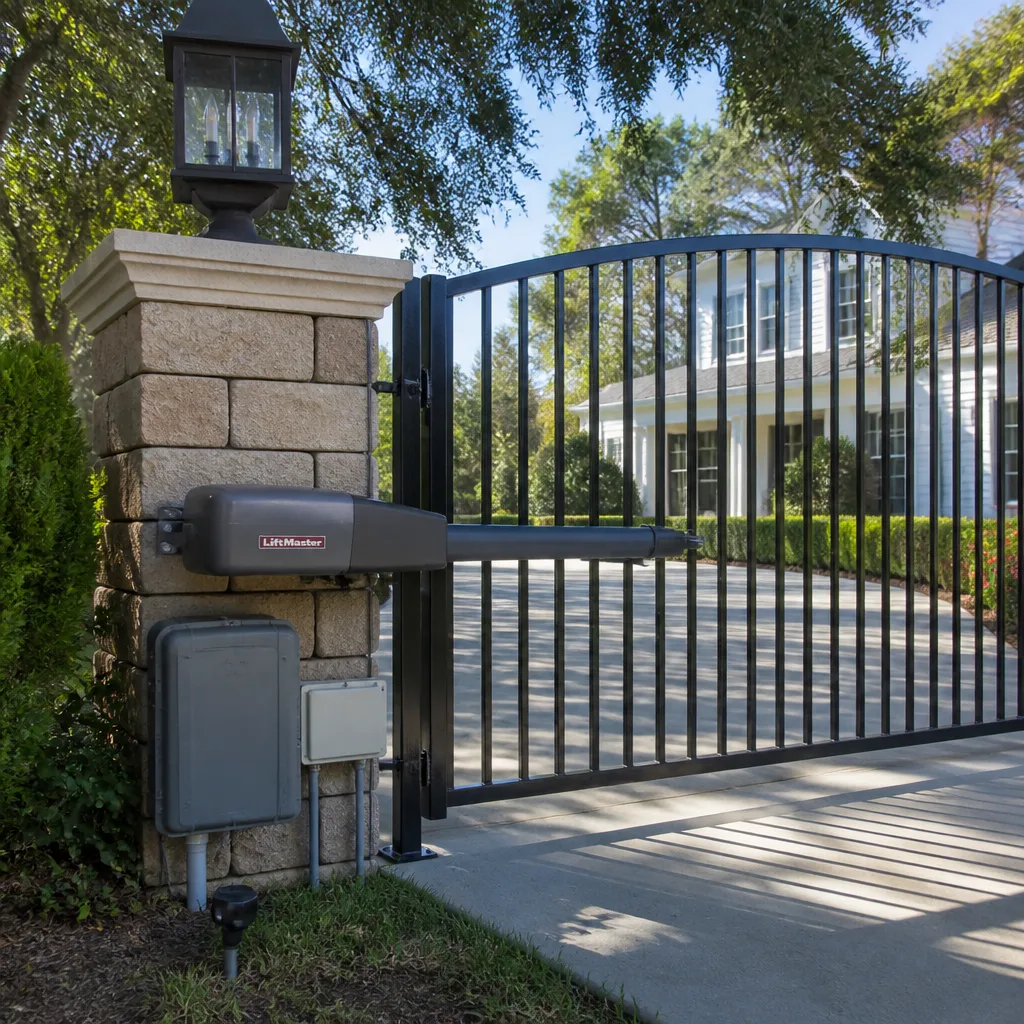
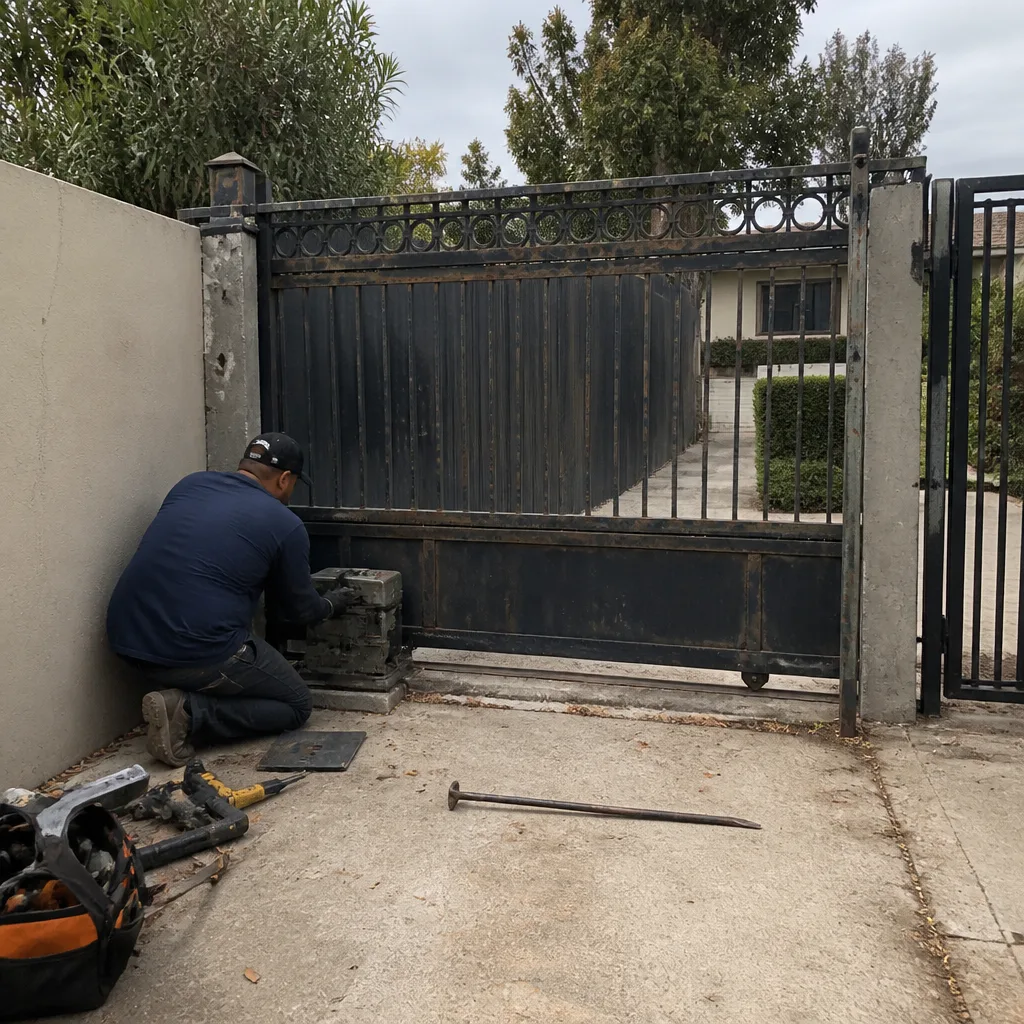 Before
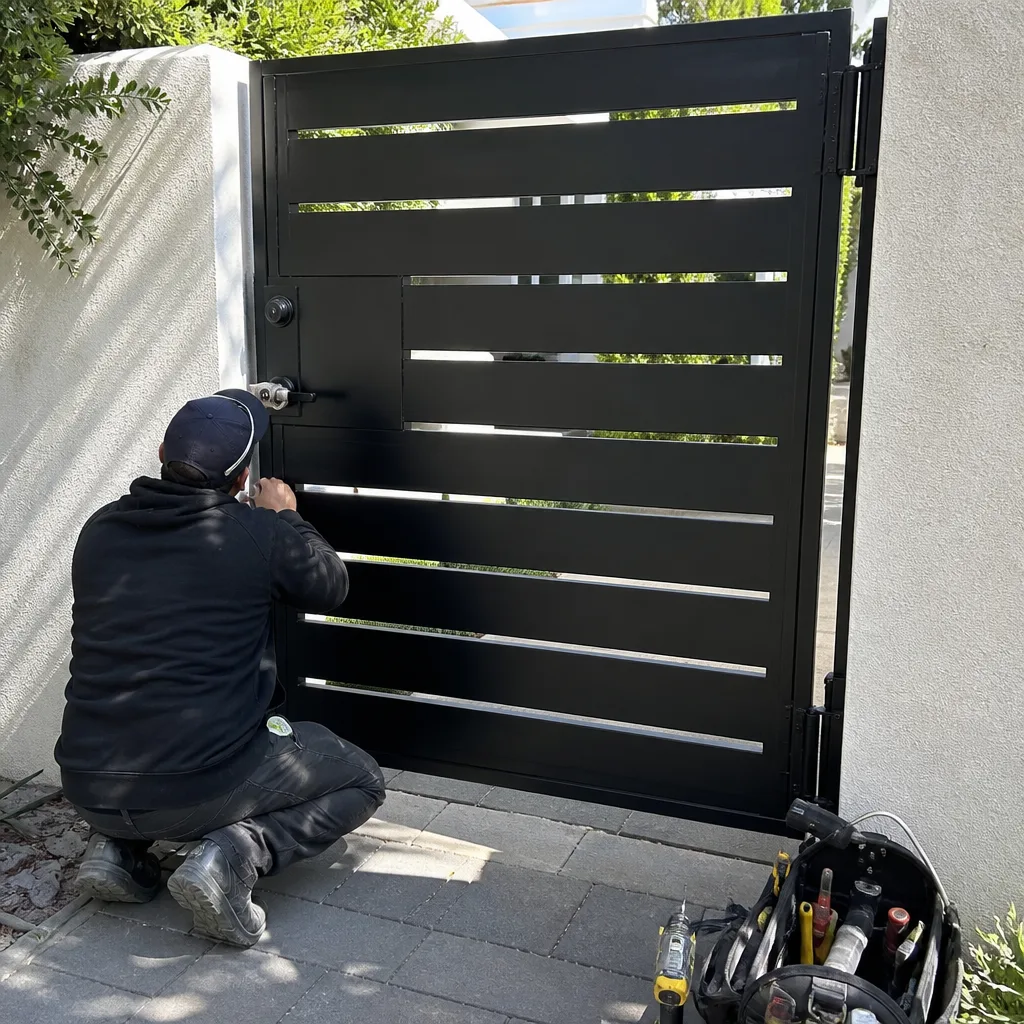 After
After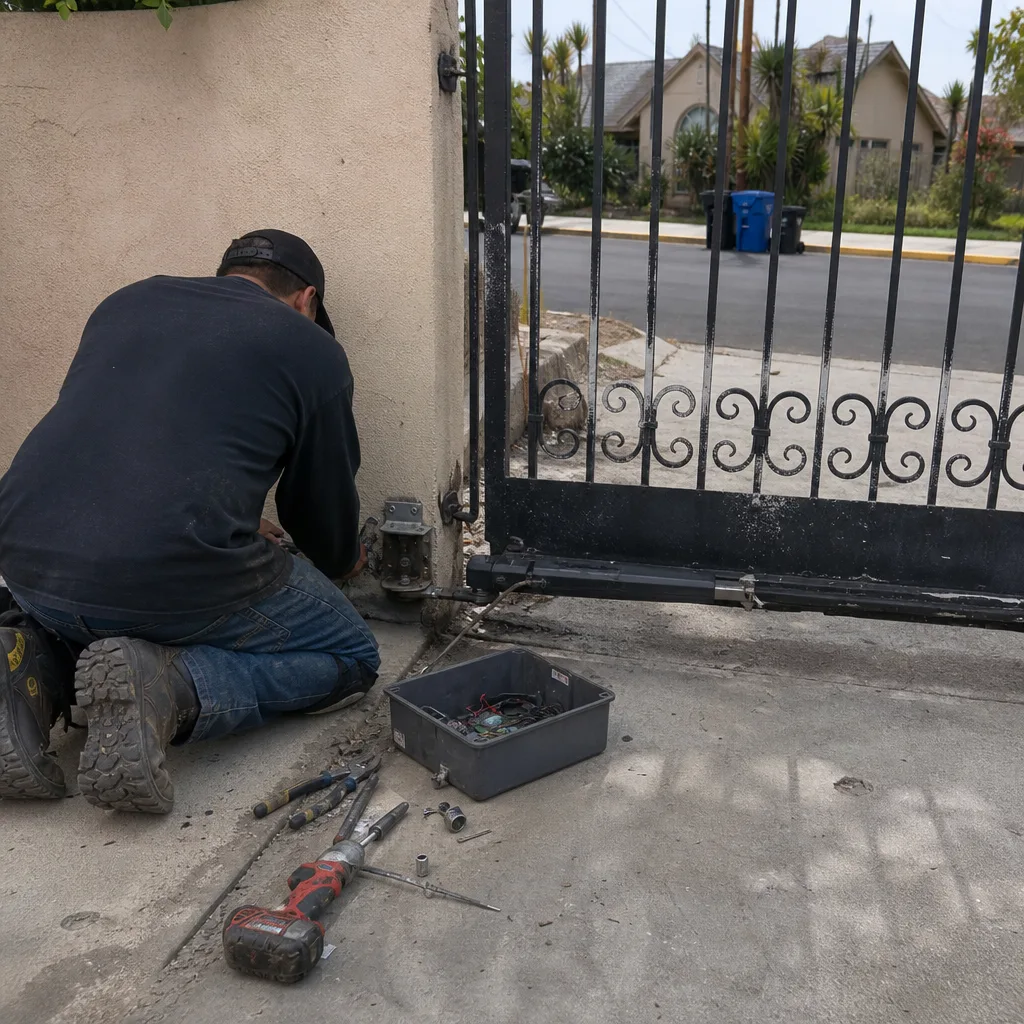 Before
 After
After Before
 After
AfterChoosing the Right Gate Repair Brand: A Buyer’s Guide for Los Angeles
Here’s a truth most gate company websites won’t tell you: LiftMaster, Viking, DoorKing, and FAAC are all reputable brands, and all four are commonly installed wrong for the application. The purchasing decision usually comes down to price and name recognition rather than duty cycle rating and gate weight calculation. In Los Angeles, where a single property might cycle a gate forty times a day during school drop-off and twice on Sunday, that mismatch shows up as a burned-out motor, a stripped gear, or a circuit board that dies six months after installation. This guide will show you how to evaluate gate operator brands not by logo recognition but by the specifications that actually predict whether a unit will last five years or fifteen. For detailed installation insights, see The Complete Gate Installation Guide for Los Angeles Homeowners.
Quick Answer
The right gate repair brand in Los Angeles is the one whose operator matches your gate’s actual weight, daily usage cycles, and power setup. For professional help matching the right operator to your needs, see our Gate Repair services. For most single-family homes, a well-spec’d residential-duty operator from brands with strong local parts availability like LiftMaster or Viking is the smart play. For multi-family, mixed-use, or high-traffic properties, you should move up to commercial-duty options from FAAC or BFT, regardless of what the gate looks like.
Table of Contents
- How to Calculate Gate Weight and Daily Cycles (The Two Numbers That Matter)
- Residential vs. Commercial vs. Industrial Duty: What Los Angeles Properties Actually Need
- Why Parts Availability in the LA Market Matters as Much as Build Quality
- Solar-Powered Operators in Los Angeles: Which Brands Do It Right
- Evaluating a Brand by Its Repair Ecosystem, Not Its Purchase Price
- Brand-by-Brand Notes for Los Angeles Gate Systems
- Common Mistakes to Avoid
- When to Call a Professional
- Frequently Asked Questions
How to Calculate Gate Weight and Daily Cycles (The Two Numbers That Matter)
Before you can choose a brand, you need two numbers. The first is your gate’s total weight. The second is how many open-close cycles the gate performs in a day. Every operator manufacturer publishes a maximum gate weight and a duty cycle rating. When the operator’s spec sheet matches your measured numbers, brand choice becomes secondary to correct specification. When it doesn’t match, even a premium brand fails early.
Here’s how to get the weight number. A steel ornamental gate typically weighs between 18 and 25 pounds per linear foot of gate leaf. So a 14-foot driveway gate in a single leaf weighs roughly 250 to 350 pounds. A 16-foot gate with wood infill or a solid steel panel can push 400 to 500 pounds. Aluminum gates run lighter, usually 10 to 15 pounds per linear foot, but many Los Angeles properties still have wrought iron or steel from the 1980s and 1990s, and those are heavier than homeowners expect.
- Measure the gate leaf length and height. Multiply to get square footage.
- Identify the infill material. Hollow steel, solid steel, aluminum, wood, or composite all carry different weights per square foot.
- Add the weight of any attached hardware. That includes the receiver post hardware, keypad boxes, and any decorative elements bolted to the gate.
- Use a conservative estimate. If you land between two weight ranges, round up. An under-spec’d operator is the single most common cause of premature gate failure we see across Los Angeles.
Now count the cycles. A cycle is one full open plus one full close. If your household leaves for work and school in the morning, returns in the afternoon, and maybe has a delivery or a visitor during the day, you might count 15 to 20 cycles per day. Now think about a 12-unit apartment building in Mid-City where tenants come and go at all hours. That gate might cycle 80 to 120 times daily. Add a delivery driver, a dog walker, and a rideshare pickup, and you can cross 150 cycles easily.
Here’s the point most brand comparison guides miss: a specific model from a respected brand may have a duty rating that is completely wrong for a Los Angeles property’s actual traffic pattern, and that’s not a defect. It’s a specification mismatch. The brand didn’t fail. The selection process did.
Residential vs. Commercial vs. Industrial Duty: What Los Angeles Properties Actually Need
Gate operators are classified by duty cycle, and the labels are not interchangeable with property type. A single-family home can need a commercial-duty operator. A multi-family property might technically get away with a residential-duty unit under light use, but it won’t last. Understanding the three classes saves you from overpaying for capacity you don’t need and from under-buying a unit that will burn out in a year.
Residential-duty operators are designed for low frequency, typically 20 to 40 cycles per day. They’re built with lighter motors, smaller capacitors, and plastic or nylon gears in some models. That’s fine for a house where the gate opens a handful of times. In Los Angeles, we see these specified correctly for single-family homes in areas like Los Feliz, Studio City, and the Palisades. We also see them specified incorrectly for small apartment buildings and condo complexes with four or six units, because the installer matched the property’s curb appeal rather than its traffic count.
Commercial-duty operators are rated for 60 to 150 cycles per day, sometimes higher. They use heavier transformers, steel gears, and larger motors with better heat dissipation. In Los Angeles, any gate serving more than about eight units, any mixed-use building, any commercial parking lot, or any gated community entrance should have a commercial-duty operator, even if the gate itself looks like a residential driveway gate. We regularly replace residential units on multi-family properties in Koreatown, West Adams, and the Valley where the operator was undersized from day one.
Industrial-duty operators handle continuous or near-continuous use. These are the operators you see on freight entrances, large commercial complexes, and high-volume parking facilities in downtown Los Angeles and around the port. They’re heavy, expensive, and rarely needed for residential work. But if a property’s gate cycles more than 200 times daily, it’s the correct class.
The takeaway: choose the duty class from your cycle count, not from the word “residential” in the brand’s marketing. A residential-use operator from a top-tier brand installed on a 12-unit Los Angeles apartment building is still the wrong operator.
Why Parts Availability in the LA Market Matters as Much as Build Quality
A gate operator is not a smartphone. When it fails, you can’t wait three days for a component to ship from a warehouse across the country. Los Angeles has hundreds of thousands of automatic gates, and when a circuit board fails or a limit switch breaks, the gate is usually stuck in whatever position it was in when the part died. Sometimes that’s open. Sometimes that’s closed, and no one can get in or out of the driveway.
This is where brand choice becomes practical rather than theoretical. Some brands have deep distributor networks in Southern California, with parts stocked in local warehouses and available for same-day pickup. LiftMaster is the most obvious example, with multiple authorized distributors across Los Angeles County and Orange County that stock control boards, limit switches, and remotes. If a LiftMaster board fails in the morning, a technician can often have the replacement in hand by early afternoon.
Viking and FAAC also maintain strong distributor presence in the LA market, though their parts are more commonly stocked by specialist gate supply houses than general electrical distributors. BFT, which is more common in Europe and high-end custom installations, has fewer local stock points. When a BFT component fails, it’s often a two-to-four-day wait for the part to arrive. That matters when your gate is the only way into your property.
Before you commit to a brand, ask two questions. First, where is the nearest stocking distributor for that brand’s parts? Second, how long does a typical repair take when a circuit board or motor capacitor fails? If the answer to the second question is measured in days rather than hours, that brand might be a poor fit for a single-gate property in Los Angeles where the gate is used every day.
At Gate Repair in Los Angeles, we keep common control boards and replacement parts for the brands we service most often, which shortens downtime significantly compared with waiting on a distributor order.
Solar-Powered Operators in Los Angeles: Which Brands Do It Right
Los Angeles is a solar city, but a solar panel bolted onto a gate operator is not the same thing as a solar kit designed for the application. The difference shows up in battery life, charge controller quality, and how the system behaves during the long overcast stretches Southern California sometimes gets in May and June.
Two brands stand out in the solar gate operator market. LiftMaster offers solar kits for several of its swing and slide gate operators, and those kits include matched charge controllers and appropriately sized panel output for the motor they’re paired with. Viking has been building solar-compatible operators for decades and its LA120 series, though no longer the newest offering, established the brand’s reputation for field-tested solar reliability. FAAC offers solar options on specific models, and they work well when the panel sizing is done correctly.
The problem comes with brands or aftermarket vendors that sell a generic panel and a cheap charge controller and call it a solar kit. We’ve seen installations in Topanga, Malibu, and the hills above Pasadena where the panel was undersized for the daily cycle count, the battery bank was inadequate, and the gate worked fine in August and dead in January. A solar gate system needs the panel wattage, battery amp-hour capacity, and daily sun-hours calculation done honestly. That means accounting for the fact that a north-facing hillside in the Santa Monica Mountains might get four useful sun-hours in January, not the six or seven you’d assume from a flat rooftop in the Valley.
If you’re considering solar for a gate in Los Angeles, verify that the panel and charge controller are matched to the operator by the operator manufacturer, not added by a third party. And make sure the battery bank is sized for at least two days of autonomy, because a gate that cycles ten times daily with no sun for two days will drain a single 12-volt battery faster than you’d think.
Evaluating a Brand by Its Repair Ecosystem, Not Its Purchase Price
The purchase price of a gate operator is a fraction of the total cost of ownership. The real costs come later: parts, labor, and downtime. A brand’s repair ecosystem includes how easy it is to get parts, how many technicians in the Los Angeles area are trained on that brand’s systems, and how the manufacturer handles firmware updates and technical support.
Some brands treat their operators as proprietary systems. That’s not inherently bad, but it means you’re locked into that brand’s parts and service network. If the brand has weak distribution in Southern California, you’ll feel it every time something breaks. Other brands publish their specs openly and have cross-compatible aftermarket parts. In our experience, LiftMaster, Viking, and FAAC all maintain solid repair ecosystems in Los Angeles. BFT and Linear are more variable, depending on the specific model and how the unit was sourced.
Here are the factors we recommend weighing, in order of practical importance for a Los Angeles property:
- Parts cost and availability. Can a circuit board or limit switch be sourced within one business day in Los Angeles? What does a replacement control board actually cost, including labor to install and reprogram it?
- Technician training and familiarity. How many service providers in the LA market actually work on this brand? A brand with one authorized dealer in Simi Valley is less useful than one with trained techs across the basin.
- Firmware and support. Does the manufacturer release firmware updates for its control boards, and does it provide a technical support line that independent technicians can actually reach?
- Remote and receiver compatibility. Will your existing remotes, keypads, and vehicle transmitters work with the new operator, or will every gate remote on the property need replacement?
Where other gate companies focus only on the box price, the repair ecosystem is the number that actually predicts long-term satisfaction. A $900 operator that needs a $400 board every 18 months costs more over five years than a $1,400 operator that runs for a decade with one limit switch replacement.
Brand-by-Brand Notes for Los Angeles Gate Systems
Four brands come up most often in our Los Angeles service work, and each has a profile worth knowing before you decide. This is not a ranking. It’s a description of how each brand tends to behave in the field, in this market, under these conditions.
LiftMaster. The most common brand we service in Los Angeles, and the parts supply is the strongest in the region. LiftMaster operators are widely available, well-documented, and serviceable by a broad field of technicians. Their residential swing gate operators are reliable when correctly specified, and their commercial slide gate units hold up well on multi-family properties. The main failure mode we see is incorrect specification rather than manufacturing defects. A LiftMaster LA400 installed on a heavy wrought iron gate that cycles 60 times daily will fail, exactly as a residential-duty unit should be expected to under that load.
Viking. A brand with a long history in gate operators, particularly in the commercial and industrial segments, and particularly well-suited to slide gates. Viking operators are more expensive up front but are built with heavier components than many residential competitors. In Los Angeles, Viking is a common sight on commercial parking gates and apartment complex slide gates. Parts availability is solid. The trade-off is weight and size: Viking units can be physically larger, which matters if your operator housing is tight.
FAAC. An Italian brand popular in the high-end residential market, and for good reason: FAAC swing gate operators run quietly, perform well on ornamental gates, and look clean. FAAC solar kits are also better integrated than most. The downside in Los Angeles is parts availability. When a FAAC board fails, it often needs to be ordered, and lead times of a few days are common. That’s workable for a secondary pedestrian gate or a property with another point of entry. It’s more painful on a primary driveway gate that gets used every day.
BFT. Most common on custom and architectural installations, often specified by gate fabricators who work with European hardware. BFT equipment is generally well-made, but it shares FAAC’s parts availability challenge in the LA market. We see more BFT units on new construction with custom gates than as replacements in established Los Angeles neighborhoods. If you have a BFT operator and it fails, plan for a longer repair window than the same failure on a LiftMaster or Viking.
Common Mistakes to Avoid
- Buying by brand name instead of specification. A top-tier brand with the wrong duty cycle rating will fail just as reliably as a budget brand with the same rating. The specification is the decision, not the logo.
- Ignoring gate weight. A 16-foot steel gate with solid infill can weigh over 400 pounds. Installing an operator rated for 300 pounds means the motor strains every single cycle, and the failure comes predictably. This is the mistake we see most often on Los Angeles hillside properties where custom gates were never weighed when the original operator was chosen.
- Assuming “residential” means residential property. A six-unit condo building with a shared driveway gate often cycles more in a day than a single-family home cycles in a week. Choose by cycle count, not property label.
- Forgetting about the power source. Some Los Angeles garages and gates share a circuit with other loads, or the nearest outlet is 80 feet from the operator. Solar and battery backup options differ by brand, and choosing a brand without a proper solar kit for a property with no nearby power means an expensive electrical run later.
- Overlooking parts availability. A brand with no local distribution in Los Angeles means every repair starts with a shipping delay. For a gate that’s the only access point to a property, that’s a practical problem, not a minor inconvenience.
- Replacing the operator without checking the gate itself. If the gate’s hinges are worn, the track is misaligned, or the wheels are shot, a new operator inherits the old problems. The gate and the operator are one system. Replacing only the motor is like changing a car’s engine without checking the transmission.
- Buying the cheapest option and calling it savings. A $400 operator that fails every 14 months, plus the service call to replace it each time, costs more over a five-year period than a properly specified $1,000 operator installed once.
When to Call a Professional
Some things are worth doing yourself, and some aren’t. Gate operators involve high-torque motors, heavy steel panels, and electrical connections that can injure or kill if handled incorrectly. The springs and counterweights on a swing or slide gate are under tension, and a gate leaf that weighs 400 pounds carries enough energy to cause serious injury if it moves unexpectedly. If your gate is making a grinding noise, the operator hums but the gate doesn’t move, the gate reverses before fully closing, or the keypad and remote stop responding consistently, call someone who works on these systems daily. You’re not just buying a part; you’re buying the diagnosis that tells you which part to buy. At Portcullis Gate Repair, we’ve been repairing electric gates in Los Angeles since 2008, and we’re happy to come out, diagnose the issue, and give you a written price before any work starts. Call (940) 412-7340 for a free estimate.
Frequently Asked Questions
The best brand is the one whose operator matches your gate’s weight, cycle count, and power supply. For most single-family homes in Los Angeles, a correctly specified LiftMaster or Viking residential-duty operator with good local parts availability is the practical choice. If your property cycles the gate more than 40 times daily, move to a commercial-duty unit from FAAC, Viking, or LiftMaster regardless of brand preference. Call (940) 412-7340 and we’ll help you figure out the right spec for your gate.
For a standard single-family swing gate in Los Angeles, replacing the operator typically runs $1,200 to $2,800 for parts and labor, depending on the duty class, brand, and whether the gate itself needs adjustments. Commercial-duty operators on multi-family properties typically run $2,500 to $5,500 installed. We give a written price before any work starts, so you’ll know the exact number before a single bolt is turned.
A correctly specified residential-duty operator on a single-family gate in Los Angeles should last 8 to 12 years with basic maintenance. A commercial-duty unit on a multi-family property under normal traffic should last 10 to 15 years. The operators that fail in 2 to 4 years are almost always under-spec’d for the gate they’re driving or have been starved of basic maintenance like lubrication and limit switch adjustment.
In most cases, a failed circuit board on a LiftMaster, Viking, FAAC, or BFT operator can be replaced without replacing the whole unit, assuming the motor and gearbox are still in good shape. A replacement board typically costs $200 to $500 for the part, plus labor. If the operator is more than 12 years old or has multiple failing components, replacement is usually the better financial call. We’ll tell you which makes sense for your unit, and the price is in writing before we start.
Yes. Homes in Topanga, Malibu, Laurel Canyon, and parts of the San Fernando Valley without nearby utility power are common sites for solar gate operator installations. We match the panel wattage, charge controller, and battery bank to the operator manufacturer’s specs and the property’s actual sun exposure, so the system works through winter, not just July. Call (940) 412-7340 and we’ll evaluate your site.
The Kingswell Guarantee covers a written price before any work starts, a real arrival window, a clean job site, and a written guarantee on the repair itself, for 365 days. If the repair fails inside that period, we return and correct it at no charge under the 365-Day Done Right Promise. That promise is stamped on every invoice, not offered as a verbal assurance. We’ve operated as a Kingswell company since 2008, and every Portcullis location follows the same five commitments.
The Bottom Line
Choosing a gate operator brand in Los Angeles is a specification decision disguised as a brand decision. The brand matters less than the duty cycle rating, the gate weight calculation, and the parts availability in the local market. Do the math on your gate’s weight and daily cycles. Match the operator’s duty class to your actual usage, even if that means buying a commercial-duty unit for a residential-looking gate. Check where the brand’s parts are stocked. And account for the repair ecosystem, not just the purchase price. Then get the guarantee in writing. If you’d like help with any part of that process, we’re at Portcullis Gate Repair, providing gate installation in Los Angeles and repair with a written price before any work starts. Call (940) 412-7340 for a free estimate.
Written by Dean Prescott, Owner at Portcullis Gate Repair, serving Los Angeles since 2008. Browse more guides & resources.