
Last updated October 8, 2026
Free on-site gate assessment - hinges, posts, and your LiftMaster or Nice gate operator checked before anything is quoted
The assessment is free and the quote is the invoice.
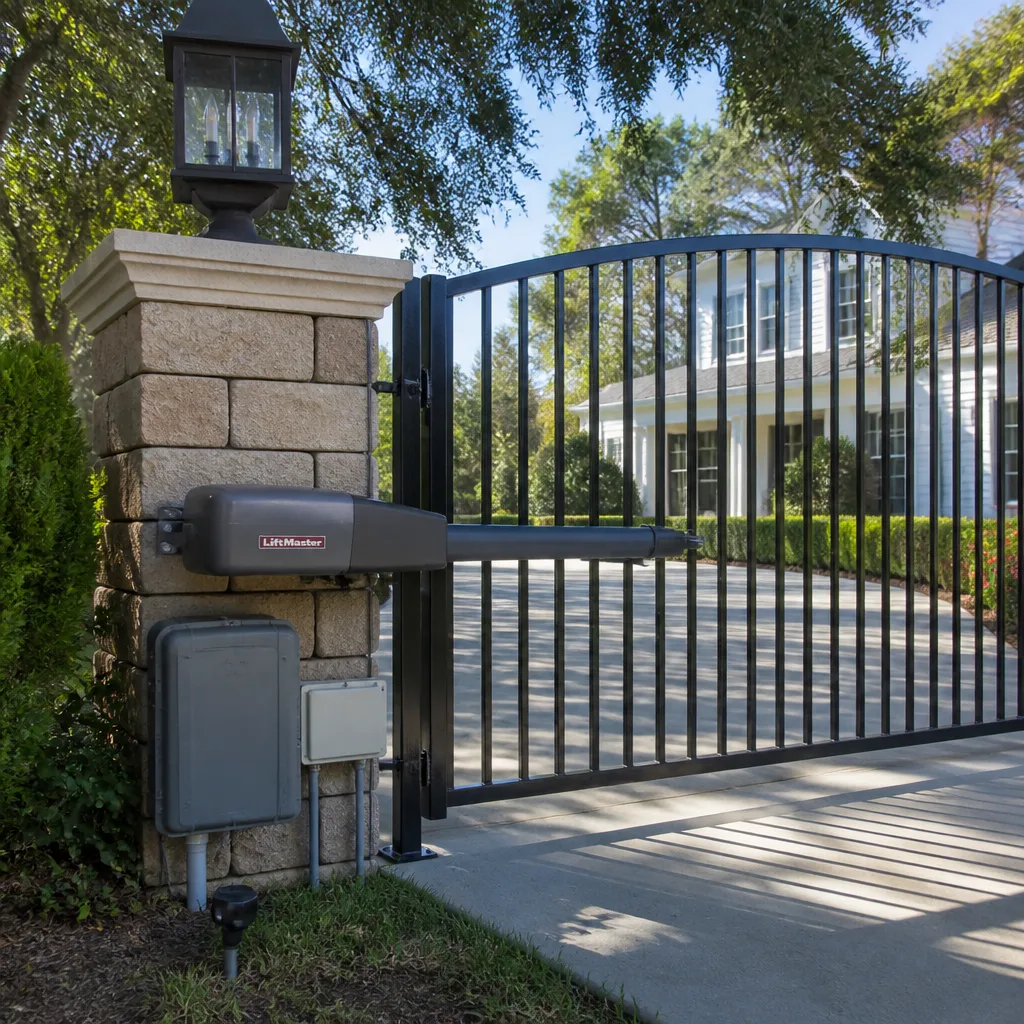
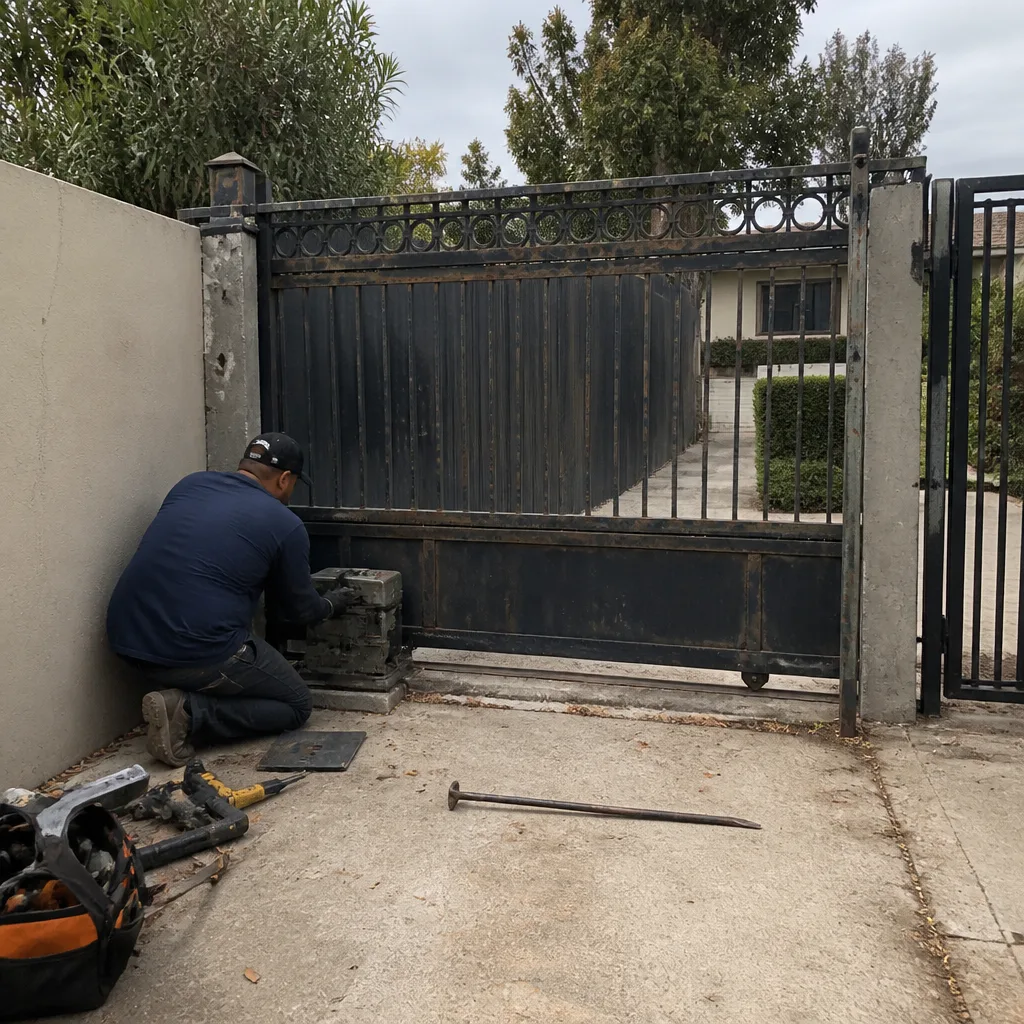 Before
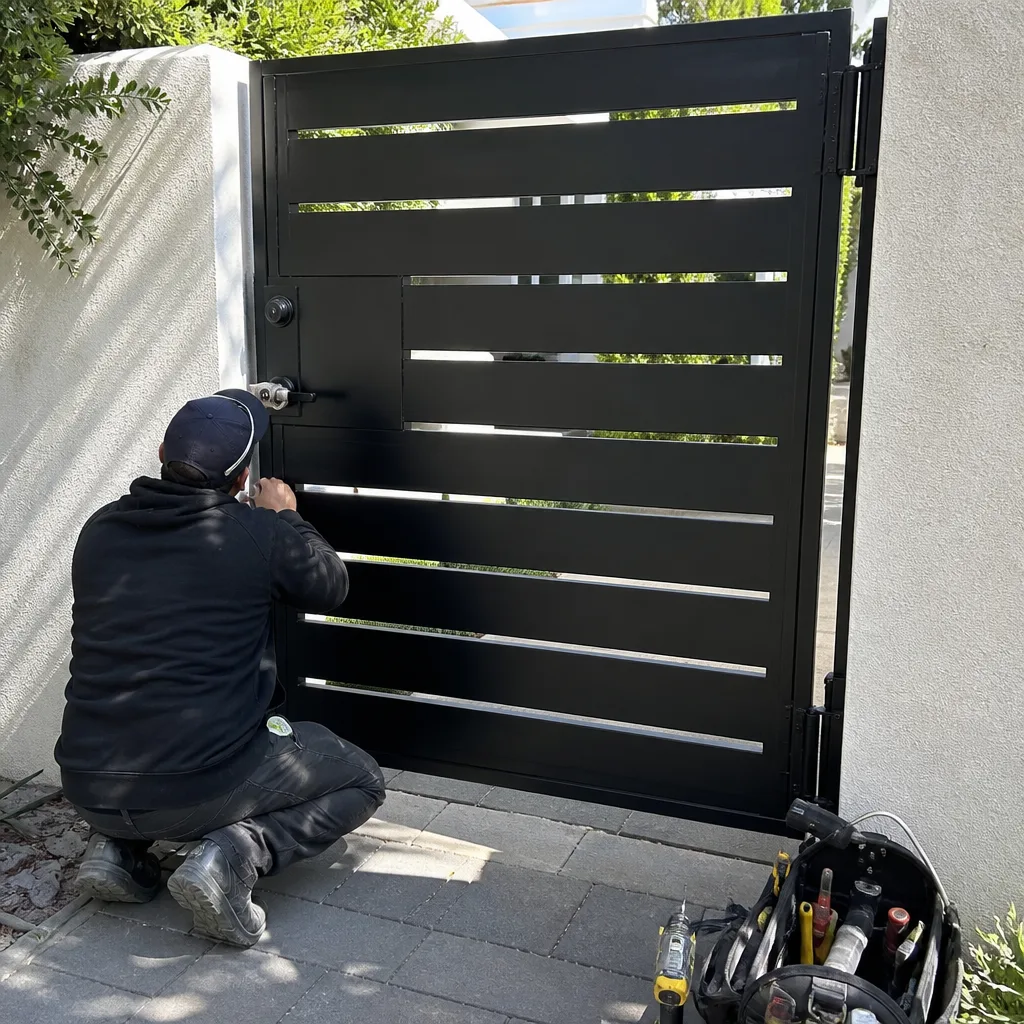 After
After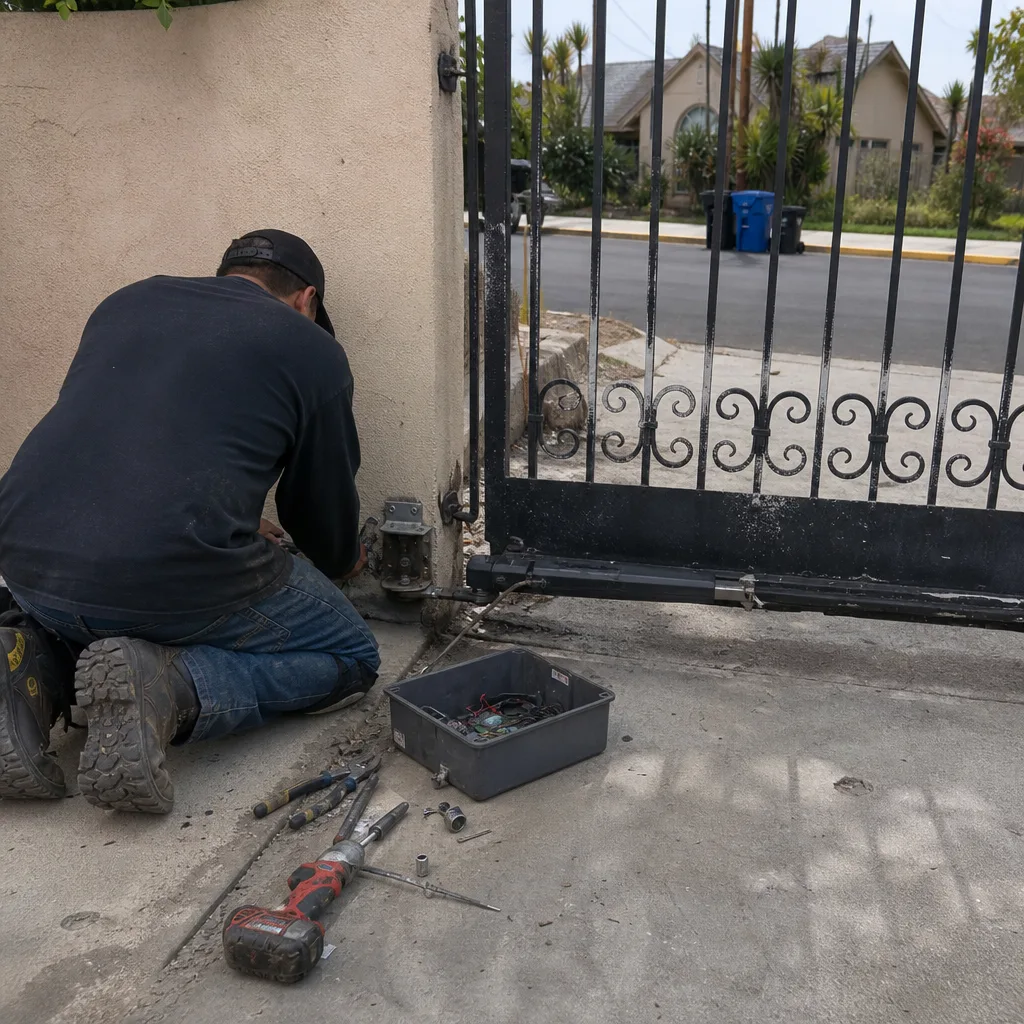 Before
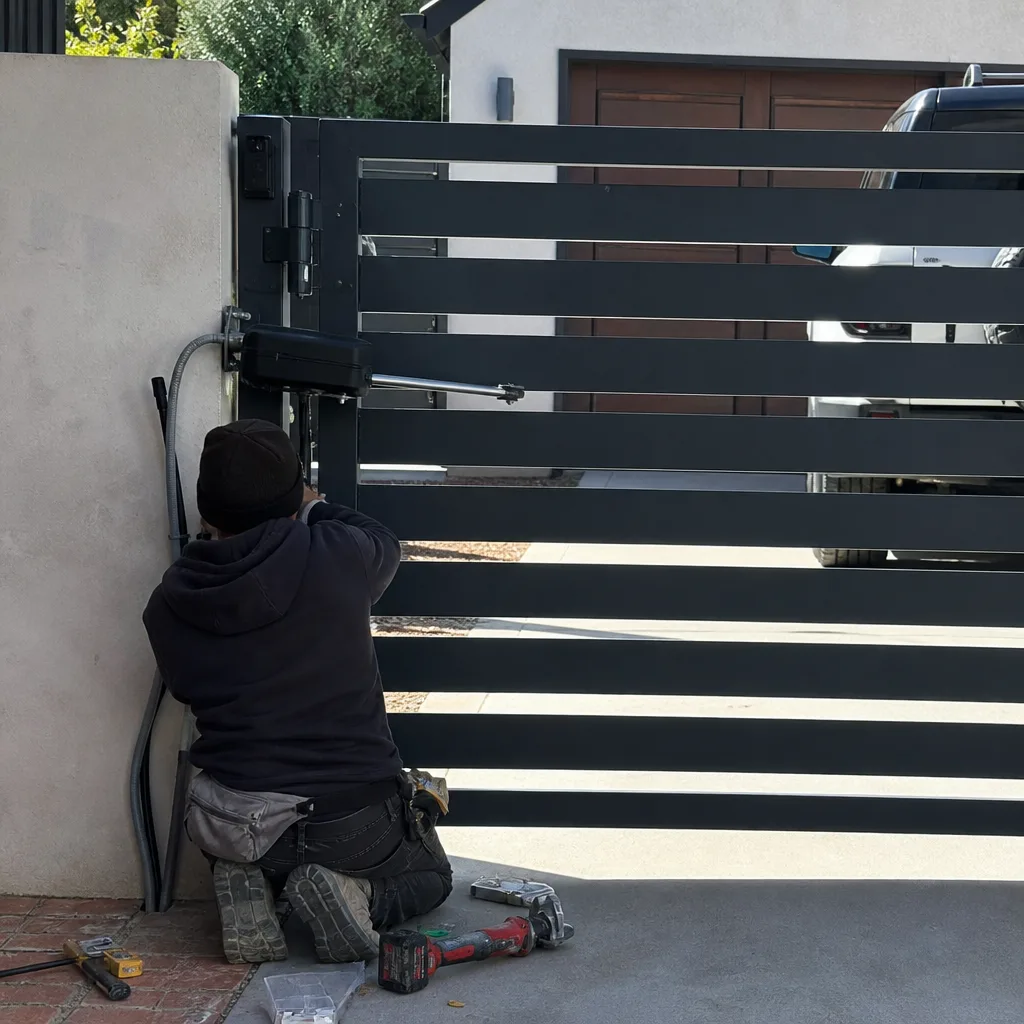 After
After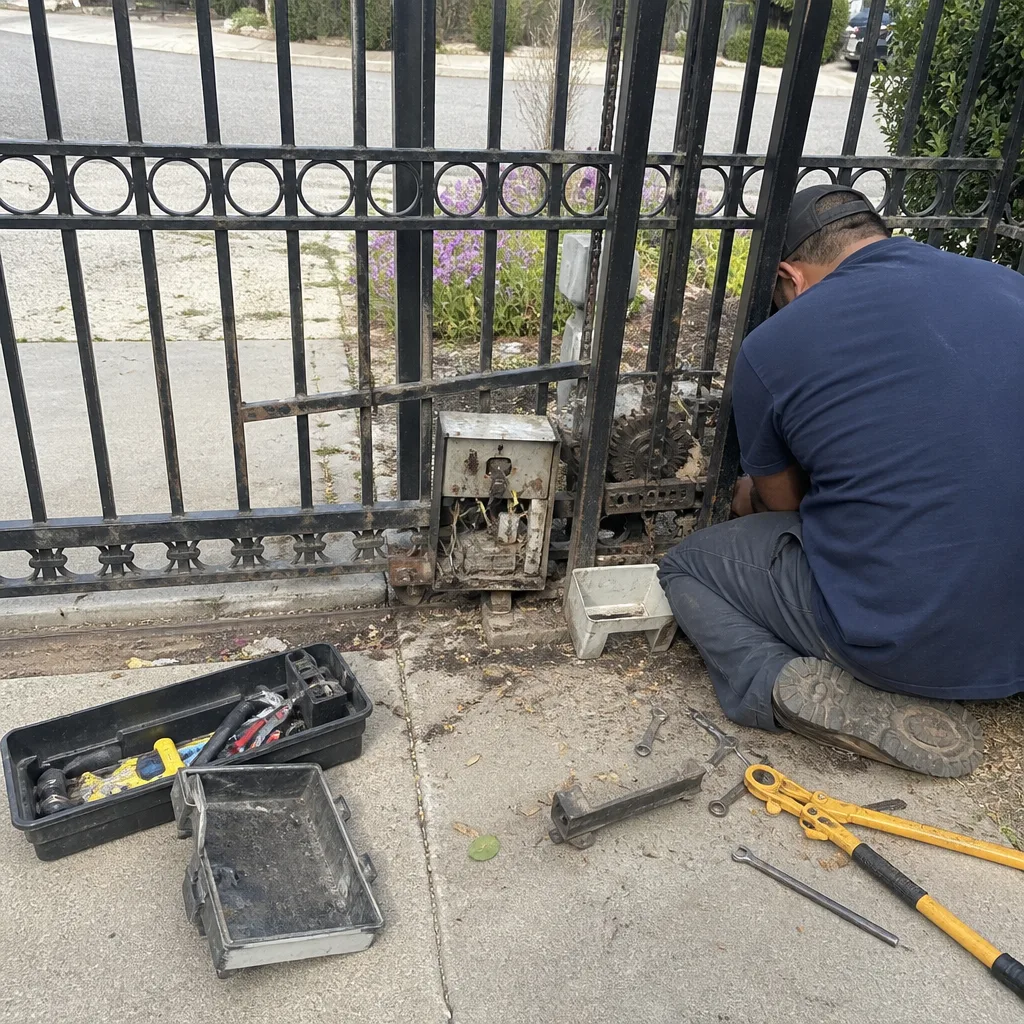 Before
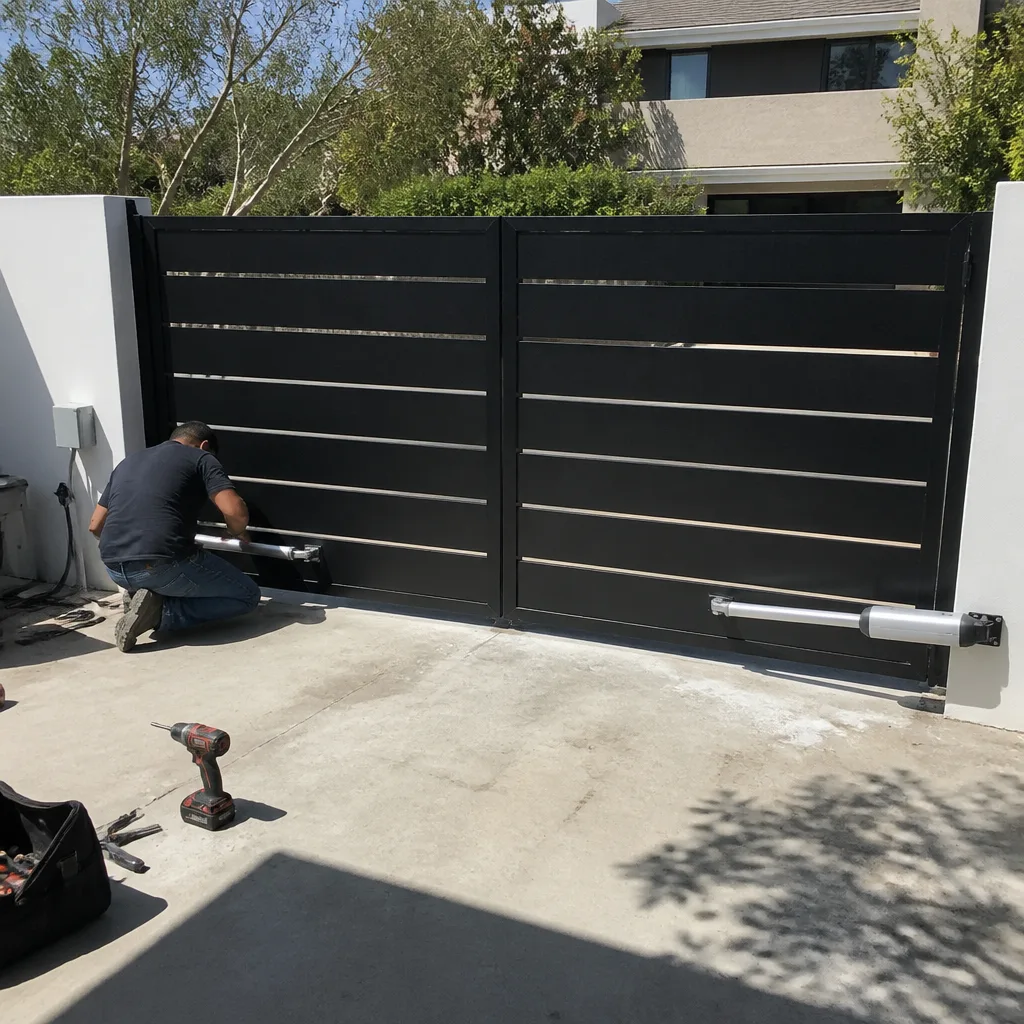 After
AfterGate Repair Warning Signs Every Homeowner Should Know
A gate that hesitates for half a second before moving is not “just doing that.” That pause is a motor drawing more current than it should, and in our experience across Los Angeles, that pattern typically precedes a full motor burn-out by two to four months. Most Gate Repair Warning Signs: A Los Angeles Homeowner’s Reference Guide articles tell you to listen for grinding or watch for a gate that reverses on its own. Those are late-stage symptoms. By the time you hear metal scraping, you’re replacing parts. This guide covers the early signals: the things you’ll notice weeks or months before the failure, when a $150 fix still beats a $1,400 replacement. If you catch these signs in the first weeks, you’ll save money and avoid the security gap of a gate stuck open at 2 a.m.
Quick Answer
The earliest gate repair warning signs are a hesitant start-up, a change in the sound the gate makes, visible rust at weld joints or bolt holes, a slight lean in the post, and moisture staining at the base of a concrete-set post. None of these are urgent in the “call at midnight” sense, but each one is a signal that wear has begun. Left alone, each of these signs escalates into the expensive failures most homeowners only notice when the gate stops moving entirely. Our Gate Repair team operates throughout Los Angeles and provides a written price before any work starts, so catching these signs early costs you nothing to confirm.
Table of Contents
- The Hesitation-Before-Movement Signal
- Changes in the Gate’s Sound Profile
- Reading Rust Patterns: Surface Oxidation vs. Deep Pitting
- The Post-Plumb Check: A Five-Second Visual Test
- Los Angeles-Specific Warning Signs: Efflorescence, Salt Bloom, and Asphalt Heave
- How to Document and Photograph Warning Signs for an Accurate Quote
- Electrical Warning Signs Most Guides Never Mention
- Warning Signs That Are Actually Normal (Don’t Overreact)
The Hesitation-Before-Movement Signal
This is the signal we see ignored most often in Los Angeles. You press the remote or enter the code, and the gate takes a beat before it moves. It’s not a long pause; it’s half a second, maybe a second. Most people assume that’s just how the gate works, or that the remote battery is getting weak. The remote is rarely the issue.
What that hesitation usually indicates is the motor’s start capacitor beginning to degrade. The capacitor is a small cylindrical component inside the operator cabinet that stores the initial burst of electrical energy needed to get the motor turning from a dead stop. When the capacitor weakens, the motor still works; it just takes longer to overcome inertia. A motor that runs with a failing capacitor draws more current than it’s rated for, and that extra heat is what eventually burns out the motor windings.
The first component to inspect is not the motor itself but the capacitor. On most residential operators in Los Angeles, a replacement capacitor runs $40 to $90 for the part and a half-hour of labor. Compare that to a full motor swap, which on a typical swing-gate operator runs $800 to $1,400 parts and labor. The hesitation sign is the cheapest warning you’ll ever get.
Other causes of hesitation include worn gear teeth inside the operator’s gearbox, a gate that’s binding against the ground or the stop post, or a failing limit switch. But the capacitor is the most common and the easiest to address early. In our Los Angeles service area, from the hillside lots in Silver Lake to the flat driveways in the Valley, we respond to hesitation complaints most often in gates that are eight to twelve years old, which is the typical service life of a residential operator’s capacitor.
If your gate hesitates, note whether the delay happens every time or only on cold mornings or after the gate has sat unused for several hours. A delay that’s worse after idle time points even more strongly to the capacitor. Write down the pattern, then call for an estimate. A technician who arrives knowing the gate hesitates worst after idle time can diagnose faster, and you’ll have a written price before any parts are ordered.
Changes in the Gate’s Sound Profile
Your gate makes the same set of sounds every day. You may not consciously register them, but your brain does. A change in that sound profile is one of the most reliable early warning signs, and it’s the one homeowners most often talk themselves out of. “It’s always made that noise” is the most common sentence we hear from homeowners whose gate failed the week before.
The sounds to listen for fall into a few distinct categories:
- A steady hum that shifts to a louder, strained hum - the motor is working harder. This can mean the capacitor is failing, the gearbox lubricant has broken down, or the gate itself is dragging against the driveway or the stop post.
- A sharp clack or clank at the moment the gate starts and stops - worn hinge bushings or a loose gate leaf. On swing gates, metal-on-metal contact at the hinge is the first stage of a hinge failure that eventually requires welding or leaf replacement.
- A rhythmic tapping or clicking that matches the gate’s speed - a chain or belt inside the operator has stretched or a sprocket tooth is worn. This is most common on slide gates where the chain is the main drive mechanism.
- A squeal or high-pitched whine while the gate moves - a drive belt slipping or a bearing going dry. On LiftMaster and DoorKing slide operators, a slipping belt is often misdiagnosed as a motor problem.
The key principle: your gate should sound the same in March as it did in January. Any new sound that persists for more than a week is a mechanical event, not an atmospheric one. Los Angeles’s dry climate means lubrication failures happen faster than homeowners expect; grease dries out and turns gummy in the heat, especially on gates that face south or west and get full afternoon sun.
Record a ten-second video of your gate opening and closing once a month on your phone. It sounds obsessive, but it gives you a baseline. When you think you hear something new, compare it to last month’s clip. If the gate is genuinely making a different sound, you’ll hear it immediately. That video also helps our technicians prepare for the visit, and it means the written quote they give you reflects what’s actually wrong.
Reading Rust Patterns: Surface Oxidation vs. Deep Pitting
In a city as dry as Los Angeles, most homeowners assume rust is not a concern. That assumption is wrong in two specific places: within three miles of the coast and at every weld joint. Coastal salt air accelerates oxidation dramatically, and weld joints are where protective coatings are thinnest and where stress concentrates. Learning to read rust patterns accurately tells you whether you have a cosmetic issue or a structural one, and the difference in repair cost is significant.
Surface oxidation is a reddish-brown dusting or light staining across a visible area. It wipes off partially with a rag, it does not flake, and the metal underneath is smooth when you run a fingernail across it. Surface oxidation is a maintenance issue, not a repair issue. A scuff-sand and repaint, or a rust converter and a coat of enamel, addresses it. This is work most homeowners can do themselves safely.
Deep pitting is different. It looks like small craters or a rough, flaking crust at a specific point, most often at a weld joint, a bolt hole, or where two pieces of the gate meet. Pitting means the corrosion has eaten into the metal itself. At a weld joint, pitting indicates that moisture has penetrated the coating at the weld’s edge and is working inside the joint. A gate with deep pitting at a weld will eventually crack at that joint, and weld repairs on a residential driveway gate in Los Angeles typically run $250 to $600 depending on access and the amount of grinding and prep required - far less than the $2,000 to $5,000 for a full gate leaf replacement if the joint fails completely.
In our experience, the rust pattern to take most seriously is any rust that appears at the bottom hinge of a swing gate. That hinge carries the full weight of the leaf through every cycle, and rust at that point is a structural warning. On coastal properties in Manhattan Beach, El Segundo, and Playa del Rey, we see bottom-hinge rust on gates that are only five or six years old, while the same gate three miles inland shows no oxidation at all. If you live near the coast and your gate is more than five years old, inspect the bottom hinge monthly. It’s the highest-risk rust point on the property.
The Post-Plumb Check: A Five-Second Visual Test
Most gate foundations fail slowly, over years, and the first sign is rarely visible to the naked eye from across the yard. But there’s a five-second test you can do with nothing but your phone camera, and it catches post lean before the gate starts binding, sagging, or scraping the ground.
Here is the step-by-step process:
- Stand about ten feet back from the gate post, directly in line with the fence line, holding your phone at eye level.
- Open the camera app and line up the edge of the screen with the post. The phone’s screen edge acts as a straightedge.
- Look at the gap between the post and the screen edge. If the post is plumb (perfectly vertical), the gap will be consistent from top to bottom. If the gap widens at the top or bottom, the post has started to lean.
- Repeat from the other side of the post and from directly in front, looking at the gate leaf itself.
- Take a photo each time. Date it. Next month, compare.
A lean of less than a quarter-inch over the height of the post is usually not urgent, but it’s worth tracking. A lean beyond a quarter-inch, or a lean that increases between photos, indicates the foundation or the post’s footing is shifting. In Los Angeles, this shifting is often caused by soil movement: expansive clay soils in the Valley that swell and shrink with rain, or hillside lots where drainage patterns have changed. Once a post is leaning, the gate hardware is compensating, which means hinges, rollers, and the operator are all under stress they were not designed for.
The repair for a shifted post ranges widely. A minor adjustment with shims at the hinge can cost as little as $150. A full post reset, with excavation, re-pouring the footing, and re-hanging the gate, typically runs $800 to $1,800 depending on the size of the gate and the site access. The five-second phone check is worth doing monthly because it moves you from the $1,800 repair to the $150 adjustment, and the adjustment is always the cheaper job.
Los Angeles-Specific Warning Signs: Efflorescence, Salt Bloom, and Asphalt Heave
Los Angeles is not one climate; it’s at least three. The coastal strip from Malibu to San Pedro gets salt fog and marine layer moisture. The Valley gets extreme summer heat and cool winter nights. The hillsides get drainage movement and soil instability. Each of those conditions produces specific warning signs that a generic guide never mentions, and each of them appears at the gate before it appears anywhere else. For deeper coverage, see our more guides & resources.
Efflorescence at the Base of a Concrete-Set Post
Efflorescence is a white, chalky deposit that appears on concrete or masonry at the base of a gate post. It forms when water moves through the concrete, dissolves salts within it, and carries them to the surface, where the water evaporates and leaves the salt behind. One appearance is informational. Recurring efflorescence, especially if it reappears within a few weeks of being brushed off, means water is moving through the footing regularly. That water movement destabilizes the soil around the footing over time, and a stable-looking post is slowly losing its support. In Los Angeles, the most common cause is irrigation overspray or a downspout that discharges too close to the post. Fix the drainage issue and the footing stabilizes. Ignore it and the post eventually shifts, which leads to the full reset we described in the section above.
Salt Bloom on Coastal Hardware
Within about three miles of the ocean, the marine layer deposits fine salt particles on every exposed metal surface. On gate hinges, latch mechanisms, keypads, and operator cabinets, that salt combines with moisture to create a corrosion environment far more aggressive than anything the original manufacturer tested for. The warning sign is a white or pale green crust forming on hardware that sees no direct water exposure. That crust is salt bloom, and it means the hardware is corroding even if it never rains. The practical response for coastal Los Angeles homeowners is more frequent inspection and the use of marine-grade hardware whenever components are replaced. A standard zinc-plated hinge will last three to five years in Manhattan Beach. A marine-grade stainless hinge will last fifteen or more, and the price difference is often under $30 per hinge. If you live within the salt fog zone, specify marine-grade on every hardware replacement. Our technicians in coastal Los Angeles neighborhoods carry these parts as standard.
Asphalt Heave at Driveway-Mounted Track Systems
Slide gates that run on a track set into or mounted on an asphalt driveway face a problem that concrete driveways do not: asphalt is flexible and moves with temperature swings. In a Los Angeles summer, an asphalt driveway can reach 140 degrees in direct sun, and the asphalt expands and shifts. Over several seasons, this movement causes the gate track to heave upward at one end, which means the gate runs uphill part of the cycle and the motor strains. The warning sign is a visible lift at the end of the track, or a gate that slows noticeably in the last foot of travel. If you see a crack in the asphalt running parallel to the track, that’s another version of the same problem. The fix is usually a track adjustment or, in more advanced cases, the installation of a floating track system that accommodates the asphalt movement. Catching this early is important; a gate that runs against a heaved track will destroy its own rollers, and a full roller replacement on a slide gate runs $400 to $900 parts and labor.
How to Document and Photograph Warning Signs for an Accurate Quote
When you call a gate repair company and describe the problem over the phone, the technician shows up with a general idea of what to look for but not a specific one. That’s not a failure of process; it’s the reality of verbal description. “The gate sounds weird” could mean any of fifteen different things. But when you document the warning signs before you call, you give the technician a head start that translates directly into a more accurate written quote and a faster diagnosis.
Here is the documentation routine we recommend to Los Angeles homeowners:
- Take a wide photo of the entire gate from the driveway so the technician can see the gate type, operator type, and site conditions in one frame.
- Take a close photo of the specific area that concerns you: the rust spot, the moisture stain, the gap between the gate and the post, the crack in the asphalt.
- Take a ten-second video of the gate opening and closing. Shoot from a steady position, include the start and stop, and let the sound record naturally.
- Write down the pattern. When did you first notice it? Is it worse at certain times of day, after rain, or after the gate sits idle? One sentence of pattern information is worth more than a full paragraph of description.
- Measure the gap if you’ve done the post-plumb check and found a lean. A tape measure photo with the gate gap visible gives the technician a starting reference.
This documentation does two things. It means the technician arrives already knowing the likely cause, which shortens the diagnostic visit and gets you to a firm written price faster. And it creates a record. If the gate fails within the 365-day guarantee period, that record is part of the service history we use to determine what happened and to make it right at no charge, which is the standard every Portcullis Gate Repair location follows. We are an independently owned Kingswell company, and that guarantee is written on every repair invoice, not implied.
Electrical Warning Signs Most Guides Never Mention
A gate is a mechanical system driven by an electrical one, and some of the earliest warning signs show up in the electrical side first. These are the signals that most gate repair guides skip because they’re harder to describe, but they often appear months before any mechanical failure.
The first is intermittent operation. Your gate works normally most of the time, but occasionally it fails to respond to the remote or the keypad, and then a few minutes later it works again. Homeowners often write this off as a remote battery issue or interference. In most cases, an intermittent gate points to a loosening connection inside the operator cabinet, a failing control board capacitor, or a wire that’s chafing against the gate frame. Each of these is a small, inexpensive repair when caught early. If the control board fails completely, replacement runs $300 to $700 parts and labor depending on the operator brand, and DoorKing and LiftMaster boards are at the higher end of that range because they’re proprietary parts.
The second is a keypad that requires multiple presses. The keypad membrane wears, and the solution is a pad replacement, not a system problem. But it’s a warning sign in this sense: if the keypad is worn enough to need multiple presses, it’s also more vulnerable to moisture intrusion, and a keypad that shorts out can send a false open signal or lock the gate open. That’s a security issue as much as a repair issue.
The third is a breaker that trips when the gate operates. This is the electrical sign we take most seriously because it means the motor is drawing more current than the circuit is designed to deliver. That excess current has a cause, and the cause is usually mechanical: a gate that’s binding, a capacitor that’s failing, or a motor that’s reaching the end of its service life. A breaker trip is the last warning before a full electrical failure, so if your gate trips the breaker even once, call for an inspection. The upfront price you receive before any work begins applies to diagnostics too; you’ll know the cost before a technician starts tracing the circuit.
Warning Signs That Are Actually Normal (Don’t Overreact)
Good information works both ways. Part of reading warning signs correctly is knowing which signs are not warnings at all, and in the Los Angeles market, we regularly receive calls from homeowners who are worried about normal gate behavior. Here are the most common false alarms:
- A gate that moves slowly in cold weather. Hydraulic operators move noticeably slower when the fluid is cold. A swing gate that takes an extra two seconds on a January morning in the Valley is not failing; it’s physics. If the slow movement persists into the afternoon heat, then you have a genuine warning sign.
- A gate that makes a soft thunk when it reaches the end of travel. The gate is hitting its mechanical stop. That’s the stop doing its job. If the thunk becomes a sharp clang, then you have a worn stop bumper or a limit switch that needs adjustment.
- A gate that reverses when a leaf or a dog runs through the sensor beam. The safety sensor is doing exactly what it’s designed to do. The reversal is a feature, not a fault. What you should verify is that the sensor works consistently; testing it with a cardboard box once a month is a reasonable safety habit.
- A remote that needs to be pressed twice after a long idle period. Some operator models run a sleep cycle that requires a wake-up signal. Check your operator manual before calling for service. If the double-press issue only happens on first use after a few hours, it’s likely the sleep function.
- Surface rust streaks below a gate that faces the ocean. If you live within the salt fog zone, light surface rust is going to appear between paint touch-ups. That’s a maintenance cycle, not a failure. Deep pitting, as described above, is the actual structural warning, and that’s the pattern to monitor.
Knowing what’s normal makes the abnormal easier to spot. When you filter out these five false alarms, the remaining signals, the hesitation, the sound change, the pitting at a weld, the post lean, the moisture pattern, all of those mean something, and addressing them early is the difference between a repair that costs a few hundred dollars and a replacement that costs thousands.
Common Mistakes to Avoid
- Ignoring a hesitation because the gate “still works.” The motor is working harder than designed, and that’s the prelude to burn-out. A capacitor replacement is a fraction of a motor replacement, but only if you act while the gate still moves.
- Lubricating a gate that’s already making noise. By the time you hear grinding or squealing, the wear has already happened. Adding grease quiets the symptom temporarily but does not address the worn component, and in some cases, grease attracts grit that accelerates the wear. Diagnose first, lubricate second.
- Painting over rust without treating it. Paint seals rust in and allows it to continue spreading underneath the coating. Surface rust must be removed or converted before painting, and deep pitting at a weld should be assessed by a technician who can determine whether the joint is sound.
- Assuming a leaning post is “how it’s always been.” Most people cannot accurately compare a post’s angle from memory. Use the phone camera check monthly. If the lean is increasing, the foundation is moving, and that will not self-correct.
- Delaying a quote because you’re afraid of the price. Every Portcullis Gate Repair quote in Los Angeles is written before any work starts, which means you can get an exact number with no obligation. Knowing the number early lets you budget and choose the timing. Waiting until the gate fails takes the choice away from you.
- Replacing the operator when the gate is the problem. A gate that’s binding at the hinge or dragging on the ground will destroy a new operator the same way it did the old one. The cheapest fix often involves the gate itself, not the motor, and a proper diagnosis covers both.
- Skimping on hardware near the coast. In the salt fog zone, standard hardware fails in a few years. Marine-grade hardware costs marginally more and lasts three to five times longer. If you live within three miles of the ocean in Los Angeles, the upgrade is almost always the cheaper long-term choice.
When to Call a Professional
Some warning signs are informational and can be monitored. Others demand a call. If your gate trips a circuit breaker, call. If the post lean increased between monthly photos, call. If you see deep pitting at a weld joint or bottom hinge, call. If the gate hesitates consistently for more than a week, call. If the sound profile changed and the change is persisting, call. In each of these cases, a trained technician can confirm the diagnosis, give you a written price, and you can decide from there. The estimate visit costs you nothing out of pocket, and you’ll have a real number rather than a worry. Gate Repair in Los Angeles is our core service area, and Portcullis Gate Repair offers free estimates across the city. Call (940) 412-7340 to schedule one, and you’ll speak to a live person no matter the hour.
Frequently Asked Questions
The earliest warning signs are a hesitation before the gate starts moving, a change in the sound the gate makes during operation, surface rust progressing to deep pitting at weld joints or hinges, a slight lean in the gate post, and recurring moisture staining at the base of a concrete-set post. Each of these appears weeks or months before the gate actually stops working, and each is cheaper to address early. Call (940) 412-7340 for a free estimate in Los Angeles if you’ve noticed any of these signs.
In Los Angeles, a capacitor replacement typically runs $40 to $90 in parts plus labor, a hinge replacement $150 to $400, a post reset $800 to $1,800, and a full operator or motor replacement $800 to $2,500 depending on the brand and gate type. The written quote you receive from Portcullis Gate Repair reflects the specific problem, and the price is agreed before any work starts, so there are no surprises at the end of the job.
A gate that hesitates before opening usually indicates a failing start capacitor, which is the component inside the operator that provides the initial burst of energy to start the motor. A worn capacitor causes the motor to draw more current than designed, and that excess heat is what eventually burns out the motor. The capacitor is an inexpensive repair compared to a motor replacement, so the hesitation is a warning sign worth acting on promptly. For timeline details, read How Long Does Electric Gate Repair Take? Timelines and What to Expect.
Surface oxidation, which appears as a light reddish dusting that wipes off partially, is a maintenance issue that a scuff-sand and repaint can address. Deep pitting at a weld joint or hinge is a structural problem because it means corrosion has penetrated the metal and the joint is weakening. Coastal Los Angeles properties within three miles of the ocean see accelerated rust on hardware, and marine-grade replacements are strongly recommended for those locations.
Once a month is the right interval for a homeowner in Los Angeles. A monthly check takes about five minutes: run the gate once and listen for changes, take the phone-camera plumb check on the post, and glance at the bottom hinge and post bases for moisture or rust. Document anything unusual with a photo and a date. That monthly habit is what catches problems in the inexpensive stage, and it gives you a reference point if the gate’s behavior changes.
Whether a same-day repair is possible depends on the nature of the problem and the parts required. A hinge adjustment or a limit switch correction can often be completed the same day, while a capacitor or control board replacement may require a parts order that takes one to three business days in typical circumstances. When you call Portcullis Gate Repair home at (940) 412-7340, you’ll speak to a live person who can schedule a diagnostic visit and get you a written price, and we’ll be straight with you about the timeline before you commit to anything.
A full Gate Installation in Los Angeles includes site measurement, post setting and concrete footings, gate fabrication or assembly, operator installation, safety sensor installation, keypad or remote setup, and a final walkthrough of the operation. The written quote covers every component and every hour of labor before work begins, and every installation carries the same 365-Day Done Right Promise that applies to repairs. If you’re considering an electric gate, our Electric Gate Repair in Los Angeles team handles the power run, the safety edges, and the operator programming as part of the complete job.
The Bottom Line
The pattern is consistent across every Los Angeles neighborhood we serve: homeowners who act on the early warning signs spend a few hundred dollars, and homeowners who wait until the gate fails spend a few thousand. The hesitation, the sound change, the rust at a weld, the post lean, the moisture at the footing, these are all signals your gate is sending months before the failure. You don’t need to be a technician to read them. You need to pay attention once a month and call when something changes. The estimate is free, the price is written before any work starts, and the repair is backed by a 365-day written guarantee. That’s the standard we’ve held as a Kingswell company since 2008, and it’s the standard every one of our Los Angeles customers receives on every job.
Written by Dean Prescott, Owner at Portcullis Gate Repair, serving Los Angeles since 2008.