
Last updated October 8, 2026
Free on-site gate assessment - hinges, posts, and your LiftMaster or Nice gate operator checked before anything is quoted
The assessment is free and the quote is the invoice.

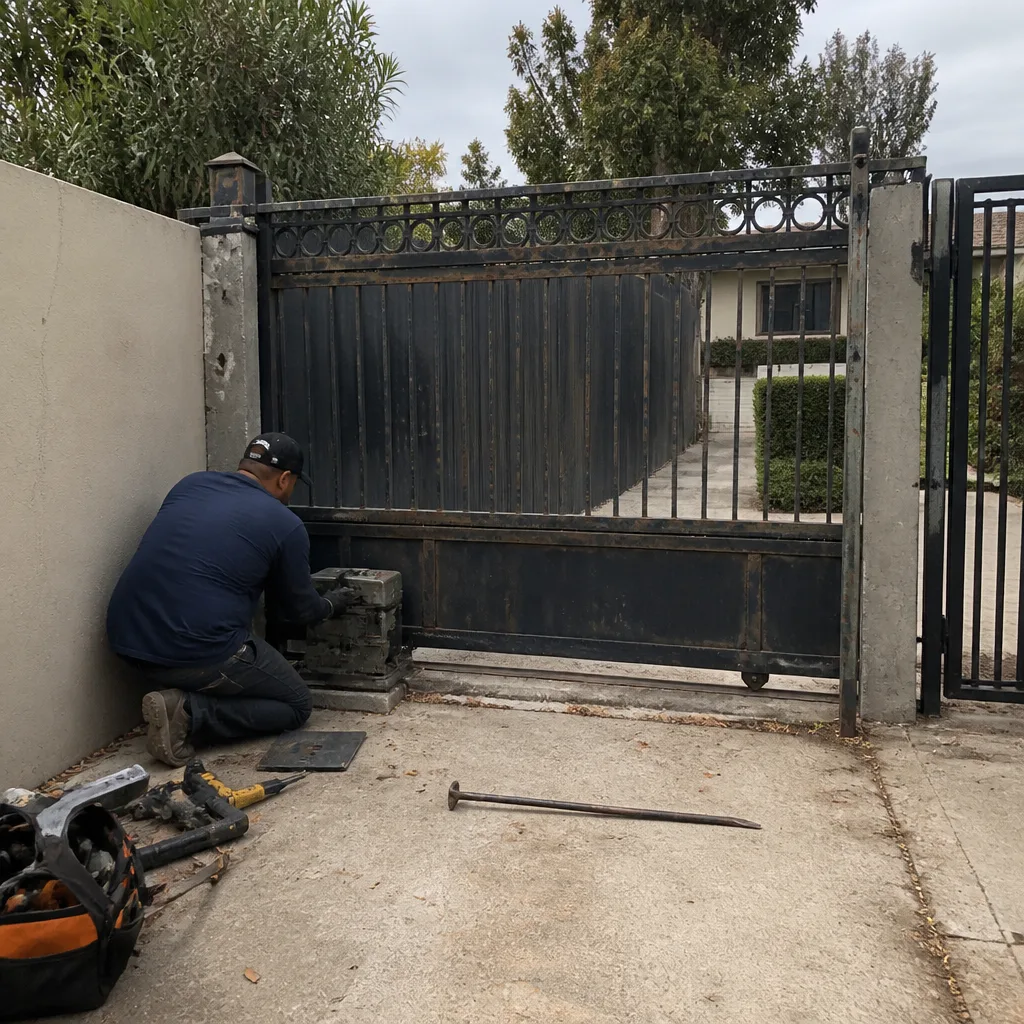 Before
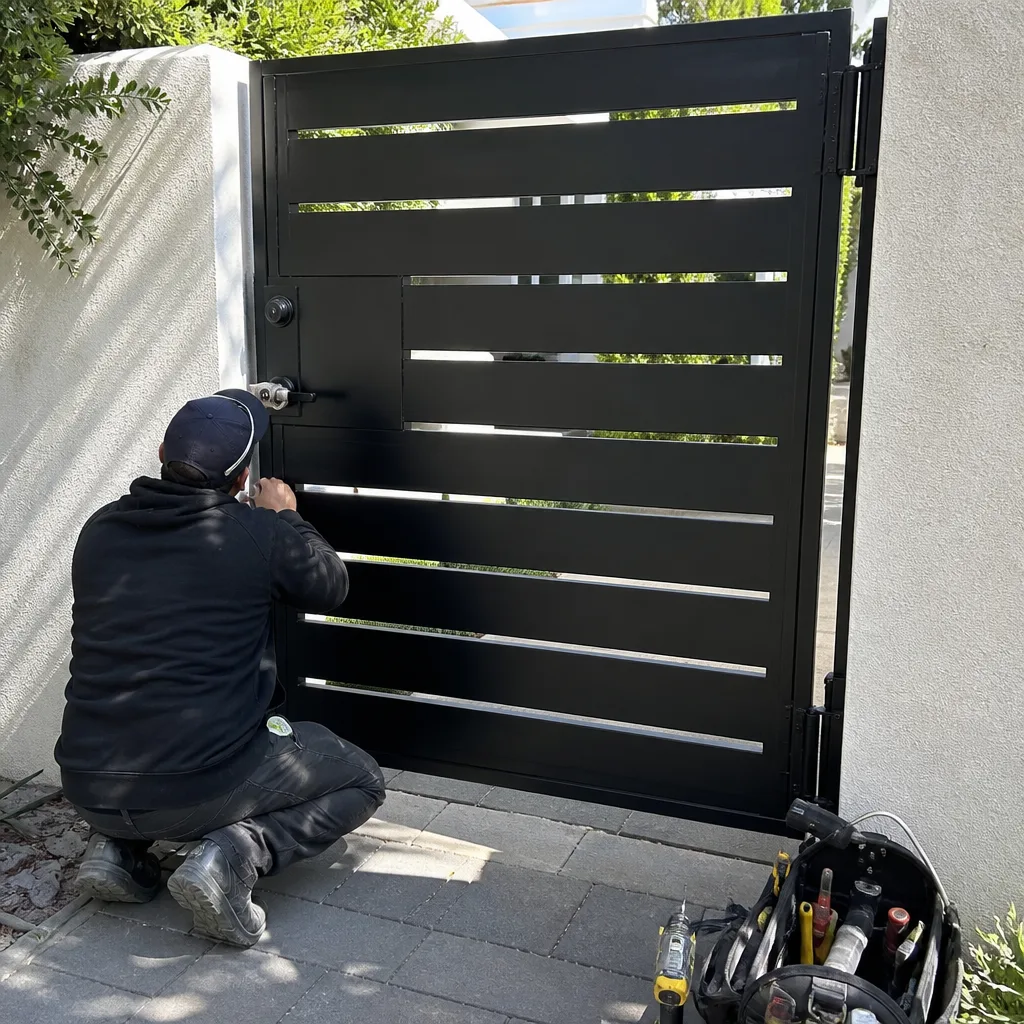 After
After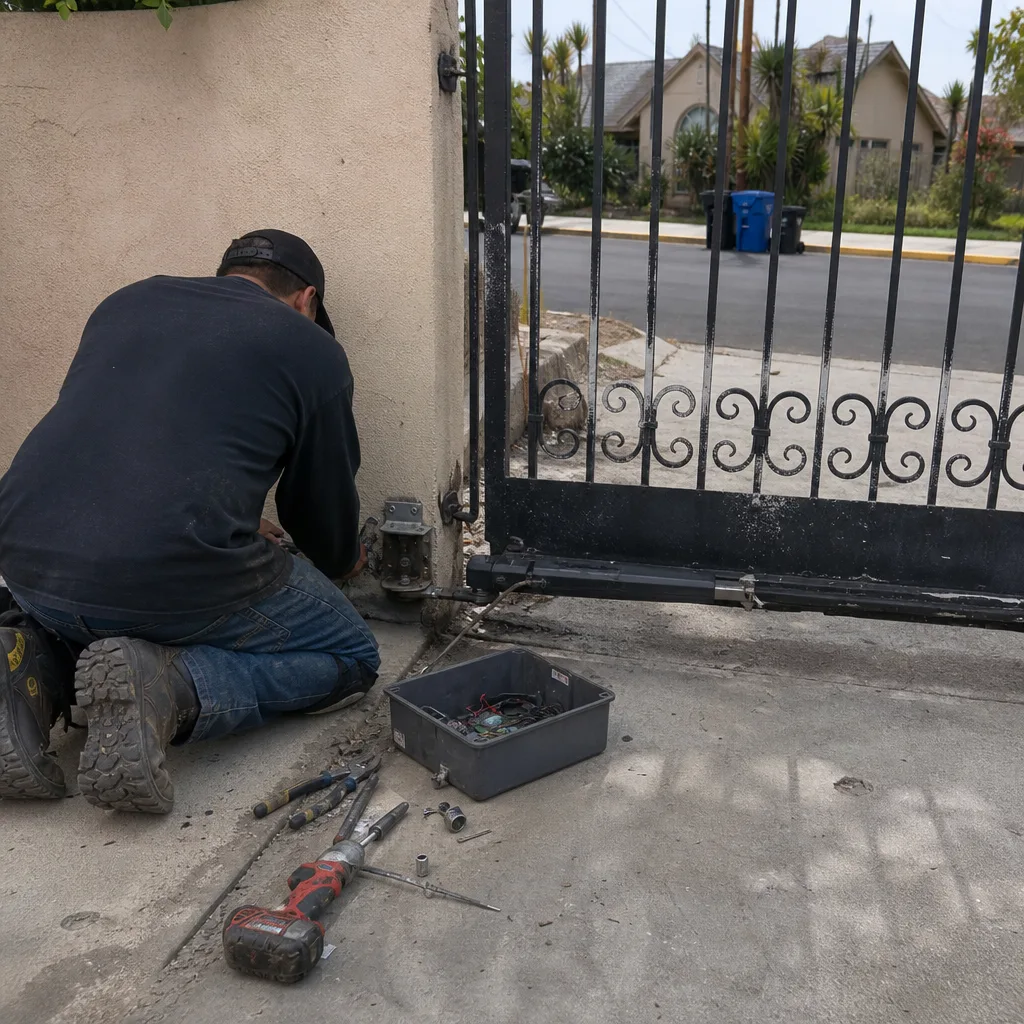 Before
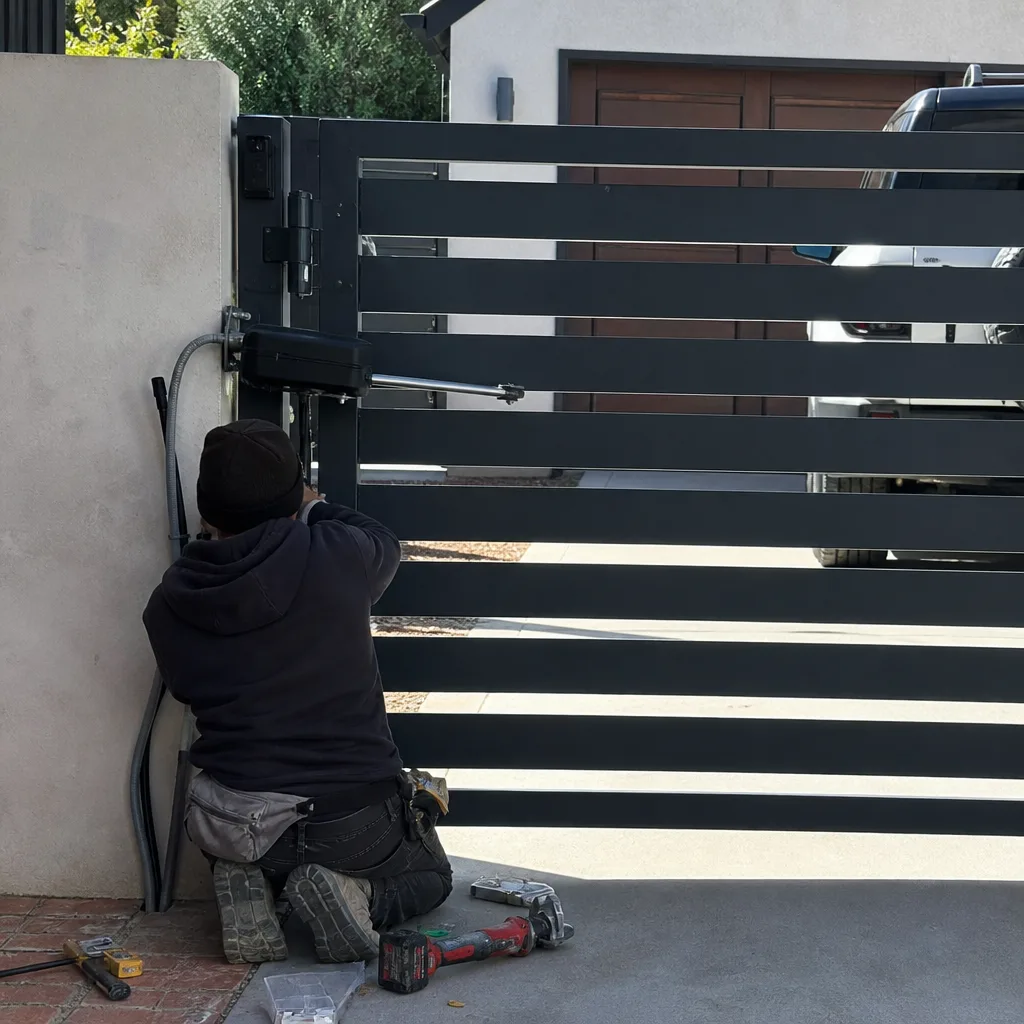 After
After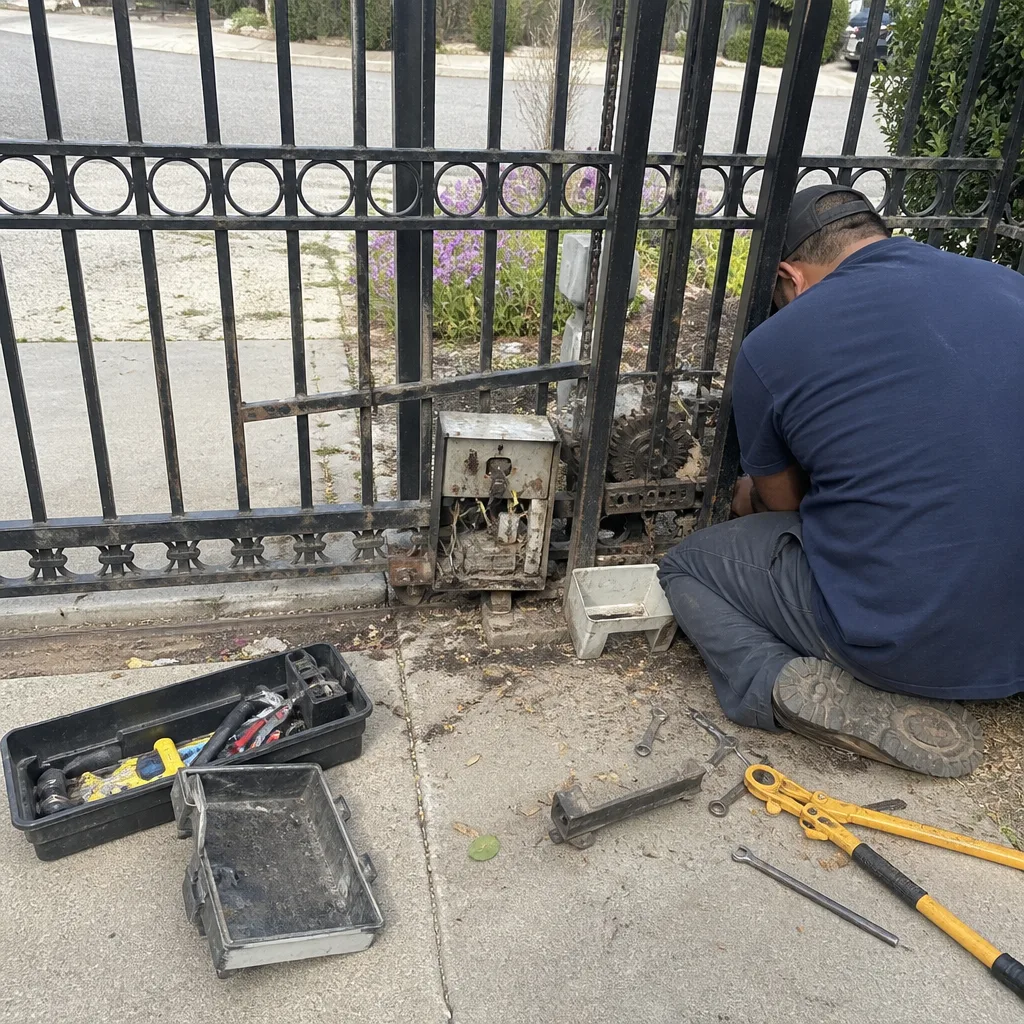 Before
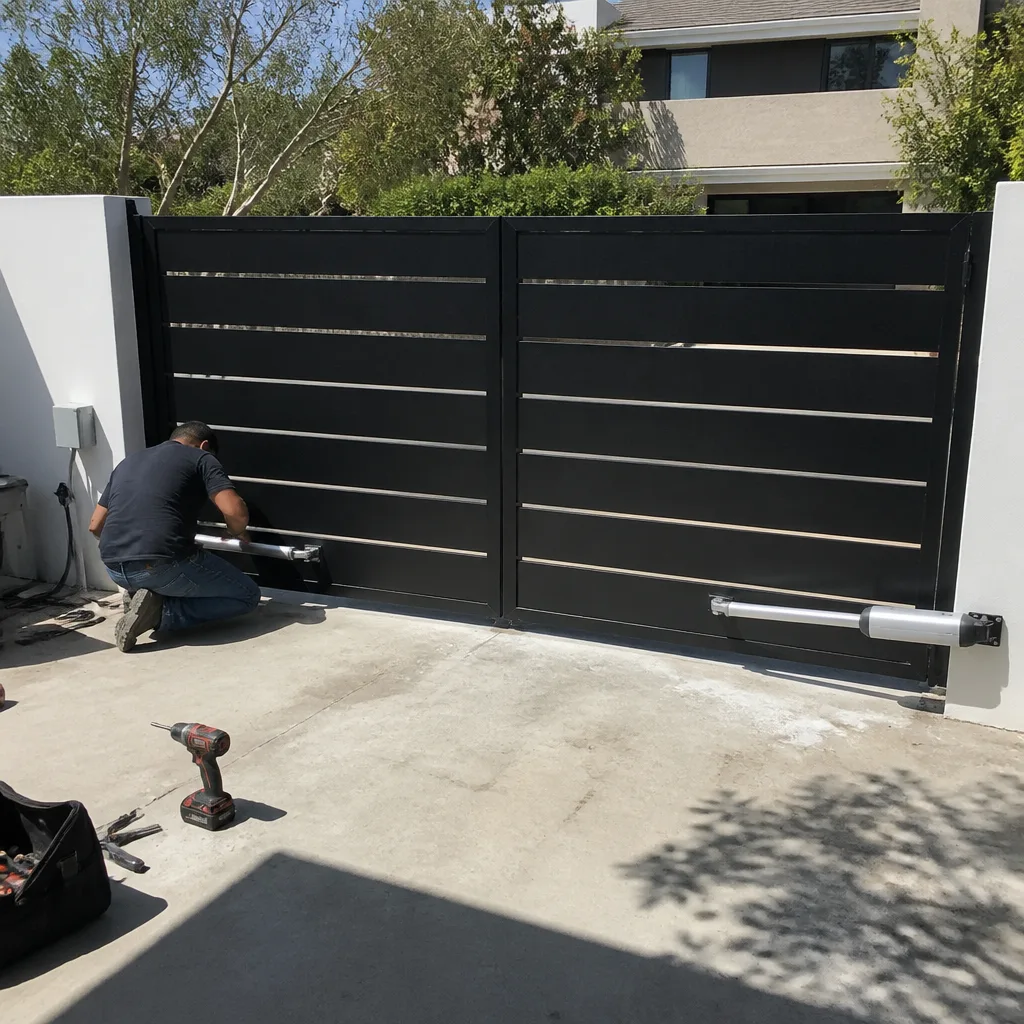 After
AfterElectric Gate Repair Warning Signs Every Homeowner Should Know
A gate that pauses for half a second before moving is not “just getting old.” It’s a control board struggling to fire the motor under load, which typically means the motor capacitor is failing. That capacitor costs about $40 to replace. Ignore it, and the motor works harder every cycle until it burns out, at which point you’re looking at $500 to $900 for a new operator. In Los Angeles, where a gate is often the first line of defense for a driveway or pedestrian entry, homeowners lose weeks of security by dismissing the early warning signs. This guide maps each sound, hesitation, and visual cue to its likely mechanical or electrical cause, so you can catch a $200 repair before it becomes a $900 replacement.
Quick Answer
The most common electric gate repair warning signs are grinding or squealing noises during travel, a gate that pauses or hesitates before moving, a gate that reverses mid-travel without any obstruction, slow operation on cold mornings, and a gate that drifts open or closed when it should stay put. Each of these points to a specific failing component, the capacitor, the limit switches, the battery backup, or the drive mechanism. Catching them early usually means a repair under $300 instead of a full operator replacement.
Table of Contents
- Grinding or Squealing During Travel
- The Half-Second Pause Before the Gate Moves
- Reversing Mid-Travel Without an Obstruction
- Slow Operation on Cold Los Angeles Mornings
- A Gate That Drifts Open or Closed on Its Own
- The “It Works Sometimes” Pattern
- Visual Warning Signs You Can Spot Without Tools
- The 30-Second Monthly Check Routine
Grinding or Squealing During Travel
Grinding is the sound of metal on metal where metal should not be touching. On a sliding gate, it’s usually the chain or rack that transfers power from the operator to the gate itself. When lubrication breaks down or the chain stretches, you hear a rough, metallic growl during travel. On a swing gate, a squeal typically comes from the hinge bearings or the actuator, the motorized arm that physically pushes the gate open. In our experience across Los Angeles neighborhoods, from Woodland Hills to Pasadena, the grinding noise is the single most ignored warning sign because the gate still opens. It works, so it gets tuned out.
Here is the problem: friction generates heat, and heat kills motors. A gate grinding for six months is pulling 20 to 40 percent more current than it should. That excess current wears the motor brushes, overheats the control board, and can eventually trip your breaker. The fix early on is straightforward, a chain adjustment, fresh lubrication, or replacing worn hinge bearings. The fix late is a new actuator for a swing gate or a new drive assembly for a slide gate, which runs $600 to $1,200 parts and labor in the Los Angeles market.
The Half-Second Pause Before the Gate Moves
When you press the remote or the keypad and the gate hesitates before responding, the control board is struggling. That pause is the board attempting to fire the start capacitor, the component that gives the motor its initial jolt of power. A failing capacitor holds less charge, so it takes longer to reach the voltage needed to spin the motor. You hear a click, a beat of silence, then movement.
This is the moment to act. A start capacitor on most residential gate operators, including BFT and Linear systems common in Los Angeles, costs $35 to $60 for the part. Labor to swap it typically runs $150 to $250 total. Wait too long, and the capacitor fails completely. When that happens, the board keeps trying to start a motor that cannot spin, which overheats the board’s relay. You replace a capacitor for $200, or you replace a board and a motor for $800 to $1,500. The pause is not a personality quirk. It is a diagnostic signal.
Reversing Mid-Travel Without an Obstruction
A gate that starts to open, gets halfway, then reverses as if it hit something, usually means one of two things: limit drift or sensor misalignment. Limit switches tell the operator where the gate’s open and closed positions are. Over time, vibration and temperature shifts knock them out of alignment. The operator thinks the gate has traveled too far, panics, and reverses. The other common culprit is a photo-eye sensor, the safety device that stops the gate if a child, pet, or car is in the path. Dust, spider webs, or a slight angle change from a bumped post causes the sensor to read a phantom obstruction.
Both issues are inexpensive to fix when caught early. A limit switch adjustment or replacement runs $85 to $180. Realigning and cleaning photo-eyes is often a $75 to $150 service call. Some Los Angeles homes with older Viking or Ghost Controls operators have limit switches that are particularly prone to drift after the seasonal temperature swings we get between the coast and the Valley. The gate working “mostly fine” except for the occasional unexplained reversal is your clue that a limit switch is already on its way out.
Slow Operation on Cold Los Angeles Mornings
Los Angeles cold is not Minneapolis cold, but a 45-degree morning in December is enough to expose two failing components. The first is the battery backup. Many Los Angeles gates run on 12-volt DC systems with sealed lead-acid batteries that keep the gate operational during power outages. Those batteries lose capacity in colder temperatures. If the gate moves noticeably slower on a chilly morning than it does at noon, the battery backup is likely degraded and should be load-tested. A replacement battery runs $40 to $120 depending on the system.
The second possibility is motor brush wear. Brushes are the carbon contacts that transfer electricity to the spinning motor shaft. As they wear down, the motor produces less torque. Cold thickens the grease in the gearbox, and the weakened motor cannot overcome it. A motor brush replacement is a $150 to $250 job when caught early. If ignored, the motor eventually stalls under load and burns out the armature, pushing you into full operator replacement territory. If you notice the gate is sluggish in the morning but fine by afternoon, you have a specific diagnostic clue, not a quirky gate.
A Gate That Drifts Open or Closed on Its Own
A gate that slowly drifts after it stops is giving you a clear signal that its limit switches or its mechanical brake are failing. On a slide gate, the operator has an internal brake or a gearbox that holds position. When the brake pads wear or the gearbox develops play, the gate’s own weight starts to win. On a swing gate, the limit switch tells the actuator exactly where to stop. A limit switch that is failing will let the gate overshoot, then gravity pulls the leaf downhill. The drift is especially noticeable on sloped Los Angeles driveways, where even a two-degree grade creates constant pressure on the mechanism.
The danger here is twofold. First, a drifting gate does not seal your property. The gap at the latch side widens, which is a security issue and a visible invitation. Second, the actuator or motor is working against gravity every time it tries to rest, which accelerates wear on the gear train. A limit switch replacement on most operators, including Viking and Ghost Controls units, runs $85 to $180. A brake adjustment is typically $100 to $200. Let the drift continue, and the gearbox itself goes, a $400 to $700 repair on many slide gate operators.
The “It Works Sometimes” Pattern
Intermittent operation is the most frustrating and most misdiagnosed gate problem. It works all week, then refuses to open on a Sunday morning, then works again an hour later. Homeowners often assume it is the remote, so they change batteries. The gate still misbehaves. Intermittent faults are almost always one of two things: a heat-related control board fault or a loose terminal connection.
Control boards have solder joints and relay contacts that expand and contract with temperature. A board with a hairline crack works fine when cool, but once the afternoon sun hits the operator box in a Los Angeles summer, the expansion separates the joint, and the board goes dark. When the box cools at night, the gate works again. A loose terminal connection behaves the same way. Vibration from months of operation loosens a screw terminal, and the connection is made or broken by temperature and humidity. Both issues are far cheaper to fix early. Tightening connections and applying dielectric grease is a service call, not a replacement. Replacing a relay on a board runs $100 to $250. A full board replacement on a BFT or Linear operator runs $400 to $900. If your gate is moody, do not wait for the mood to become permanent.
Visual Warning Signs You Can Spot Without Tools
You do not need to open the operator box to find trouble. Three visual cues are visible from your driveway and predict serious problems.
Rust streaking from the hinges or the base of the gate post. Rust is not cosmetic. It is the steel expanding as it oxidizes, which seizes hinge bearings and weakens the post at exactly the point where the gate’s weight concentrates. In Los Angeles, coastal neighborhoods like Venice and Marina del Rey get salt air that accelerates this dramatically. A hinge replacement runs $150 to $400 per hinge. A failed post that requires excavation and re-setting runs $1,500 to $3,500.
Concrete cracks at the post base. A gate is a long lever, and the post is the fulcrum. Every cycle puts thousands of pounds of stress on the post footing. Hairline cracks in the concrete around the post mean the footing is flexing. Once the post moves even a quarter inch, the gate sags, the latch stops aligning, and the operator has to work against a misaligned track or hinge. Reinforcing the footing early is a concrete repair job, often under $500. Replacing a snapped post is a three-day project.
A sagging gate leaf at the latch side. Stand at the closed gate and look at the horizontal gap between the two leaves. If the gap is wider at the top than the bottom, the hinge-side structure is failing. The gate’s own weight is slowly pulling it down and out of square. Adjusting hinges on a swing gate runs $200 to $400. If the gate sags far enough to drag on the ground, you have already damaged the actuator, which now has to lift the gate’s full weight on every cycle.
The 30-Second Monthly Check Routine
You do not need to be a technician to catch changes before they become failures. Here is a simple monthly routine that takes 30 seconds and catches most of the issues above at the repair stage, not the replacement stage.
- Listen during a full travel cycle. Open and close the gate once while standing near the operator. You are listening for any new sound: grinding, squealing, clicking, or a hum that was not there last month. A healthy gate with a properly lubricated chain should be quiet enough that you notice the birds.
- Watch for hesitation. Note the time between pressing the button and the first movement. If it is growing, the capacitor or the board relay is telling you something. A half-second becomes a full second becomes a dead gate.
- Test the manual release. Every operator has a manual release mechanism, usually a key or a pull handle. Disengage it and push the gate by hand. It should move smoothly with moderate effort. If it feels heavy, catches, or feels gritty, the mechanical resistance is wearing out your motor.
- Check the sensor lights. Photo-eye sensors have small LED indicators. On most operators, a solid green means aligned, a blinking or red light means a fault or misalignment. Wipe the lenses with a dry cloth, because Los Angeles dust is relentless.
- Look at the hinges and the post. Ten seconds of visual inspection, looking for rust, new concrete cracks, or a changing gap at the latch. Write it down if something is different. The written baseline from last month is what makes this month’s change obvious.
This routine is not a substitute for professional service, but it is the difference between hearing a new noise in month one and discovering a dead gate in month six.
Common Mistakes to Avoid
- Lubricating without diagnosing. Spraying WD-40 or a generic lubricant on a grinding gate masks the noise for a week and attracts dust, which turns the lubricant into an abrasive paste. The right fix is identifying why the metal is touching, and using the correct grease on the correct component. In Los Angeles, where fine dust and coastal salt are both factors, the wrong lubricant accelerates the damage.
- Replacing the remote first. When the gate works sometimes, the remote is the easiest thing to blame, and the most common wrong answer. A $15 remote battery replacement does not fix a failing capacitor or a cracked solder joint on the board.
- Ignoring a reversing gate because it “corrects itself.” A gate that reverses and then works on the second or third try is a gate with a failing sensor or limit switch. Each false reversal is the operator working double cycles, wearing everything inside the box twice as fast.
- Power-washing the operator box. Operators are rated for weather resistance, not for direct high-pressure water. Power-washing a gate and its operator forces water into the board enclosure and the gearbox, which causes corrosion and short circuits. We have replaced boards in Beverly Hills and Encino that died a week after a pressure-washing session.
- Waiting until the gate fails completely to call anyone. A gate that “kind of works” is a gate that is actively destroying its most expensive components. The $200 fix today becomes the $900 replacement in three months, and during those three months, you are parking an unsecured car and sleeping behind an unsecured gate.
- Assuming all gate companies honor their quotes. If you have been burned before, you know the pattern: quote one price, show up, disassemble the gate, then discover “additional problems.” Portcullis Gate Repair operates differently. The Kingswell Guarantee puts the price in writing before a single bolt is turned.
When to Call a Professional
Call a professional when the warning sign is persistent or recurring. A single unexplained reversal could be a leaf crossing the sensor. A reversal that happens every other day is a failing component. A gate that hesitates every cold morning, a new grinding noise that gets louder by the week, a post base with fresh cracks after a rain, these all need a diagnosis. Do not open the operator box yourself. The capacitor inside holds a charge even when the power is off, and the moving gate itself carries enough force to cause serious injury if the manual release is mishandled. Portcullis Gate Repair offers our Gate Repair services with free estimates in Los Angeles. Call (940) 412-7340 and a live person answers, not a voicemail tree.
Frequently Asked Questions
Most electric gate repairs in Los Angeles run between $150 and $450 depending on the failing component. A capacitor replacement is typically $150 to $250. A limit switch swap runs $85 to $180. A new battery backup is $40 to $120 for the part plus labor. A full control board replacement on a BFT or Linear operator runs $400 to $900. A new actuator for a swing gate runs $600 to $1,200 installed. Every Portcullis Gate Repair job includes a written price before work starts, so you will never see an invoice bigger than the quote. Call (940) 412-7340 for an exact quote, estimates are free.
Intermittent operation is almost always a heat-related control board fault or a loose terminal connection inside the operator box. Temperature changes cause solder joints and connectors to expand and contract, making and breaking the circuit. The fix is often a simple terminal tightening or a relay replacement, which is far less expensive than the full board replacement you will need if it is ignored. If your gate is moody, check our Gate Installation Troubleshooting: Common Problems and How to Fix Them guide, then call (940) 412-7340 and describe the pattern, the time of day it fails matters for diagnosis.
You can safely clean photo-eye lenses, lubricate visible hinges, and perform the monthly check routine described above. You should not open the operator box. Start capacitors hold a dangerous charge even with power disconnected, and the gate’s moving parts carry enough force to cause serious injury. A trained technician with background-checked credentials and the correct tools will diagnose and repair it safely, and you can find more guides & resources in our blog. Portcullis Gate Repair technicians arrive in uniform, service nine major operator brands including Viking and Ghost Controls, and put the guarantee in writing.
With regular maintenance following a Gate Installation Maintenance Schedule: What to Do and When, a residential gate operator in Los Angeles should last 10 to 15 years. The Los Angeles climate works against that number in two ways: summer heat stresses the control board’s solder joints, and in coastal neighborhoods, salt air corrodes hinges and posts faster than inland. Operators that are ignored and asked to work against a grinding chain or a sagging gate often fail in 5 to 7 years. The 30-second monthly check is the cheapest life insurance your operator will ever have.
Every Portcullis Gate Repair job carries a written guarantee stamped on the invoice. If the repair fails within 365 days, we return and correct it at no charge. That includes the return visit. The promise is part of the Kingswell Guarantee, which also commits us to a written price before any work starts, a real arrival window, and a clean job site. Each Portcullis location is independently owned and operated, but every location is held to the identical written standard.
Yes. That pause is the control board struggling to fire the motor under load, which usually means the start capacitor is degrading. Replacing a capacitor costs about $150 to $250 parts and labor. If you wait until the capacitor fails completely, the board’s relay overheats trying to start a stalled motor, and you are looking at a $400 to $900 board replacement. A half-second pause is a $200 warning. Call (940) 412-7340 and describe what you are hearing, the diagnosis starts on the phone.
The Bottom Line
Electric gates rarely fail without warning. They grind, hesitate, drift, reverse, and slow down for weeks or months before they stop. Each of those behaviors maps to a specific failing component, and the repair cost is a fraction of the replacement cost when caught early. A $40 capacitor can save a $600 motor. A $150 limit switch can save a $900 board. A $200 hinge repair can save a $3,500 post replacement. The monthly 30-second check costs you nothing and catches most of these issues while they are still cheap to fix. For everything else, Portcullis Gate Repair has served Los Angeles since 2008 with written prices, a written 365-day guarantee, and a live person answering the phone around the clock. See our Portcullis Gate Repair home page for service details, or explore our Electric Gate Repair in Los Angeles page for specific repair services. For new installations, visit Gate Installation in Los Angeles, and for full-service gate work across the area, see Gate Repair in Los Angeles.
Written by Dean Prescott, Owner at Portcullis Gate Repair, serving Los Angeles since 2008.