
Last updated October 8, 2026
Free on-site gate assessment - hinges, posts, and your LiftMaster or Nice gate operator checked before anything is quoted
The assessment is free and the quote is the invoice.

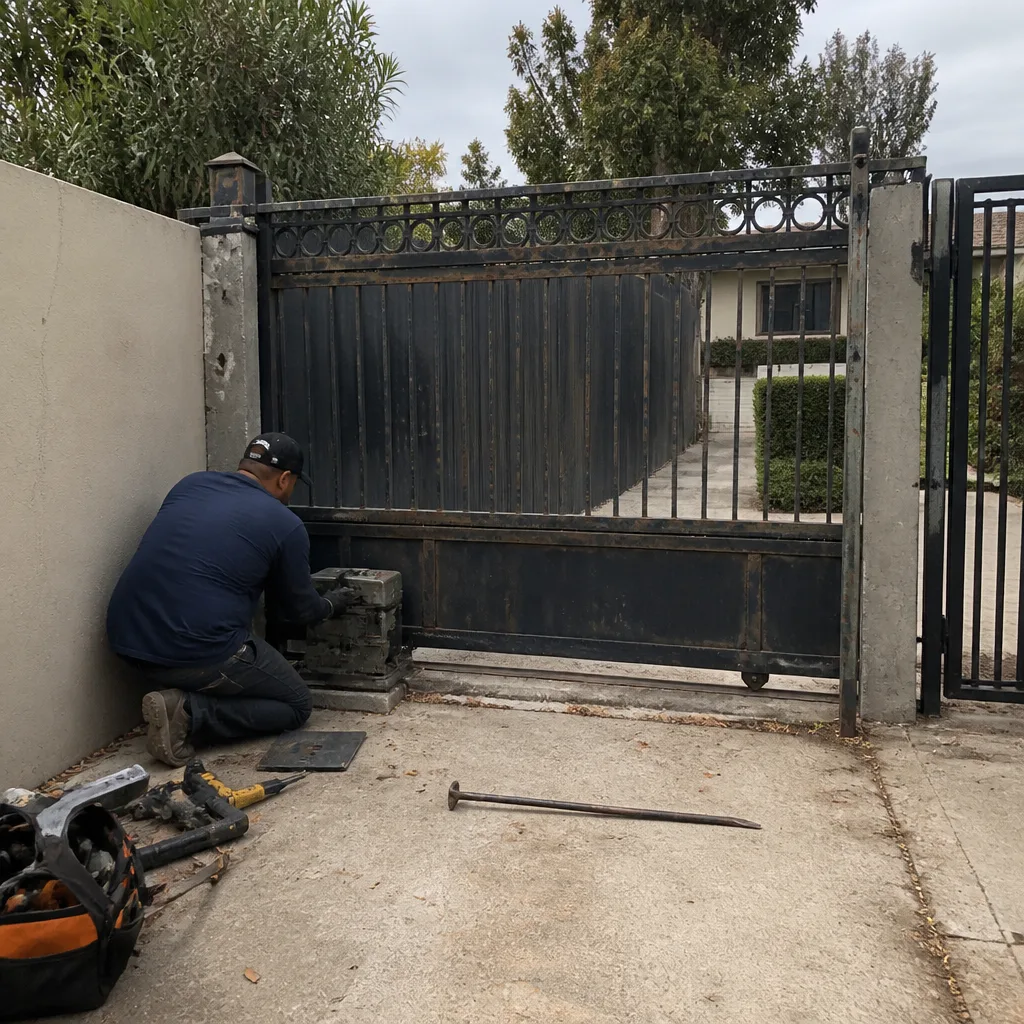 Before
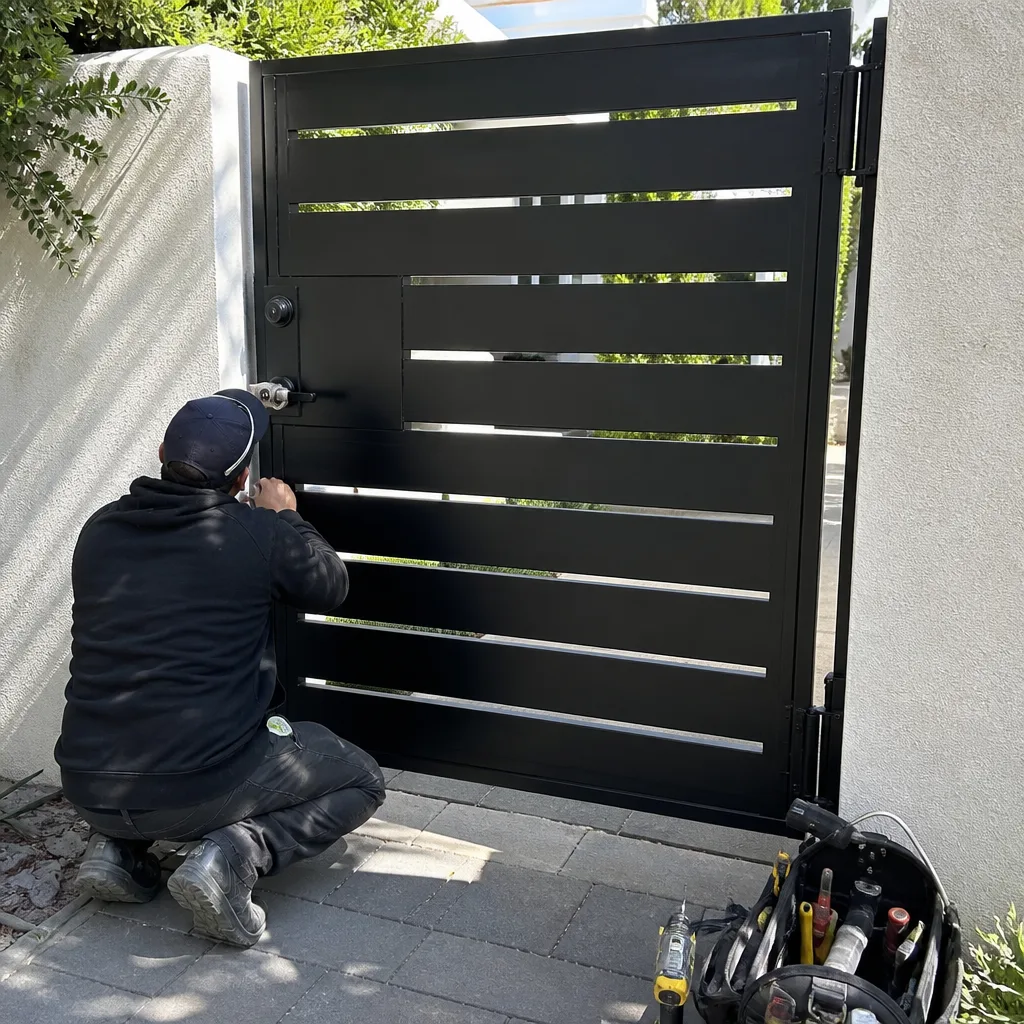 After
After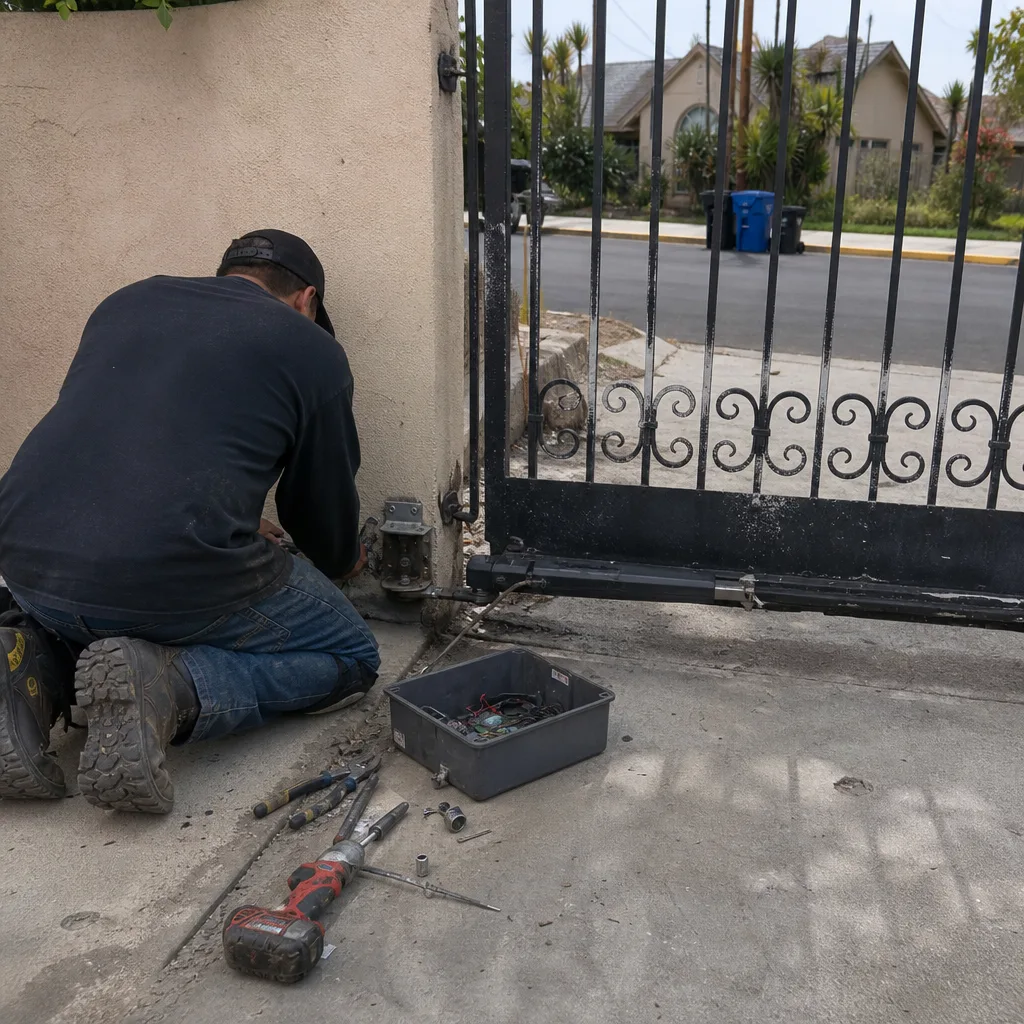 Before
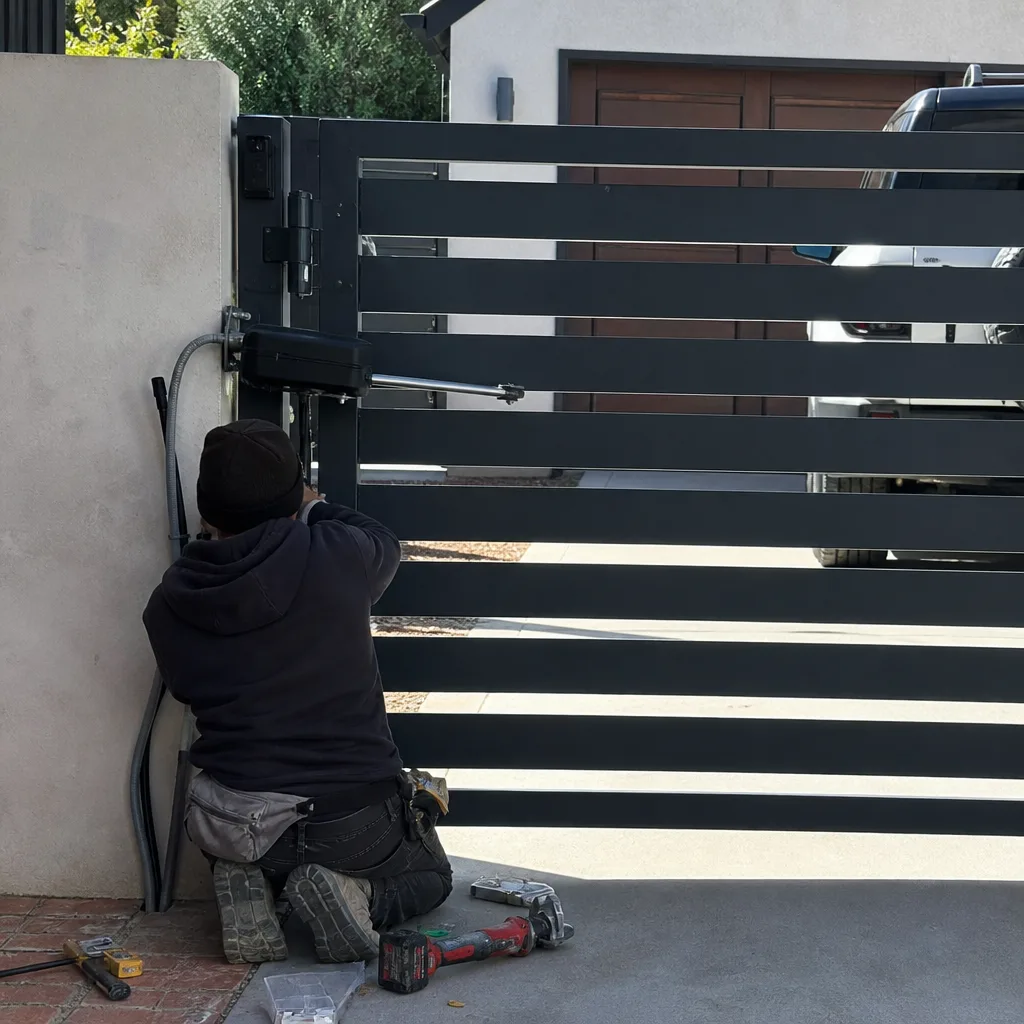 After
After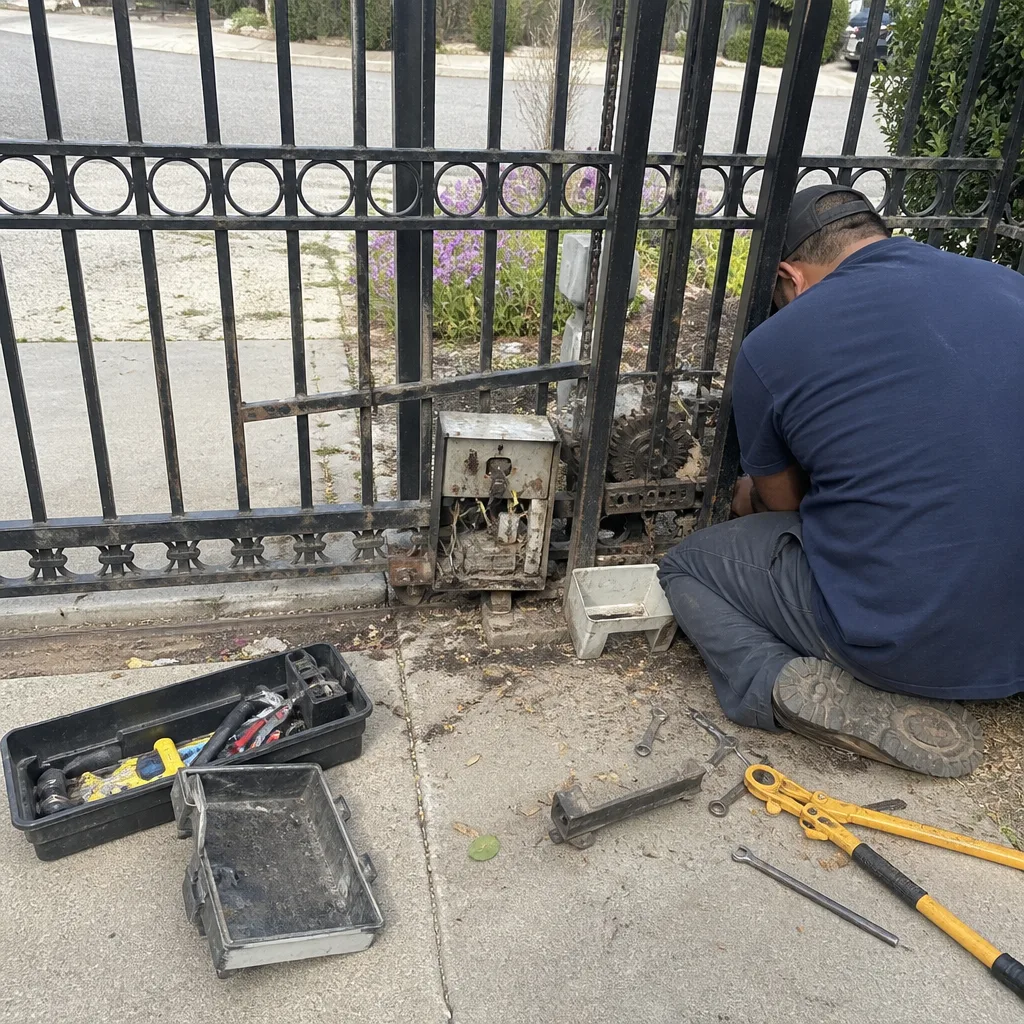 Before
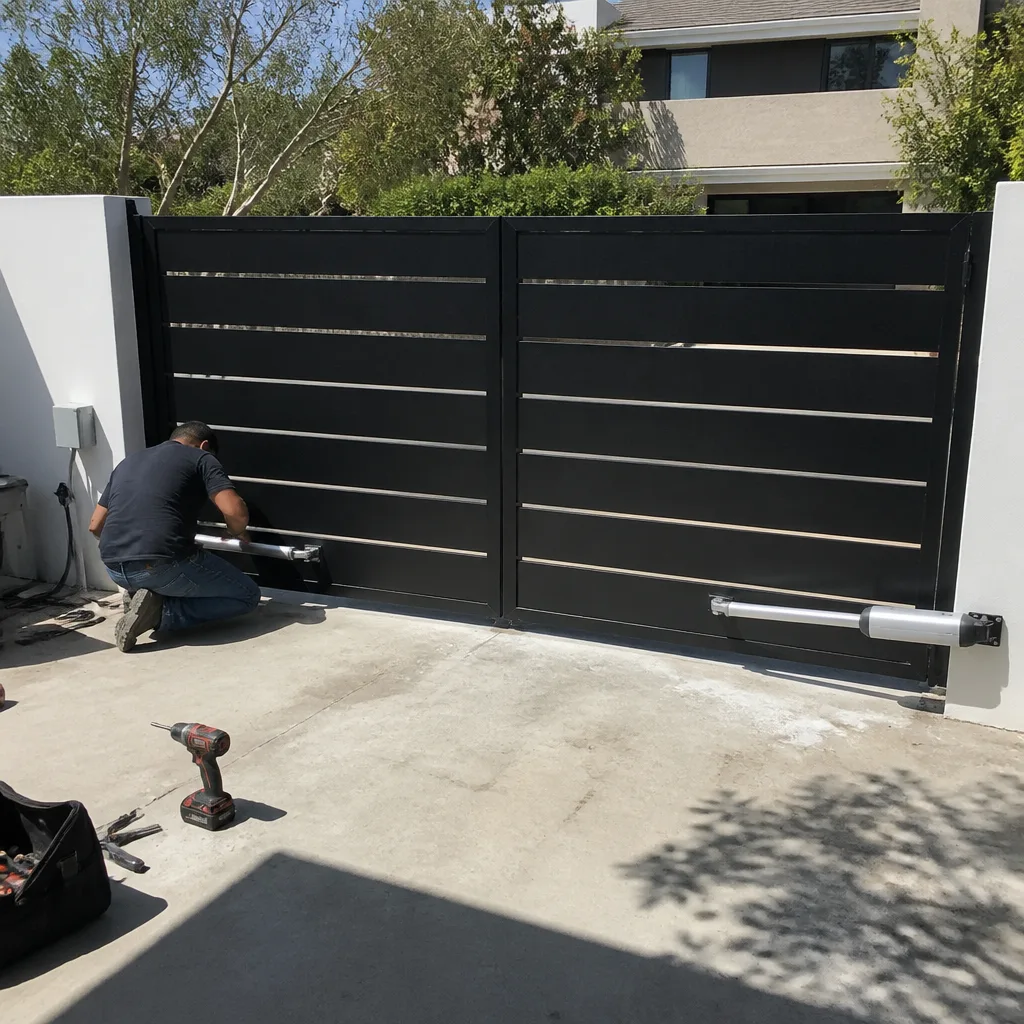 After
AfterGate Repair Troubleshooting: Common Problems and How to Fix Them
Most homeowners in Los Angeles don’t actually have a broken gate motor. They have a hinge that’s been binding for eight months, a wheel that seized up last spring, or a chain that stretched until it started dragging. The motor gets blamed because it’s the part that finally gives up, but the real problem started days or weeks earlier, one component upstream. This guide walks you through the diagnostic chain gate technicians use, so you can find the actual root cause instead of replacing a $400 control board when a $30 hinge is what’s wrong. For professional help, see our Gate Repair services. By the time you finish reading, you’ll know which problems are safe to handle yourself and which ones justify a service call in Los Angeles before the damage compounds.
Quick Answer
Start gate repair troubleshooting by testing the mechanical system first: disengage the operator with the manual release and push the gate by hand. If it’s hard to move, heavy on one side, or catches mid-swing, the problem is mechanical (hinges, wheels, track, rack) not electrical. If the gate moves easily by hand but won’t run under power, you’re looking at an operator, sensor, or electrical fault. This 30-second test eliminates about half of all misdiagnoses and tells you exactly where to look next.
Table of Contents
- The Upstream-Downstream Diagnostic Chain
- The Manual Release Test: A 30-Second Check That Splits the Problem in Half
- Mechanical Failures: Hinges, Wheels, and Track Problems
- Operator Faults: When the Motor Is Actually the Problem
- Fault Codes on LA’s Most Common Operators and What They Actually Mean
- Sensor and Safety-Edge Problems: How to Tell a Hazard Apart from a Nuisance
- Power Supply Issues: What to Check Before You Call Anyone
- What Los Angeles Climate Does to Gates (and Why It Matters)
The Upstream-Downstream Diagnostic Chain
Gate systems are chains of cause and effect. A wheel seizes, which makes the gate drag, which makes the motor work harder, which draws more current, which trips the thermal overload, which stops the gate mid-cycle. If you replace the control board at the end of that chain, you’ve fixed a symptom and left the cause. The gate will run for a few weeks, maybe a few months, then the new board burns out the same way.
We see this pattern in Los Angeles all the time, particularly on older swing gates in the hills where a misaligned hinge on a heavy steel gate slowly cooks an otherwise healthy operator. Learn to spot these issues early in our Gate Repair Warning Signs Every Homeowner Should Know. The diagnostic chain works upstream from the symptom to the source:
- Mechanical components first. Hinges, wheels, rollers, track, rack, chain, and the gate’s physical alignment. These parts carry the gate’s weight and define how much force the motor needs.
- Electrical connections second. Loose terminals, corroded contacts, damaged wire insulation, blown fuses, and failed safety devices. These are the nervous system.
- The operator third. The motor, gear train, control board, and limit settings inside the operator housing. This is the brain and muscle.
- The access controls last. Keypads, remotes, intercoms, vehicle loop detectors, and smartphone modules. They trigger the operator but almost never cause mechanical symptoms.
The rule is simple: if the gate physically doesn’t move properly when you push it, no amount of electronics work will fix it. Trace upstream before you touch the board.
The Manual Release Test: A 30-Second Check That Splits the Problem in Half
Every automatic gate has a manual release mechanism, usually a lever or pull cord on the operator that disconnects the motor from the gate. On sliding gates it’s often a red T-handle. On swing gates it’s typically a release lever on the actuator arm or gearbox. This single test tells you whether you have a mechanical problem or an electrical one before you spend a dime.
How to run the manual release test
- Find the release mechanism on your operator. Look for a red handle, a pull cord, or a lever with “MANUAL” printed near it.
- Disengage the operator so the gate moves freely.
- Push the gate through its full travel by hand, both directions.
- Pay attention to resistance, noise, catching, or lifting.
- Re-engage the operator when you’re done.
Reading the results
- The gate moves smoothly and easily by hand: Your mechanical system is fine. The problem is electrical or in the operator.
- The gate feels heavy, catches, or grinds by hand: You have a mechanical problem. Fix it before running the operator again, because forcing the motor through the same resistance is how operator gearboxes and control boards fail prematurely.
- The gate swings shut on its own or drifts open: The gate is out of level or a hinge has worn, and gravity is now part of the load. This also needs mechanical correction.
This is the first thing any experienced gate technician in Los Angeles does when they step out of the truck, and it’s why a good diagnostic visit starts with a physical inspection, not a laptop plugged into the control board.
Mechanical Failures: Hinges, Wheels, and Track Problems
Mechanical troubles cause more “motor failures” than actual motor failures. Here’s what goes wrong and what it looks like in practice.
Swing gate hinges
A swing gate hangs on hinge points that carry the entire gate weight across decades of daily cycles. In Los Angeles, gates near the coast get salt air corrosion; gates in the Valley cope with dry heat that bakes out lubricant. When a hinge starts to wear, you’ll notice the gate sagging on the free end, scraping the ground, or needing to be lifted to close. The motor then has to overcome the extra friction plus the gate’s weight fighting gravity on a grade. Hinge replacement on a standard residential single swing gate in Los Angeles typically runs $150 to $400 per hinge installed, depending on the gate’s weight and whether jigs need to be made for realignment.
Sliding gate wheels and track
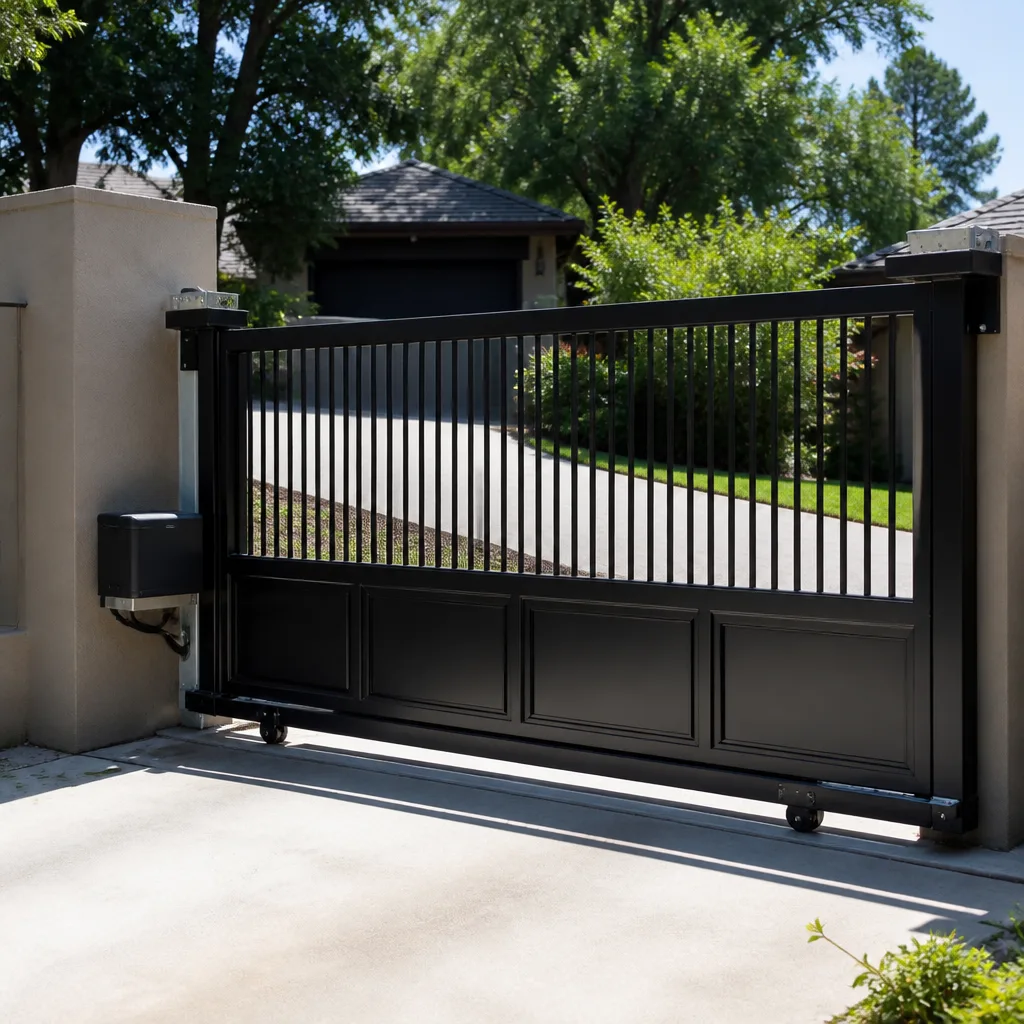
Sliding gates ride on steel wheels along a track. When the wheels wear out, the gate sits lower, the rack and pinion gear fall out of mesh, and the operator makes an awful grinding noise. You might also see the gate “walking” to one side or leaving metal shavings on the track. Replacing a set of four to six wheels runs $80 to $160 per wheel including labor in most of Los Angeles, and the gate usually needs a fresh track section if the old one has worn grooves.
Chain-drive slack
Chain-drive sliding gates use a chain that can stretch over time. A loose chain causes jerky starts and stops and a clanking sound on each cycle. Adjusting chain tension is a $120 to $180 service call in Los Angeles and takes under an hour on most gates. A chain that’s stretched beyond adjustment needs replacement, which typically runs $300 to $600 including parts and labor.
Rack and pinion wear
Rack-drive sliding gates use a steel gear on the operator and a toothed rack bar along the gate. When the rack wears down, the operator pinion spins without moving the gate, or it jumps teeth with a sharp popping sound. This is common on older gates in Los Angeles apartment buildings and neighborhoods like Panorama City or Reseda, where six hundred open-close cycles a month is nothing unusual. Rack replacement runs $40 to $70 per linear foot installed, and most residential gates use ten to sixteen feet of rack.
Operator Faults: When the Motor Is Actually the Problem
Once you’ve confirmed the gate moves freely by hand but won’t operate under power, the operator becomes the focus. A gate operator, or opener, is the motorized unit that drives the gate open and closed. Inside it are a motor, a gearbox, limit switches, and a control board. Failures here fall into a few recognizable categories.
Capacitor failure
The start capacitor gives the motor its initial kick. When it fails, the motor hums but doesn’t turn, or starts weakly and trips a breaker. Capacitors are cheap, usually $25 to $60 for the part, and a repair call to swap one in Los Angeles runs $180 to $300 total. But a capacitor that fails repeatedly points to an underlying problem: a gate that’s too hard to move, making the motor strain on every start.
Gearbox wear
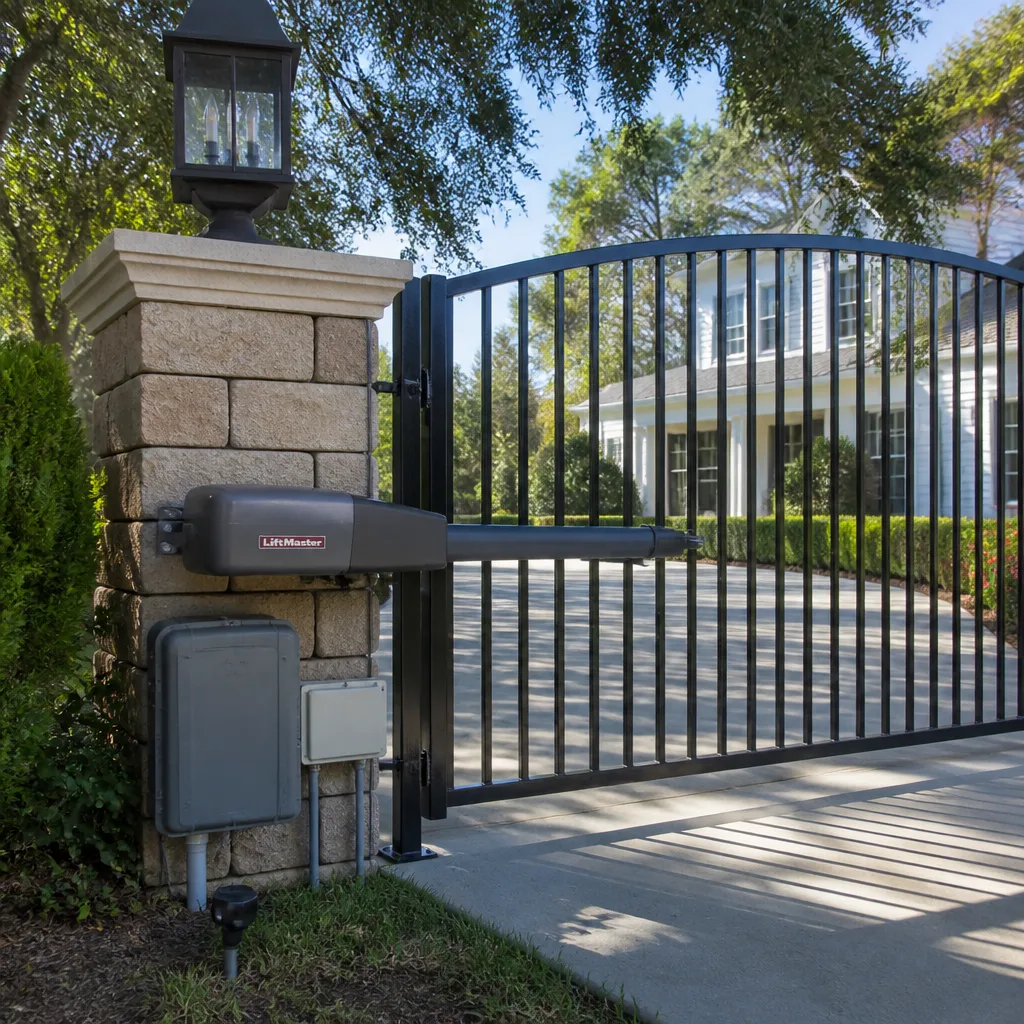
Operator gearboxes strip when the motor fights a mechanical problem for too long. You’ll hear a grinding or clicking from inside the operator, and the gate may move partway and stop. A gearbox rebuild for a common LiftMaster or FAAC operator runs $350 to $700 parts and labor in Los Angeles. A full operator replacement runs $1,500 to $3,800 installed for residential gates, more for heavy commercial units.
Limit switch failure
Limit switches tell the operator where the gate is in its travel. When they fail, the gate stops short, crashes into the open or closed stop, or reverses randomly. Adjusting limit switches is a $120 to $180 service call. Replacing the limit assembly runs $220 to $400 depending on the operator brand.
Control board failure
Control boards fail from power surges, moisture, insect damage, and heat. When the board goes, the gate may stop responding entirely, act erratically, or trip its internal fuse repeatedly. A replacement board for a linear or swing gate operator runs $250 to $700 installed in Los Angeles, which is why the manual release test matters: if you replace a board without fixing the mechanical problem that burned it out, you’ll replace it again inside a year.
Fault Codes on LA’s Most Common Operators and What They Actually Mean
If your gate operator has a digital display or a blinking LED, it’s telling you what’s wrong. Here are the fault codes we see most often on the operators Los Angeles homes actually have, decoded into plain language.
LiftMaster and LiftMaster-based slide operators (models like the SL3000, LA400)
- Blinking red light, 3 flashes: The operator detected an obstruction or the gate hit something. Check the track for debris and the wheels for binding.
- Blinking red light, 4 flashes: Photo eye misaligned or blocked. Clean the lenses, check the alignment, and clear anything in the light path.
- Blinking red light, 5 flashes: The operator hit its force setting too early. This is the code that says “gate is hard to move,” and it’s the one most often wrongly blamed on a bad board.
DoorKing slide and swing operators
- Display showing “ERR 1”: The operator sensed an obstruction during travel. The fix is usually mechanical: a wheel, a hinge, or something on the track.
- Display showing “ERR 2”: The safety loop or photo beam triggered and wouldn’t clear. Check the photo beam alignment and anything metallic near the loop detector.
- Display showing “ERR 3”: The motor ran too long without reaching its limit, often meaning the chain broke or the gate came off its track.
FAAC swing operators
- Rapid flashing of the status LED after a stop: The operator hit its obstruction detection. Check the hinges and the movement of the gate by hand before resetting.
- LED not lit at all: No power to the board. Check the circuit breaker, the GFCI, and the power switch on the operator.
These codes are useful, but they describe the symptom, not the cause. After a fault code, always run the manual release test before replacing anything.
Sensor and Safety-Edge Problems: How to Tell a Hazard Apart from a Nuisance
Automatic gates are required by code in Los Angeles to have entrapment protection: photo eyes that watch the gate path, safety edges that stop the gate on contact, or both. These systems prevent the gate from closing on a person, a pet, or a car. When they malfunction, the symptoms fall into two serious categories.
The gate reverses every time
A gate that reverses halfway open is almost never a sensor board problem. It’s usually mechanical: a hinge binding mid-swing forces the motor to hit its torque limit, and the operator interprets that as an obstruction. Replacing the sensor board, as many homeowners do first, wastes around $200 to $500 in Los Angeles and leaves the real problem untouched. Run the manual release test. If the gate is hard to move by hand at the point where it reverses, the hinges are your problem.
The gate won’t close at all
A gate that opens fine but refuses to close usually has a photo eye issue. The beams are misaligned, the lenses are dirty, or something is in the light path. On some older Los Angeles houses, incompatible photo eye systems from prior retrofits create this exact symptom. Adjusting or cleaning photo eyes is a $120 to $170 call. Replacing a pair runs $200 to $350.
The gate doesn’t stop on contact
If the gate touches something and keeps pushing, the safety edge is dead or the operator’s force settings are too high. This is a genuine safety hazard, not a nuisance. A gate that won’t stop on contact can injure a child or pet, and it violates the entrapment protection requirements in the Los Angeles building code. Shut the gate off at the breaker and call a professional before running it again.
Safety note: These systems exist to prevent crush injuries. Bypassing a photo eye, jumping a safety edge, or cranking the force up to “make the gate work” is not a repair. It’s creating a hazard that can injure someone on your property, and if you ever sell the house, it’s a liability that follows the gate to the next owner.
Power Supply Issues: What to Check Before You Call Anyone
Before calling a gate repair company in Los Angeles, spend five minutes checking the power path. A surprising number of “dead gate” calls turn out to be a tripped GFCI or a switched-off breaker, and no technician visit is needed.
- Check the outlet or circuit breaker. Gate operators are frequently on a dedicated circuit. If the breaker tripped, reset it once and see if it holds.
- Check the GFCI. Many Los Angeles gate installations run through a GFCI outlet. A tripped GFCI cuts power to the operator while leaving the rest of the house fine. Press the reset button.
- Check the operator’s power switch. Most operators have a rocker switch or disconnect on the housing. A good bump or an overenthusiastic leaf blower can knock it off.
- Check for a battery backup. Some operators run on DC with a battery. If the battery is dead, the gate won’t move even though incoming power is fine. Battery replacement on a residential operator runs $150 to $400 in Los Angeles.
- Check for wire damage. Exposed wires at the hinge point of a swing gate flex every cycle and eventually crack inside the insulation. This causes intermittent failures that are notoriously hard to diagnose without a meter.
If all five checks come back clean and the gate still won’t run, you’re looking at a component failure inside the operator or a control wiring problem. That’s the point where a pro with a multimeter pays for the service call.
What Los Angeles Climate Does to Gates (and Why It Matters)
Gates age differently in Los Angeles than they do elsewhere. Understanding how the local environment affects the hardware changes how you troubleshoot the symptoms.
In beach communities like Venice, Playa del Rey, and San Pedro, the salt air accelerates corrosion on exposed steel: hinges, tracks, chains, and control board contacts all rust faster than they would inland. A gate that’s only six years old can look twelve. Corroded limit switches and rusted capacitor terminals are common failure points we see on coastal L.A. gates, and a gate operator that works flawlessly in Burbank may fail within a few years a mile from the water.
In the San Fernando Valley, where summer temperatures regularly pass 100 degrees, control boards bake inside metal operator housings. Electronic components degrade with heat, and an operator installed in full sun on a west-facing wall in Woodland Hills or Tarzana will have a shorter control board life than the same model in a shaded carport. Capacitors also fail more readily in heat, which is why Valley gate service calls spike in August and September.
In hillside neighborhoods from Silver Lake to Mount Washington, gates often sit on slopes. A gate installed on a grade fights gravity on every cycle. The operator works harder opening uphill than closing downhill, which creates asymmetric wear and unusual fault code patterns. Gates on slopes need their hinges, wheels, and force settings checked more often than gates on flat lots, and the manual release test on a sloped gate will often reveal a gate that wants to roll or swing on its own.
None of these conditions are your gate’s fault. They’re what the gate lives with in this city, and they mean a troubleshooting guide written for Arizona or Ohio doesn’t quite apply here. Los Angeles gates need diagnosis with local conditions in mind.
Common Mistakes to Avoid
- Replacing the control board before checking the mechanical system. A burned board is rarely the root cause. If the gate binds, the new board will fail the same way. Run the manual release test first.
- Lubricating a gate to fix a grinding noise. Grease quiets a binding hinge for a week and makes a mess of the track. If the gate grinds, something is wearing or misaligned. Lubricant hides the symptom.
- Adjusting force settings to “fix” a gate that stops mid-cycle. Crank up the force and the gate will power through the obstruction, until the motor burns out or the gate damages itself. Force settings are safety parameters, not a repair tool.
- Ignoring a sagging gate because it “still works.” A sagging gate is telling you the hinges are failing. By the time it stops working, the repairs will include the hinges, the operator, and usually the gate frame.
- Bypassing photo eyes or safety edges because they’re “annoying.” In Los Angeles, entrapment protection is a code requirement and a safety necessity. Disabling it is not a repair.
- Welding a cracked gate frame without checking what caused the crack. Gate frames crack from fatigue, usually because something else in the system is binding. Weld the crack and the same stress will crack it again, often worse.
- Calling for an operator replacement when the gate simply needs hinge work. In our experience in Los Angeles, a notable share of “dead operator” calls turn out to be hinge failures that a trained eye catches in the first five minutes. The operator was never the problem.
When to Call a Professional
Some gate problems are safe to diagnose yourself, and some are not. Call a professional when the gate is heavy and off its hinges, when the operator makes grinding noises from inside the gearbox, when the gate continues moving after contact, when you’ve replaced a part and the same symptom returns within weeks, or when you’re not comfortable working with the electrical side of the system. High-tension chains, heavy gate panels, and line-voltage wiring are not worth the risk of injury on a DIY attempt. Portcullis Gate Repair offers free estimates in Los Angeles, and every job gets a written price before any work starts. Call (940) 412-7340 and someone will answer, day or night.
Frequently Asked Questions
A gate that reverses halfway open usually means the operator hit its torque limit because the gate is binding on a worn hinge, a bad wheel, or a misaligned track. The manual release test will confirm it: if the gate is hard to push by hand at the point where it reverses, the problem is mechanical. Fix the mechanical issue first, and the reversal usually clears without any electronics work.
Gate repair in Los Angeles typically runs $150 to $300 for a standard service call and minor adjustment, $300 to $700 for hinge or wheel work on a residential gate, and $1,500 to $3,800 for a full operator replacement. The price varies by gate type, weight, and the specific components involved. A free estimate with a written price is the way to know your number before committing.
For mechanical repairs like hinge replacement, wheel swaps, and chain adjustments, same-day service is often possible in Los Angeles. Operator replacements and custom gate fabrication work take longer and are scheduled. Call us at (940) 412-7340 and we’ll give you a real arrival window, not a four-hour guess.
No. A grinding noise means metal is wearing against metal somewhere in the system, and every cycle is making it worse. A gate that grinds today will fail completely at some point, and the longer you run it, the more parts it takes down with it. A $30 hinge repair is much cheaper than a $700 gearbox rebuild.
A gate that opens but won’t close is usually a photo eye problem: the beams are misaligned, dirty, or blocked. It can also mean the safety edge is damaged and sending a constant “stop” signal. Check the photo eye lenses and alignment first, and if the problem persists, a service call is the next step.
We service LiftMaster, FAAC, BFT, and Linear operators, along with most other major residential and commercial gate brands. Our technicians train across the common boards and error codes for each system, so the person who arrives understands your specific operator before they touch it. Electric Gate Repair in Los Angeles is our core service, and every visit starts with the same mechanical-first diagnostic process.
The Bottom Line
Gate repair troubleshooting starts with one rule: check the mechanical system before anything electronic. The manual release test splits every gate problem into mechanical or electrical in thirty seconds, and it saves homeowners from replacing control boards, sensors, and capacitors that were never the problem. Hinges, wheels, track, and rack wear out with time and Los Angeles conditions, and when they go, the operator suffers. If the gate moves freely by hand but won’t run under power, look at the operator, the sensors, and the power supply. And if you’re at all unsure, a written price and a real diagnostic from someone who does this daily beats another weekend of guessing. For more guides & resources, explore our blog.
Go back to the Portcullis Gate Repair home page, or see our Gate Repair in Los Angeles and Gate Installation in Los Angeles service pages for more detail on what we do and what it costs.
Written by Dean Prescott, Owner at Portcullis Gate Repair, serving Los Angeles since 2008.