
Last updated October 8, 2026
Free on-site gate assessment - hinges, posts, and your LiftMaster or Nice gate operator checked before anything is quoted
The assessment is free and the quote is the invoice.
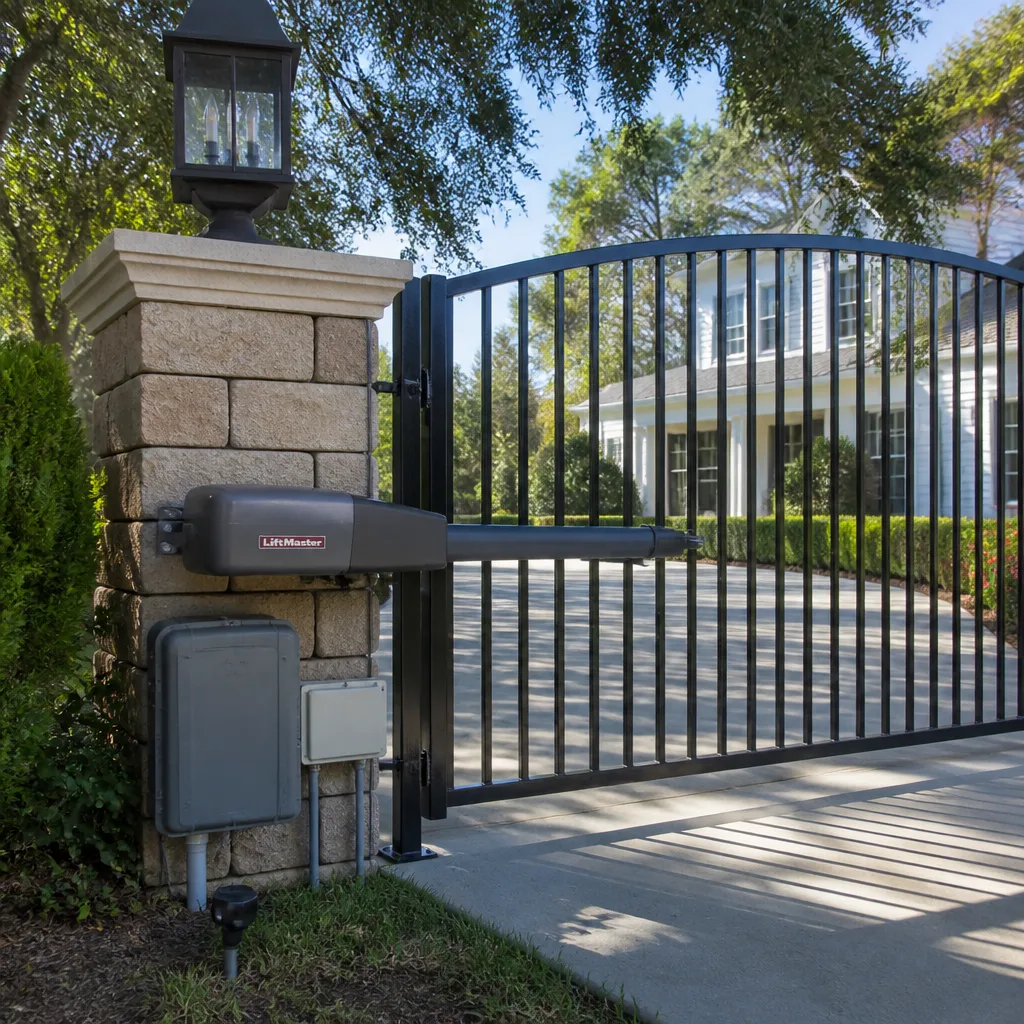
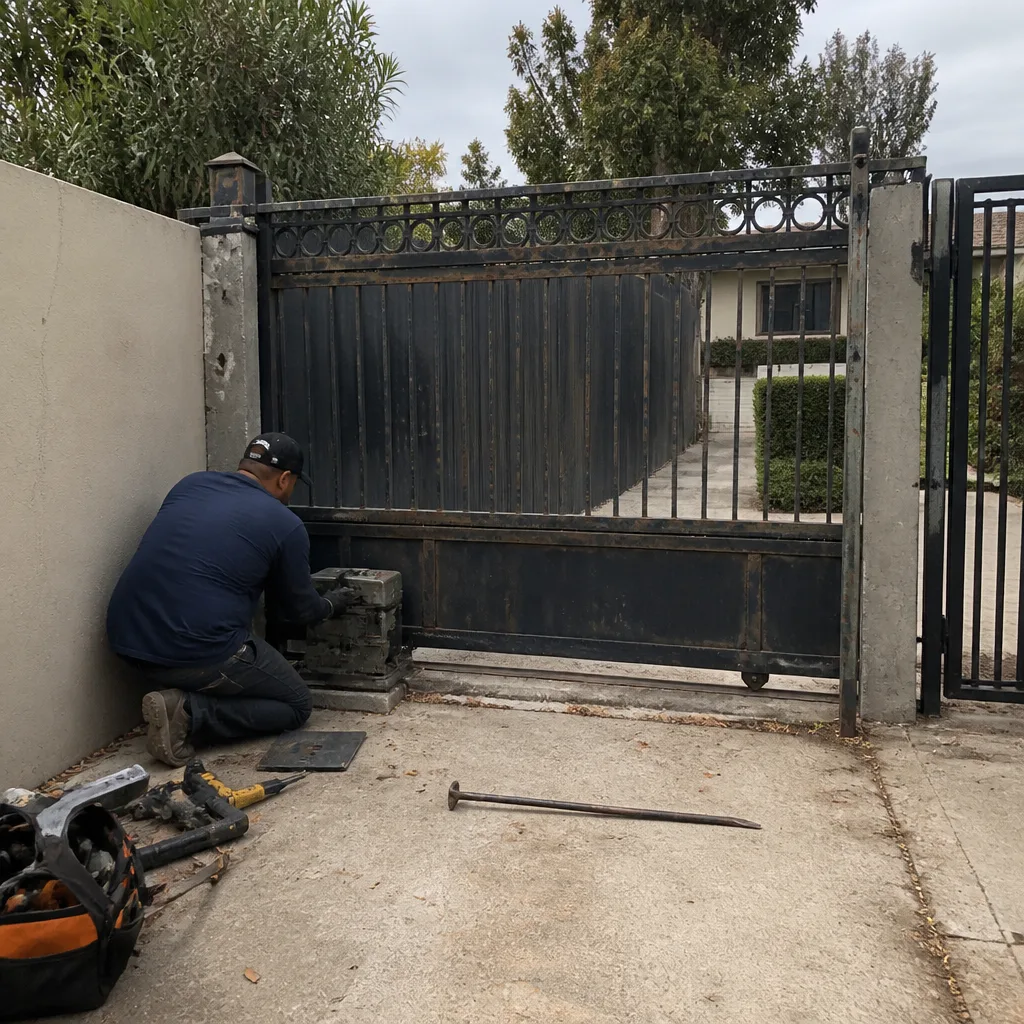 Before
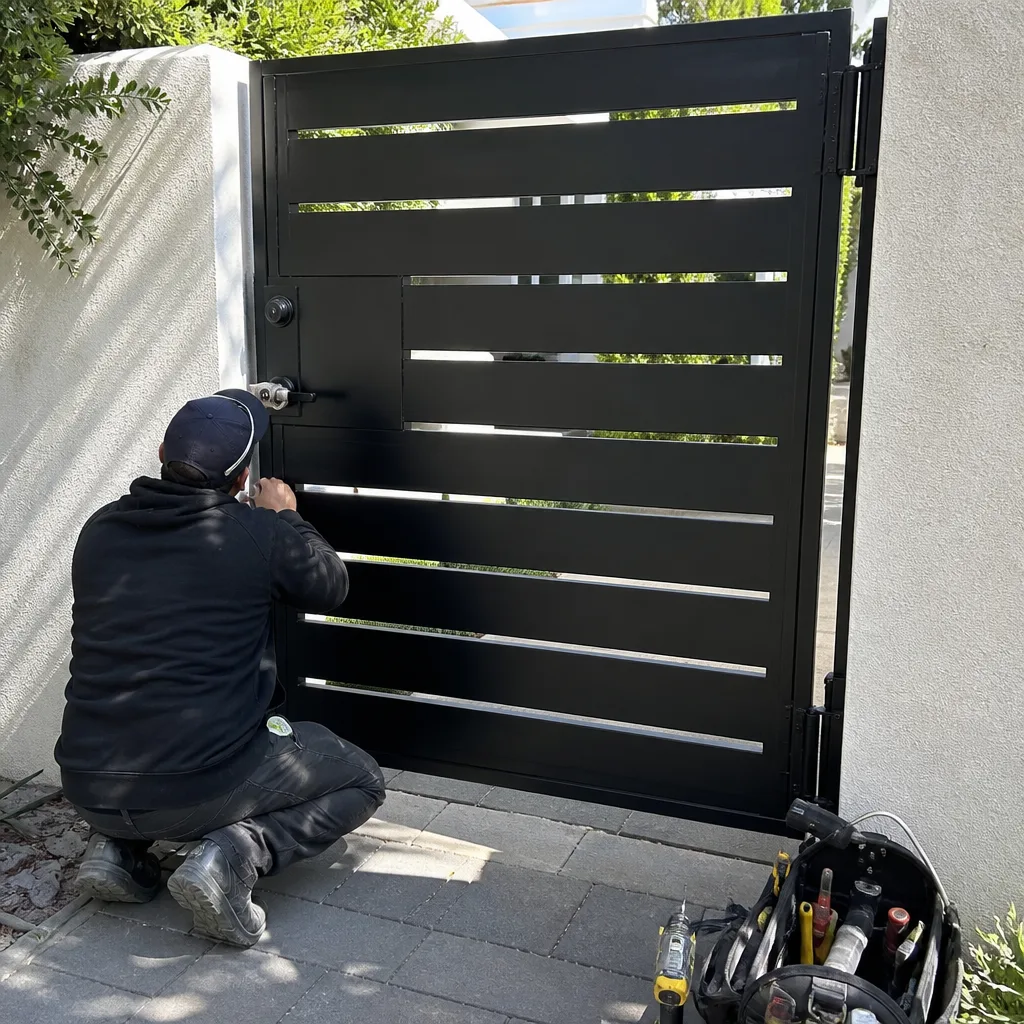 After
After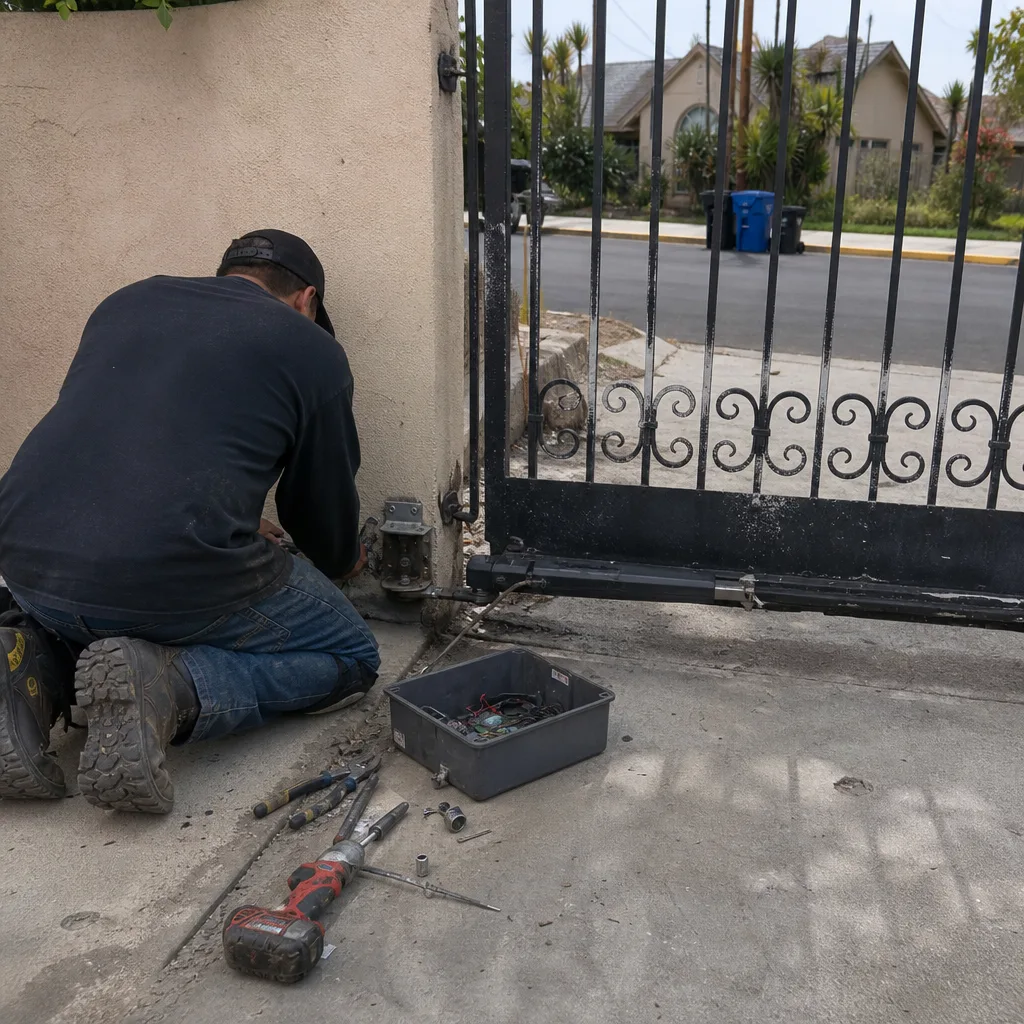 Before
 After
After Before
 After
AfterSeasonal Gate Repair Care for Los Angeles: Year-Round Homeowner’s Guide
January in Los Angeles is harder on gates than July, and that catches a lot of homeowners off guard. Not because of rain volume, but because gates that sat dry and untouched through a hot summer seize up, crack, and short-circuit the moment the first real rain soaks components that haven’t been serviced in months. This guide reframes Los Angeles climate into a gate-care rhythm that works: four distinct stress periods, each with its own checklist and each tied to the weather patterns we actually live with. You’ll learn what to do before the first rain, what to inspect after a Santa Ana wind event, why inland valley heat behaves differently than coastal heat, and when to spend money on prevention rather than emergency calls.
Quick Answer
Seasonal gate maintenance in Los Angeles means working with four stress periods, not four calendar seasons: pre-rain prep in October through November, wet-season response from December through February, Santa Ana wind and brushfire season in September and October, and summer heat-expansion management from June through August. Spring is the right time for a full tune-up in LA, not fall. A basic seasonal inspection costs about $95-$180, while a full tune-up with adjustments and lubrication typically runs $150-$300, and catching problems early almost always costs less than an emergency our Gate Repair services call after a failure.
Table of Contents
- The Real LA Gate Calendar: It’s Not Four Seasons
- Pre-Rain Season Prep: October to November
- Wet-Season Response: December to February
- Santa Ana Wind and Brushfire Season: September to October
- Summer Heat-Expansion Management: June to August
- Why Spring Is the Right Time for a Full Gate Tune-Up in LA
- Common Mistakes to Avoid
- When to Call a Professional
- Frequently Asked Questions
- The Bottom Line
The Real LA Gate Calendar: It’s Not Four Seasons
Most national gate-maintenance guides are written for places with frost, snow, and a dormant season. Los Angeles doesn’t have that. What we have is a Mediterranean climate with wet winters, dry summers, and a wind pattern that shows up every year like clockwork. If you follow a national guide that tells you to winterize in November and tune up in April, you’ll be working against the actual conditions your gate faces.
Here’s the Los Angeles gate-care rhythm we’ve refined over years of service calls across the basin, from the Westside to the San Fernando Valley to the foothill communities:
- September to October: Santa Ana wind and brushfire season. Gates get blasted with dry, hot wind that carries grit and fine ash. This is when hinges wear unevenly and operator housings get packed with debris.
- October to November: Pre-rain prep. The window between fire season and the first significant rain is your opportunity to seal, lubricate, and test everything before water becomes a factor.
- December to February: Wet-season response. This is when we get the most emergency calls in Los Angeles: water intrusion into operator housings, rusted limit switches, dead battery backups that finally reveal themselves during a power outage.
- March to May: The full tune-up window. The ground is still soft enough to reveal drainage problems, but the worst rain has passed. This is the moment to spend money on prevention.
- June to August: Heat-expansion management. Gates in the San Fernando Valley and inland areas can see daily temperature swings of 35 degrees or more, and that thermal cycling physically moves steel and aluminum.
We’ve written this guide for Los Angeles homeowners specifically. If you own a driveway gate, a pedestrian gate, or an electric gate system in Los Angeles, this is the maintenance rhythm that prevents the calls you don’t want to make.
Pre-Rain Season Prep: October to November
The single most important maintenance window in Los Angeles runs from mid-October through late November. This is the stretch between the last Santa Ana event and the first significant rain. It’s short, and if you miss it, you’ll be one of the people calling us in December because water got into a housing that should have been sealed in October.
The Pre-Rain Checklist
- Inspect drainage around gate posts. Walk the gate track and post area after a light rain or with a hose. If water pools around the base of a post, you have a drainage problem that will compound over the winter. Water that sits around a steel post expands and contracts with temperature, working the post loose over time. In Los Angeles, many posts are set in decomposed granite, which handles drainage differently than the clay-heavy soils in other parts of the state. A post that wobbles in January was probably loose in October.
- Test the battery backup. If your gate operator has a battery backup, unplug the operator from wall power and run the gate through a full cycle. Most residential operators use a 12V or 24V sealed lead-acid battery that degrades silently over 2 to 4 years. The first power outage of the Los Angeles rainy season is when most homeowners discover their battery died two years ago. Replace batteries that fail a load test before the rain arrives.
- Weatherproof operator housings. Check the gasket around the operator cover. On many LiftMaster and BFT residential operators, the gasket shrinks or cracks after a few years of LA sun. A cracked gasket is an open invitation for the first December rain. Replace the gasket or apply a weather-resistant sealant rated for outdoor electronics enclosures.
- Lubricate hinges, rollers, and the actuator arm. Use a dry-film or lithium-based lubricant rated for outdoor use. Avoid WD-40 as anything other than a cleaner. The actuator, the motorized arm that physically pushes the gate open, has pivot points that seize when rain washes away the lubricant and introduces corrosion. This is the number-one reason swing-gate actuators fail in wet Los Angeles winters.
- Check photo-eye sensors and safety edges. Wipe the photo-eye lenses clean and verify the gate reverses when an object blocks the beam. Rain and wind-blown debris reduce sensor reliability, and a gate that won’t reverse under load is a safety and liability issue, not just an inconvenience.
Expect to spend about $95-$180 for a seasonal inspection in Los Angeles, and another $40-$90 if lubrication and minor adjustments are included. Compared to $250-$600 for an emergency call in the rain, pre-rain prep is the cheapest insurance available. For more guides & resources, see our blog.
Wet-Season Response: December to February
Los Angeles rainfall is famously inconsistent. Some winters bring 20 inches concentrated in three or four storm events. Others bring 6 inches spread across months. Either pattern creates the same failure modes: water intrusion, corrosion, and electrical faults. The difference is timing. In a storm-heavy year, every gate in the neighborhood tends to fail in the same 72-hour window, which is why we answer calls around the clock during wet season.
What Actually Fails in Los Angeles Rain
- Limit switches. On electromechanical operators from brands like Mighty Mule and Linear, the limit switch tells the operator where to stop. Moisture corrodes the switch contacts, and the gate either doesn’t fully close or slams past its stop point. A rusted limit switch is not a catastrophic failure, but it often presents as one.
- Control boards. The control board is the brain of the operator. When water wicks along a wire into the housing and reaches the board, corrosion follows. Repairing water damage on a control board is hit-or-miss. Often the cleaner fix is a board replacement, which on residential operators runs $200-$450 parts and labor.
- Actuator seals. On swing-gate operators from FAAC and BFT, the actuator is a sealed hydraulic or electromechanical unit. But seals age, especially after several years of Los Angeles UV exposure. A failed seal lets water into the actuator, and that’s when you get a gate that drifts, operates slowly, or doesn’t move at all.
- Battery backups. The first storm that knocks out power is the test. A dead battery backup means your gate is locked in place during the outage. Replace batteries that are more than 3 years old regardless of how they test; the cost of a new battery ($60-$150) is less than a service call to diagnose a dead one.
If your gate fails during a storm, you can do a visual inspection safely from inside the property: check for standing water around posts, look for water inside the operator housing, and listen for unusual sounds when the gate moves. High-voltage components inside the operator, especially the capacitor, carry enough current to injure or kill. Do not open an operator housing and probe around with a screwdriver. That is not a DIY step; call a trained professional.
Portcullis Gate Repair is an independently owned Kingswell company serving Los Angeles, and every repair includes a written price before any work begins. You’ll know the cost before a technician touches a single bolt.
Santa Ana Wind and Brushfire Season: September to October
Los Angeles homeowners associate Santa Ana winds with brushfire risk, and rightly so. But the winds also cause a specific pattern of gate failures that we see every year, usually in the weeks after the first big blow. The winds hit from the northeast, channeled through passes and canyons, and they carry fine particulates that work into every moving joint on a gate.
What Santa Ana Winds Do to Gates
- Hinge wear accelerates. A gate that weighs 300 to 600 pounds puts constant load on its hinges. Add gusting wind that pushes and pulls the gate against that load, and you get accelerated wear in one specific direction. The result is a gate that sags, scrapes the ground or the track, and eventually binds the operator.
- Latch hardware loosens. On double driveway gates, the center latch takes the brunt of wind stress. Bolts back out, the latch plate shifts, and the gate stops closing cleanly. This is a 30-minute fix if caught early, and a broken latch post if ignored.
- Overhead arm operators bind. Overhead arm operators are rare in Los Angeles compared to swing and slide gates, but they exist on older properties. Wind load twists the arm slightly, and the operator has to work harder to move the gate. Left uncorrected, the gearbox wears prematurely.
- Fine ash and grit work into chains and tracks. During active brushfire season, gates in areas like the foothills of the San Gabriel Valley collect fine ash that mixes with lubricant to create an abrasive paste. That paste acts like sandpaper on sprockets and rollers.
After every significant Santa Ana event, do a visual walk-around: check the gate’s range of motion, look at hinge bolts, test the latch, and listen for grinding. Catching a loose bolt takes 10 minutes and a wrench. Catching a fractured hinge takes a welder and a service call.
Summer Heat-Expansion Management: June to August
Coastal Los Angeles fairly benign in summer: marine layer, afternoon breeze, rarely over 85 degrees at the beach. Inland is different. The San Fernando Valley, the San Gabriel Valley, and the Inland Empire regularly see summer days at 100 degrees or higher, followed by overnight lows in the 60s. That swing of 35 to 45 degrees in a single day is a physical stress cycle for every steel and aluminum component on a gate.
How Thermal Expansion Racks Gate Frames
Steel expands roughly 0.0000065 inches per inch per degree Fahrenheit. Over a 10-foot gate frame in a 40-degree daily swing, that’s about 0.03 inches of dimensional change each day. It sounds tiny, but it’s enough to bind a gate that was set tight in cooler months. Aluminum expands at about twice that rate. When a gate frame racks, meaning it twists slightly out of square, the operator has to push against the bind. That’s when you hear grinding, see the gate hesitate mid-cycle, or notice the operator tripping its force-limiter and reversing unexpectedly.
The specific adjustment that fixes most summer binding is hinge alignment and gate-frame rack correction, not operator replacement. In most cases, we loosen the hinge bolts, realign the gate to square, and check the track or actuator geometry before tightening everything back down. It’s a $150-$300 adjustment. Replacing an operator that was destroyed by running against a bound gate for a full summer runs $800-$1,800.
Summer-Specific Maintenance
- Check gate alignment every June. A gate that moves freely by hand is aligned. A gate that requires force to move off its stops is binding.
- Lubricate more frequently in inland valleys. Heat thins lubricant, causing it to drip or evaporate off. Reapply every 6 to 8 weeks during summer in the Valley.
- Inspect wiring insulation. The Los Angeles sun tears through PVC insulation faster than people expect. Exposed wires inside the operator housing or at the gate’s edge should be inspected for cracking every summer. Cracked insulation eventually leads to short circuits.
Why Spring Is the Right Time for a Full Gate Tune-Up in LA
National guides tell homeowners to do a full tune-up in fall, before winter. In Los Angeles, that’s backwards. Fall is when you do pre-rain prep, which is a subset of maintenance: drainage, sealing, and battery testing. Spring is the moment for the full gate tune-up because the ground has settled, the rain has exposed every drainage weakness, and the heat expansion cycle hasn’t started yet.
What a Spring Tune-Up Includes
- Post-to-ground inspection. Winter rain settles soil, and posts that were slightly loose in December are visibly loose by March. We check for movement, rust at the base, and water staining that indicates drainage problems.
- Full mechanical inspection. Hinges, rollers, track, actuator pivot points, and the latch assembly get inspected for wear and realigned where needed.
- Operator diagnostic. We test force settings, run the gate through full cycles, check the limit switch operation, and confirm photo-eye and safety-edge function. On operators from brands like LiftMaster and Ghost Controls, we also check for firmware-relevant settings and error codes.
- Wiring and connection check. Loose connections cause intermittent failures. We check every terminal block, wire nut, and splice accessible in the operator housing and along the gate.
- Lubrication with the correct products. Dry-film lubricant on pivot points, lithium grease on chains if applicable, and dielectric grease on electrical connections exposed to weather.
A spring tune-up in Los Angeles runs $150-$300 for a single residential gate. That’s roughly 20% of the cost of an emergency actuator replacement when the summer heat binds the gate and burns out the motor. If you’re not sure when your gate was last serviced, spring is the right answer. The team at Portcullis Gate Repair for Los Angeles gate repair performs tune-ups across the city, and every job includes a written price quote before work starts.
Common Mistakes to Avoid
- Following a national-season maintenance calendar. Los Angeles doesn’t have a dormant season. If you wait until April to wake your gate up from winter, you’ve already missed the pre-rain window that accounts for most emergency failures.
- Testing the battery backup during fair weather only. Batteries fail under load, and the first real storm of the season is the test. Test batteries in October with a load test, not a voltage check alone.
- Ignoring a gate that’s “a little noisy.” A grinding or squealing gate is not cosmetic. That sound is metal-on-metal wear, and the part that’s making the noise is the part you’ll replace if you wait.
- Lubricating with the wrong product. WD-40 is a water displacement product, not a lubricant. Using it on gate hinges strips away the real lubricant and accelerates wear. Use a dry-film or lithium-based outdoor lubricant.
- Skipping the center latch check on double gates. The center latch keeps the two gate leaves aligned under wind load. A loose latch allows the gates to rack, and a racked gate destroys the operator over time.
- Waiting until the gate fails to call. In Los Angeles, a gate repair call in the middle of a storm costs more and takes longer than the same repair on a dry spring day. The price difference isn’t because anyone’s gouging; it’s because emergency calls involve wet equipment, downed power lines, and a backlog of neighbors with the same problem.
- Opening an operator housing without training. The capacitor inside a gate operator stores enough charge to injure or kill even when the unit is unplugged. This is not a DIY inspection point. Call a professional for anything inside the housing.
When to Call a Professional
You can handle visual inspections, lubrication, and battery testing yourself if you’re comfortable with basic tools and you stay away from the inside of the operator housing. But call a professional when you see any of these: the gate hesitates or reverses mid-cycle, the actuator arm leaks fluid, the gate sags visibly on its hinges, the operator trips its breaker repeatedly, the photo-eyes won’t stay aligned, or the gate made a loud noise and then stopped working entirely. These are not maintenance items. Portcullis Gate Repair offers free estimates in Los Angeles. Call (940) 412-7340 and a live person will answer, any hour, any day.
Frequently Asked Questions
Seasonal gate maintenance in Los Angeles typically costs $95-$180 for a visual inspection with basic lubrication and adjustments, and $150-$300 for a full tune-up that includes operator diagnostics, alignment, and comprehensive lubrication. The price you’re quoted is the price you pay. At Portcullis Gate Repair, you receive a written price before any work starts, and that’s the final price. Call (940) 412-7340 for an exact quote; estimates are free.
Service your gate twice a year in Los Angeles: a pre-rain inspection in October and a full tune-up in March or April. The pre-rain visit focuses on drainage, battery backup testing, and weatherproofing. The spring tune-up covers alignment, operator diagnostics, and comprehensive lubrication before summer heat begins.
A full gate tune-up includes post-to-ground inspection, hinge and roller alignment, actuator pivot-point inspection and lubrication, operator diagnostics with force-setting adjustment, photo-eye and safety-edge testing, wiring connection checks, and lubrication with the appropriate outdoor products. On a residential swing or slide gate in Los Angeles, plan on 60 to 90 minutes of labor.
Yes. Power outages in the Los Angeles rainy season are common, and gates with dead battery backups fail during them. Portcullis Gate Repair answers calls with a live person 24 hours a day, 7 days a week, including during outages. If your gate is stuck after a power loss, call (940) 412-7340 and we’ll get someone dispatched.
Local Los Angeles companies understand the specific challenges of this climate: Santa Ana winds, inland valley heat, coastal marine air, and the specific soil conditions under our gate posts. National franchise operations use the same playbook in Los Angeles as they do in Phoenix or Denver. For local expertise, read Choosing the Right Gate Repair Brand: A Buyer’s Guide for Los Angeles. Portcullis Gate Repair is an independently owned Kingswell location in Los Angeles, and every repair carries the written 365-Day Done Right Promise: if the repair fails within 365 days, we return and fix it at no charge.
Yes, we install and service residential and commercial gate systems across Los Angeles. Our technicians are trained on nine major gate-operator brands: LiftMaster, FAAC, BFT, Linear, Viking, Ghost Controls, DoorKing, Elite, and Mighty Mule. For gate installation in Los Angeles, we provide a free measure and a written price before any work begins. Call (940) 412-7340 to schedule.
The Bottom Line
Los Angeles gates don’t follow a national maintenance calendar. They follow the four stress periods this guide walks through: pre-rain prep in October, wet-season response in December through February, Santa Ana wind season in September and October, and summer heat expansion from June through August. Spending $150-$300 on a spring tune-up and $95-$180 on a pre-rain inspection protects you from the $600-$1,800 emergency calls that follow the first rain and the first heat wave. At Portcullis Gate Repair, every visit includes a written price before work starts, and every repair carries the written Kingswell Guarantee, the 365-Day Done Right Promise. We’ve been serving Los Angeles since 2008. You can reach a live person at (940) 412-7340 any hour, any day. The Portcullis Gate Repair home page has more on the Kingswell Way and what to expect from your first call.
Written by Dean Prescott, Owner at Portcullis Gate Repair, serving Los Angeles since 2008.