
Last updated October 8, 2026
Free on-site gate assessment - hinges, posts, and your LiftMaster or Nice gate operator checked before anything is quoted
The assessment is free and the quote is the invoice.
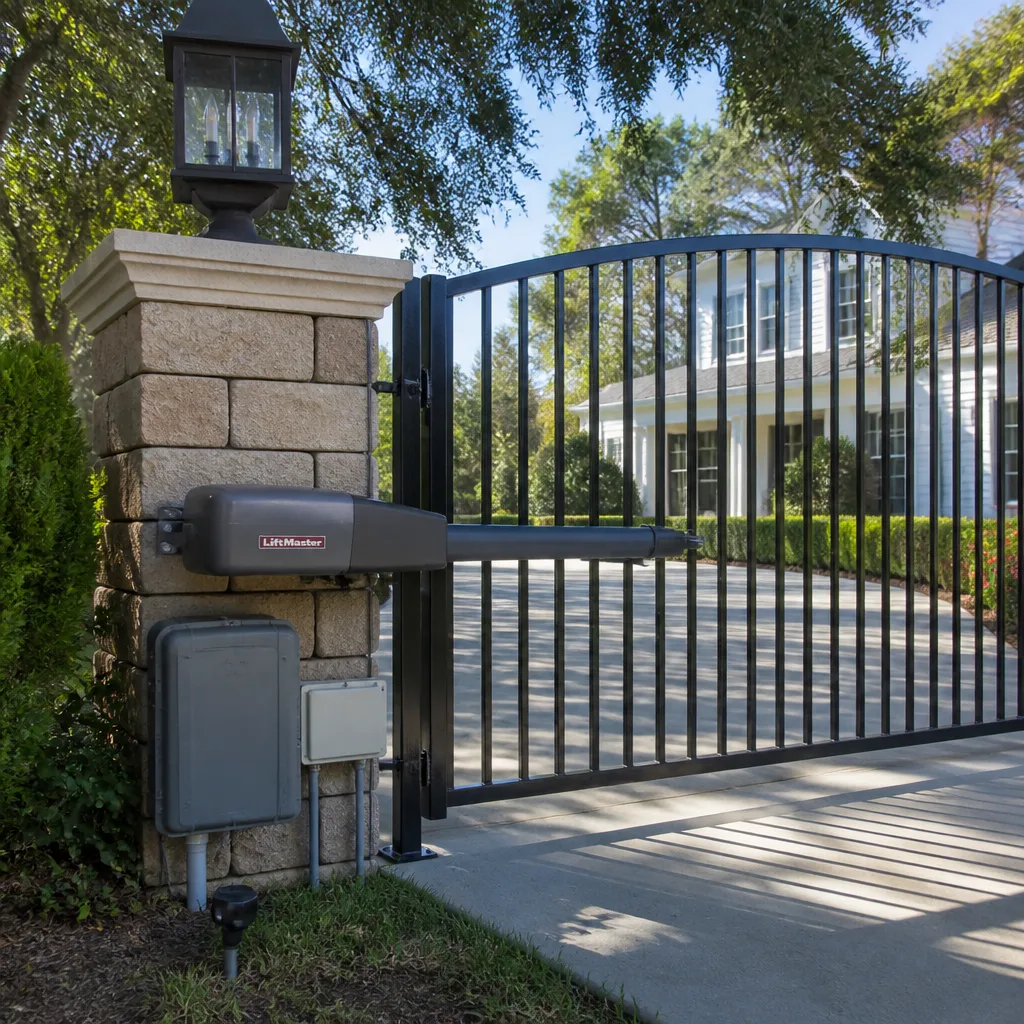
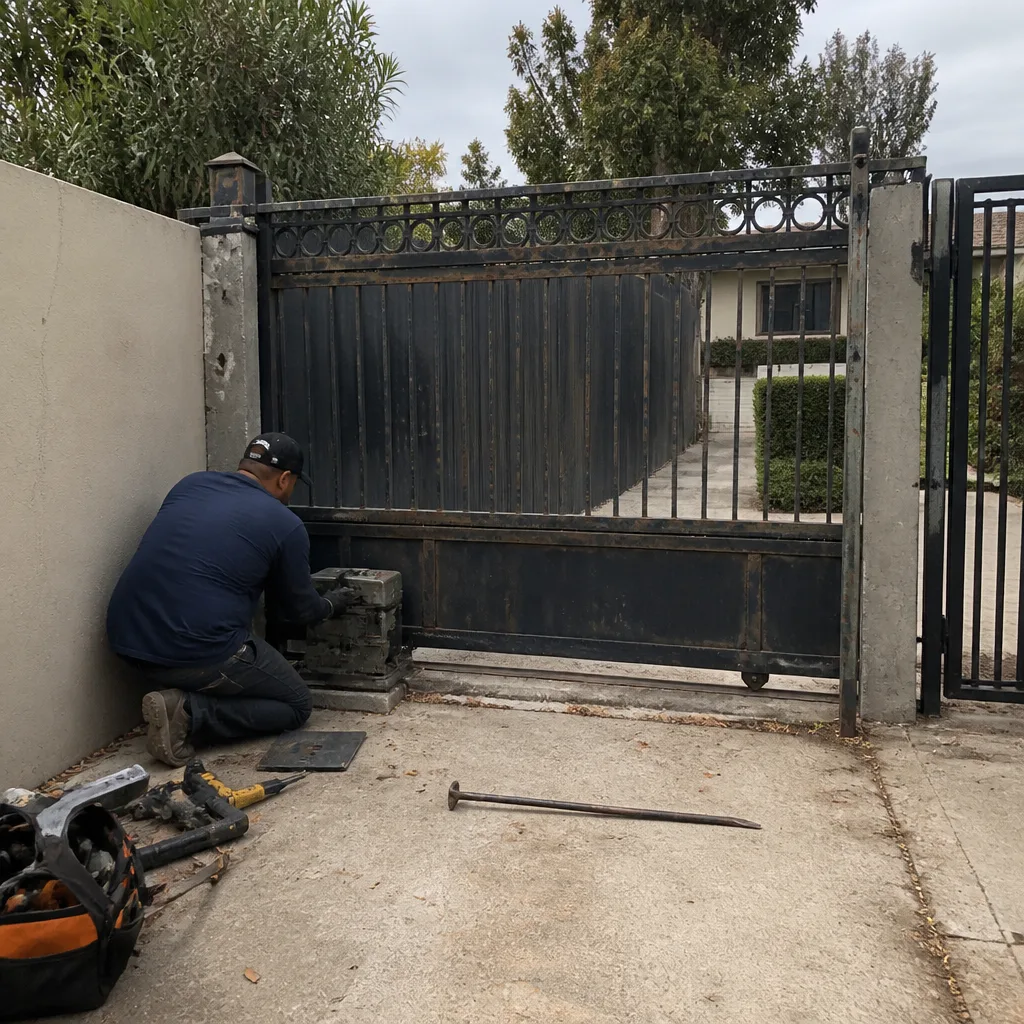 Before
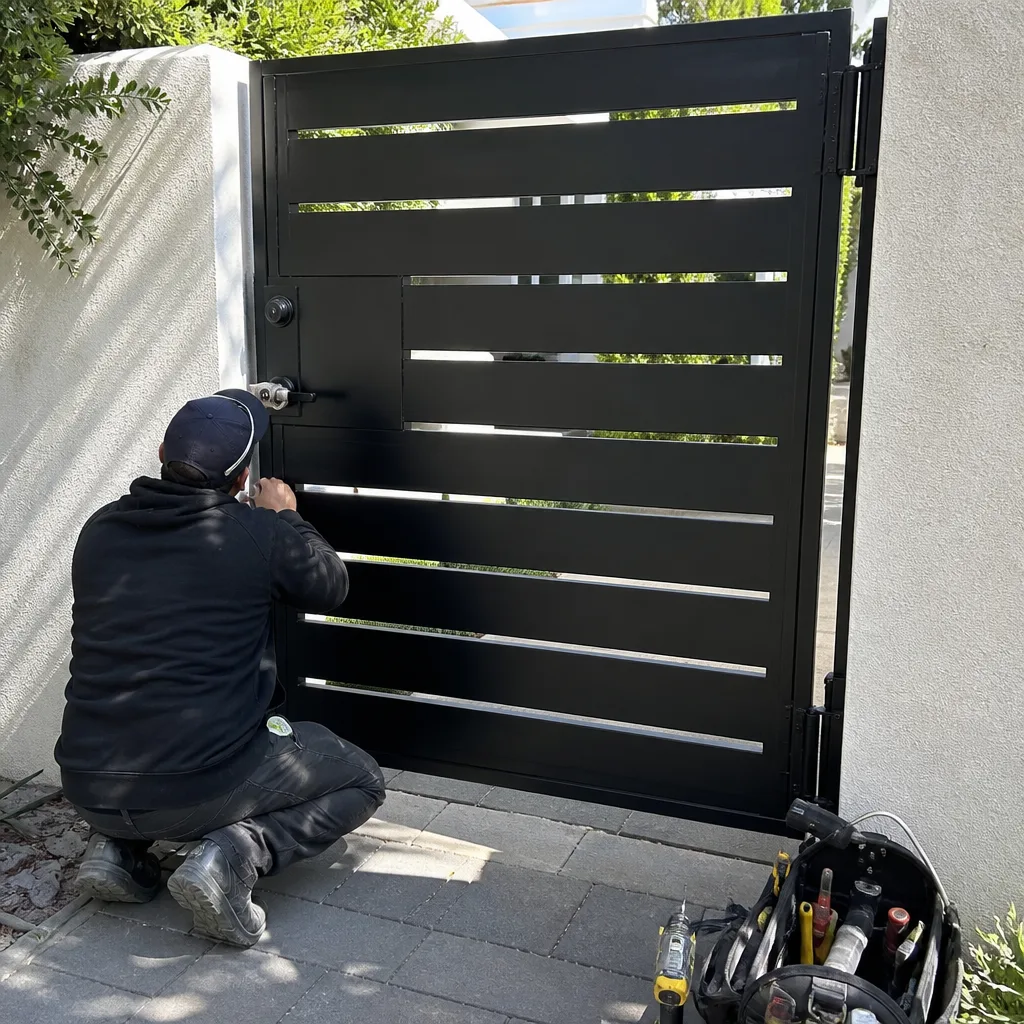 After
After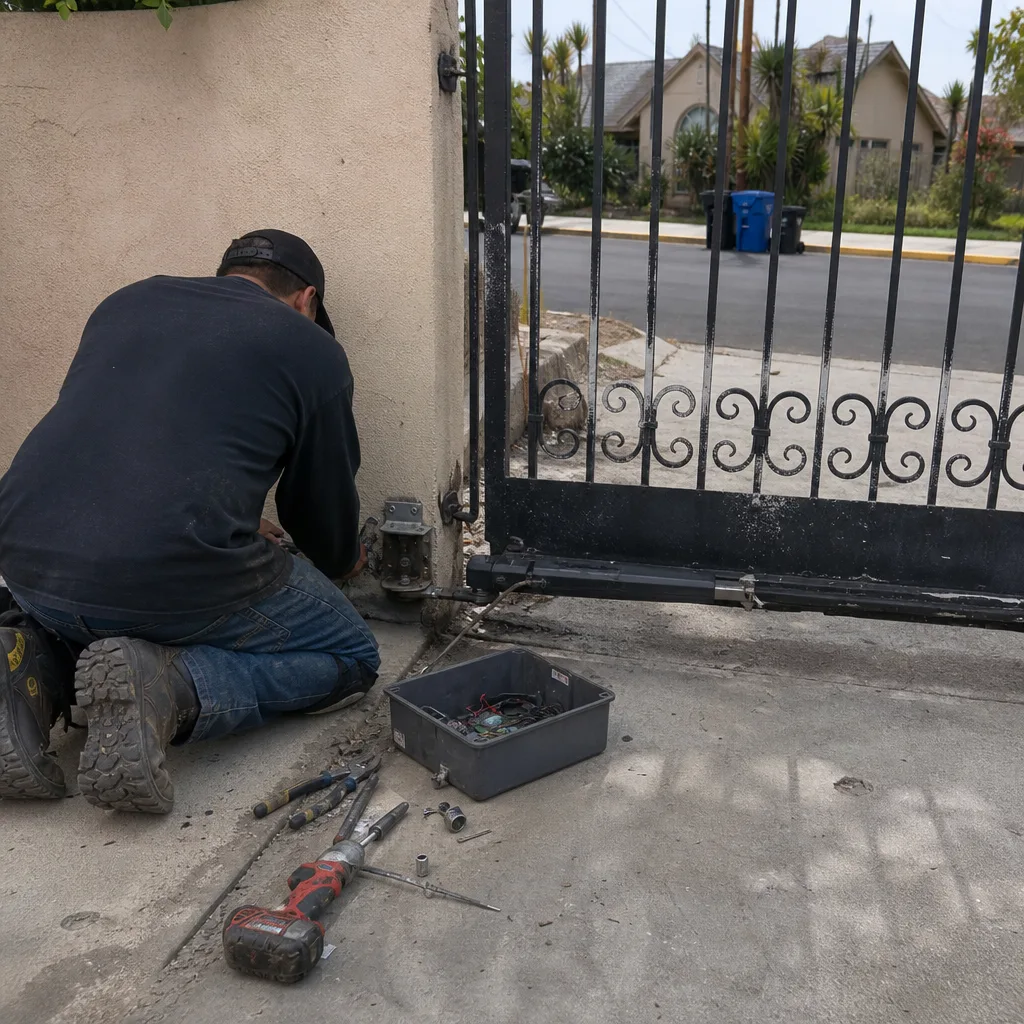 Before
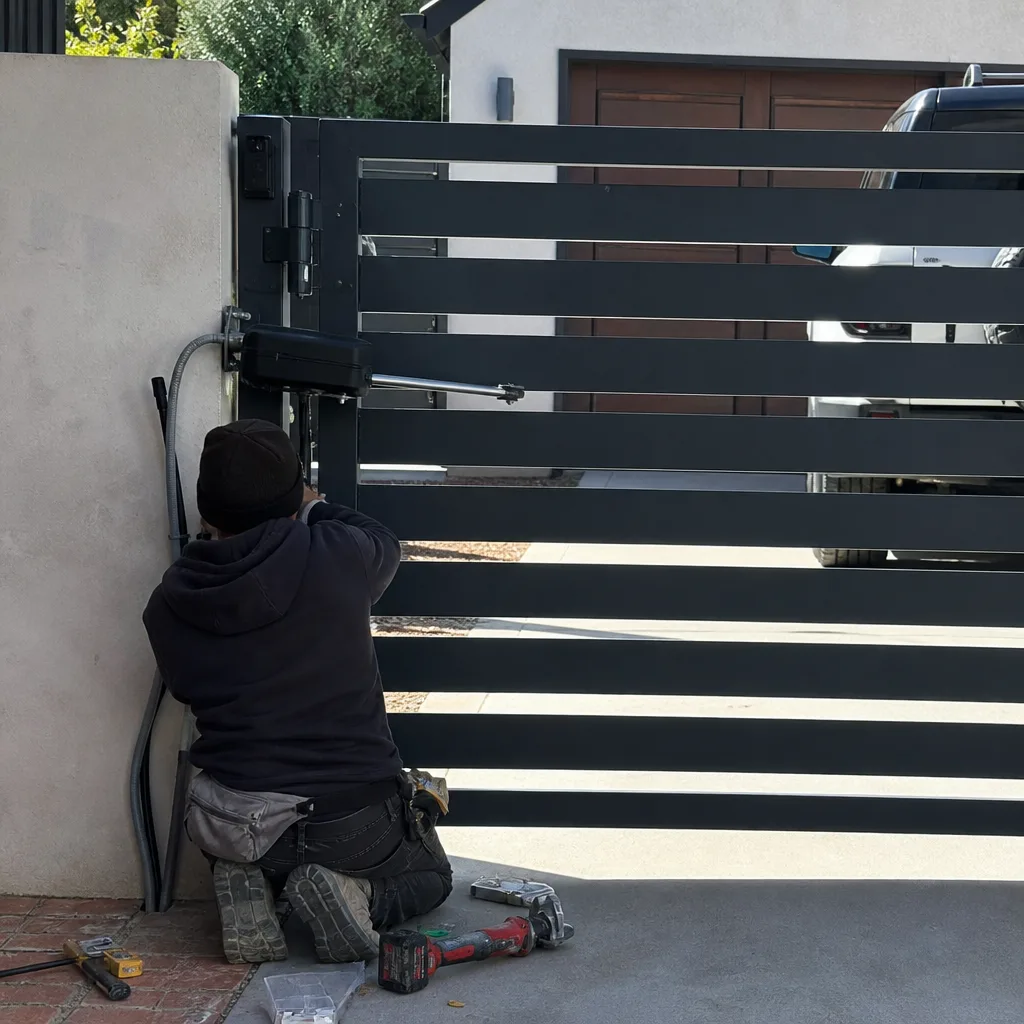 After
After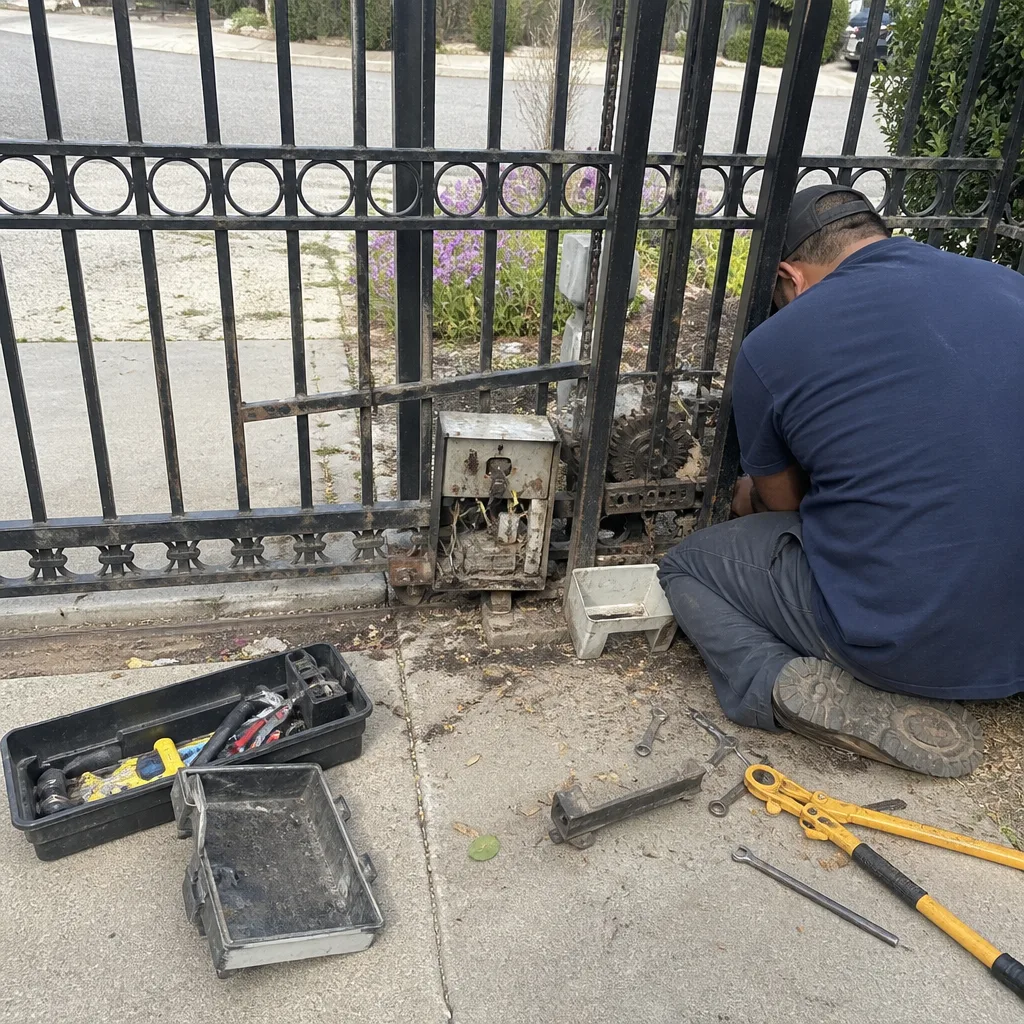 Before
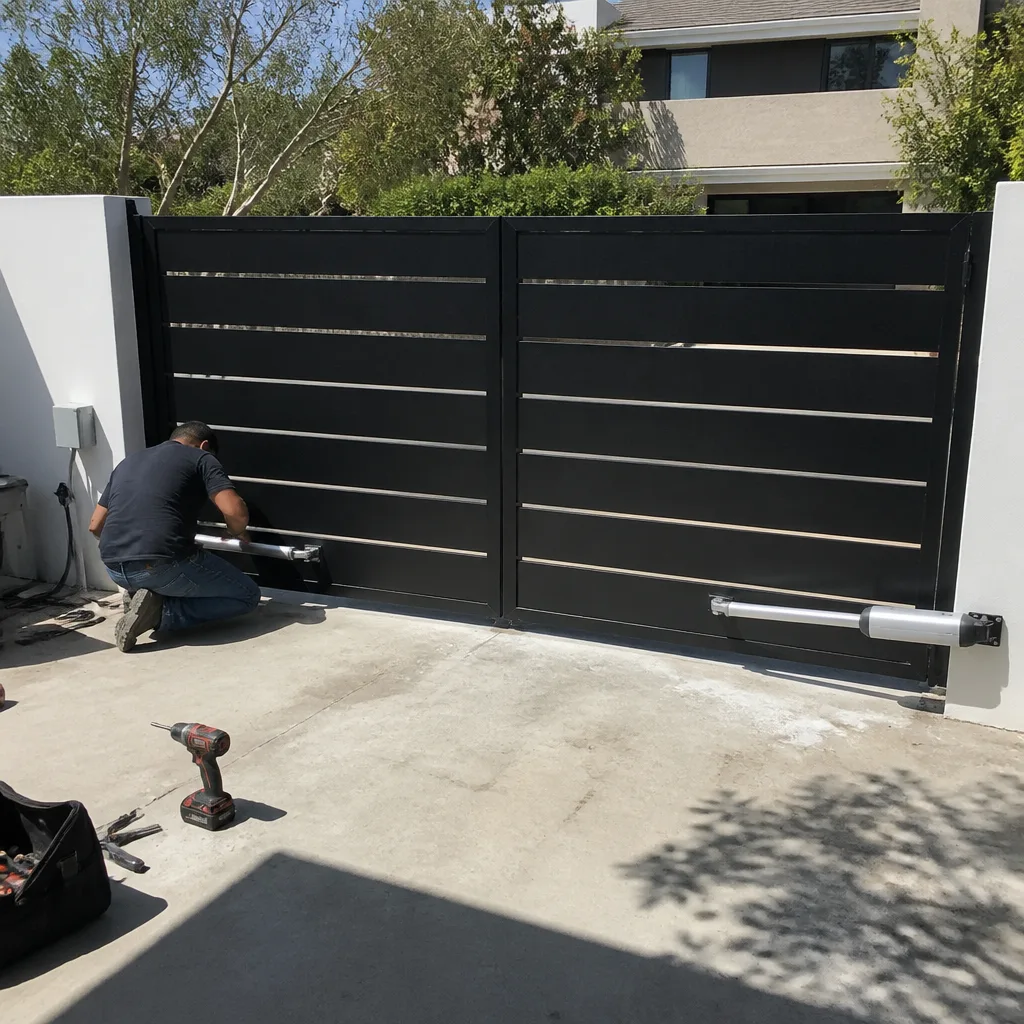 After
AfterDIY vs Professional Gate Repair: What’s Safe to Do Yourself
Most homeowners who call us after a failed DIY gate repair in Los Angeles didn’t fail because they lacked mechanical skill. They failed because they trusted a YouTube video that never mentioned voltage ratings, spring tension, or what happens when a 400-pound gate leaf drifts out of square on an unlevel concrete pad. The real dividing line between what’s safe to do yourself and what isn’t comes down to three things: voltage, stored energy, and the cost of a mistake. This guide walks you through each category honestly, so you can spend your weekend fixing what’s actually fixable and avoid turning a $200 sensor alignment into a $1,400 Gate Repair.
Quick Answer
Safe DIY gate repairs are limited to low-voltage components: replacing batteries, reprogramming remotes, realigning photo-eye sensors, and adjusting limit switches that control how far the gate travels. Anything involving 120V power supply wiring, torsion or extension springs, concrete post setting, or structural welding belongs with a licensed technician. In Los Angeles, most professional gate repair visits run $95 to $245 for diagnosis and basic labor, while the cost of fixing a botched DIY attempt typically starts at two to three times the original repair price. For a deeper look at this trade-off, see our DIY vs Professional Gate Repair: The Los Angeles Homeowner’s Decision Guide.
Table of Contents
- The Voltage Threshold Rule: 24V vs 120V
- Repairs Most Homeowners Can Safely Complete
- Repairs That Require a Licensed Technician
- The Hidden Cost of a Failed DIY Gate Repair
- Los Angeles Gate Repair Considerations
- How Professional Gate Repair Pricing Works
- Common Mistakes to Avoid
- When to Call a Professional
The Voltage Threshold Rule: 24V vs 120V
Here’s the cleanest way to think about gate repair safety: there are two electrical systems inside most automatic gates. The control system runs on 24 volts, which is the same low-voltage power category as your doorbell or thermostat wiring. The power supply that feeds that control system runs on 120 volts, which is the same voltage as your wall outlets and can stop a heart.
The 24V side includes the control board, the keypad, the remote receiver, the photo-eye sensors, the limit switches, and the battery backup. These components are designed to be serviceable. Touch the wrong terminal on a 24V control board and you might blow a $60 fuse. Touch the wrong wire on the 120V side and you’re in an emergency room.
In our experience across Los Angeles, from Westchester to Sherman Oaks to Pasadena, we see the same pattern repeated: a homeowner opens the operator housing, sees the control board and the transformer in the same enclosure, and assumes everything inside is equally safe. It isn’t. The transformer converts 120V down to 24V, but the wires feeding the transformer carry full line voltage with no visible difference in appearance. This is the exact moment where DIY gate repair becomes a medical event instead of a weekend project.
The voltage threshold also affects what you can legally do. In California, most jurisdictions require a licensed electrical contractor for any work involving line-voltage wiring, even inside a gate operator. That’s not a suggestion from your HOA; it’s state code. If the repair requires moving, splicing, or extending the 120V supply, you’re outside the DIY boundary regardless of how confident you feel.
Practical rule: if you can identify the component on a wiring diagram as 24V and you’re replacing like-for-like with the power disconnected, it’s generally DIY-approachable. If you can’t tell what voltage a wire carries by reading the diagram, stop. The uncertainty itself is the answer.
Repairs Most Homeowners Can Safely Complete
These are the four gate repairs we regularly talk Los Angeles homeowners through over the phone when a service call isn’t yet necessary. Each one involves no line voltage, no stored spring energy, and no structural load. They take between 20 minutes and an hour for a first-timer.
1. Reprogramming a Remote or Keypad
Every major operator brand used in Los Angeles, including BFT and Linear, has a learn button or programming menu on the control board. The process typically involves pressing a button on the board, then pressing the button on the remote within 30 seconds. Most remotes come with printed instructions that are accurate. Keypads are slightly more involved but still straightforward: enter programming mode, set a new code, test it with the gate connected. No tools beyond a small screwdriver. No risk beyond accidentally erasing the other remotes, which takes 10 minutes to re-add.
2. Realigning Photo-Eye Sensors
Photo-eyes are the small sensors mounted near the bottom of the gate opening on both sides. When they fall out of alignment, the gate refuses to close or reverses immediately because the safety circuit thinks something is in the way. Realignment usually means loosening a bracket screw, adjusting the angle until the small indicator light turns solid, and tightening the screw back down. On gates with sunlight interference, which is common in Los Angeles where glare hits sensors for hours each day, you may need to shade the sensor or clean the lens with a dry cloth. This is a legitimate DIY fix and often resolves stubborn “gate won’t close” complaints without any replacement parts.
3. Replacing a Battery Backup
Operators with battery backup have a 12V sealed lead-acid battery inside the housing, similar to what you’d find in an alarm panel. When these batteries age out after 3 to 5 years, the gate may work fine on line power but not during an outage, or the control board may show a battery fault code. Replacement is a unplug-old-battery, plug-in-new-battery job. Disconnect main power first, note the orientation, and you’re done in 15 minutes. The old battery goes to a hazardous waste drop-off, not the trash. Los Angeles County has locations in Sun Valley and West Los Angeles that accept them free of charge. For a full timeline of upkeep tasks, see our Electric Gate Repair Maintenance Schedule: What to Do and When.
4. Adjusting Limit Switches
Limit switches control how far the gate travels before stopping. If your gate slams at the open or closed position, or stops short of full closure, the limit switch might need a small adjustment. On newer operators from brands like Viking and Ghost Controls, the limits are set digitally through the control board menu. On older mechanical models, they’re small screws or cams inside the housing. This is a fine DIY adjustment, but it requires patience: adjust in quarter-turn or single-step increments, test the full travel, and repeat. Rushing this adjustment is how gates end up over-traveling and bending hardware.
Repairs That Require a Licensed Technician
These are the gate repairs where amateur mistakes cause injuries, property damage, or both. The common thread is stored energy: voltage, spring tension, or weight under load. None of these are worth the hospital copay or the repair bill that follows.
Counterbalance and Tension Spring Work
Slide gates often use counterbalance systems to take weight off the operator motor. Cantilever gates use spring-loaded mechanisms running through the gate’s internal frame. Torsion springs in these systems store thousands of pounds of rotational force. When they release unexpectedly, they release into whatever is nearby, which is usually your hand, wrist, or face. This is the gate-repair equivalent of working on a garage-door torsion spring, and it’s the single most dangerous do-it-yourself activity in the entire trade. No video tutorial makes this safe. Proper spring work involves winding bars, locking pliers, and a very specific sequence of releasing tension that professionals learn through supervised repetition.
Post Re-Setting and Concrete Work
When a gate post leans or the concrete footing cracks, the repair is structural, not mechanical. The post must be excavated, re-plumbed, and set in fresh concrete with proper curing time before the gate can be re-hung. In Los Angeles, this work often requires a dig permit if the footing depth exceeds a certain threshold, and the soil conditions vary dramatically across the basin, from hardpan in the San Fernando Valley to sandy loam near the coast. Get the depth wrong and the gate sags again within a year. Get the curing wrong and you’re doing the whole job twice. This is also a two-person job at minimum, since a gate leaf that size cannot be safely managed solo.
Any Work on 120V Power Supply Wiring
We covered the voltage threshold above, but it deserves repeating in the pro-only list: if the repair involves the line-voltage supply, the transformer input, a tripping breaker, a burned power cord, or a dead outlet that feeds the operator, call a licensed electrician or a gate technician who is cleared to do electrical work. In Los Angeles, permits are required for most electrical modifications, and your insurance company will not cover a claim arising from unpermitted electrical work that you performed yourself. This is the one area where the financial risk alone should end the conversation.
Welding Cracked Frames or Broken Hinges
Wrought iron and steel gates in Los Angeles neighborhoods like Hancock Park and Los Feliz are often 30 to 60 years old. Metals fatigue, welds crack, and hinges wear through. Welding is a skilled trade with equipment costs, ventilation requirements, and fire-safety considerations. A bad weld fails at exactly the worst moment, and a failing gate is a projectile. This work also requires understanding the gate’s load distribution, because welding a cracked section without addressing why it cracked means the next crack appears somewhere more expensive.
The Hidden Cost of a Failed DIY Gate Repair
The painful math of DIY gate repair goes like this: the part costs $45 online. The video makes it look easy. Two hours in, the gate is disassembled in the driveway, the part doesn’t fit the operator because you have a model that the video didn’t cover, and the gate can’t close. Now you need a technician, but you need one immediately, and the repair now involves reassembling your partial work before the actual repair can begin. The $45 part plus the $85 expedited service call plus the reassembly labor ends up around $300 to $400 for what would have been a $180 repair if done properly the first time.
That’s not the worst case. The worst case is a voided warranty. Most operator manufacturers, including the big brands used throughout Los Angeles, have warranty language that excludes damage caused by unauthorized service. If you open the operator housing, attempt a control board replacement, and damage the board in the process, the manufacturer is not obligated to help. The replacement board for a mid-range operator typically runs $200 to $450, which is another cost that didn’t exist before the DIY attempt.
There’s also the security angle. A gate that can’t close means an open driveway and an exposed property overnight. In Los Angeles, where a house with a gate is often the only one on the block with supplementary security, that exposure matters more than the repair bill. A professional repair scheduled for tomorrow morning is usually cheaper than a DIY attempt that leaves the gate disabled for three days.
Los Angeles Gate Repair Considerations
Los Angeles is not one climate. It’s a patchwork of microclimates, and the gate in your yard is dealing with conditions that a gate in Portland never faces. Coastal areas like Santa Monica and Pacific Palisades put salt air on steel hinges and weather seals, which means rust and corrosion show up earlier than they would inland. The San Fernando Valley swings from near-freezing winter mornings to 105-degree summer afternoons, which stresses solder joints and battery chemistry. The salt air rusts, the heat cycle fatigues electronics, and the dry inland air dries out lubricant and rubber seals. These aren’t speculative concerns; they’re the specific failure patterns we see when servicing Gate Repair in Los Angeles call volumes week to week.
Another local factor is gate regulation. Many Los Angeles communities with hillside lots, automated driveway gates, and new construction are now reviewing gate safety requirements more closely, including photo-eye placement, edge sensors, and automatic reverse functions. The default standard is UL 325 compliance, which governs how automatic gate operators must perform to prevent entrapment. A homeowner who modifies the operator’s travel limits or disables the reverse function to “fix” an intermittent problem has also created a liability issue. If the gate injures someone, non-compliance is difficult to defend.
Homeowners should also know that the local market for gate parts and service is broad, from big-box stores that carry universal remotes (which often don’t sync correctly with BFT or Viking systems) to specialized suppliers who only sell to licensed contractors. The parts you buy from a local hardware chain in Los Angeles are not always the same specification as what the operator manufacturer intended, and that mismatch is a frequent root cause of repeat failures.
How Professional Gate Repair Pricing Works
In Los Angeles, residential gate repair pricing follows a fairly standard structure. Most companies charge a diagnostic or service-call fee that covers the technician’s time to reach your property and identify the problem. That fee typically runs $75 to $150 depending on location and time of day. The repair itself is then quoted as a flat price with parts and labor included, and you approve that price before the work begins.
Here’s what common repairs actually cost in the Los Angeles market as of 2026:
- Photo-eye sensor replacement or realignment: $120 to $280 parts and labor
- Remote or keypad reprogramming: $85 to $185 for service call and programming
- Battery backup replacement: $130 to $260 depending on battery capacity
- Limit switch adjustment: $90 to $180, often included with a service call
- Control board replacement: $300 to $650 parts and labor depending on the brand and model
- Swing-gate actuator replacement: $550 to $1,200 parts and labor for a standard residential arm
- Post re-setting with concrete: $600 to $1,500 per post depending on depth, access, and curing time
- Spring or counterbalance replacement: $400 to $900, requires de-tensioning and re-tensioning
These ranges reflect the current Los Angeles market, where labor rates and parts availability differ from smaller California cities. The operator brand matters too. BFT and Viking tend to have proprietary parts that cost more than universal equivalents, which is why any honest quote requires knowing the exact model of the operator already installed on the property.
Every professional gate company we know of in Los Angeles, including every independently owned Kingswell location, prices this way: diagnosis first, written quote second, repair only after you approve the number. If a company is reluctant to give you a written price before they start turning bolts, that’s your sign to call someone else.
Common Mistakes to Avoid
- Disconnecting wires without photographing them first. Every control board has labeled terminals, but labels don’t help when the board is out and you’re holding six identical-looking wires. Take photos from multiple angles before removing anything. This single habit saves more service calls than any other piece of DIY advice in gate repair.
- Assuming a universal remote works with every operator. Universal remotes sold at home centers in Los Angeles work with many LiftMaster and Chamberlain openers, but compatibility with BFT, Linear, or Viking systems is hit or miss. Buying the wrong remote isn’t just wasted money; it’s wasted time re-learning the operator frequency and DIP switch settings.
- Adjusting limit switches to fix a gate that stops randomly. Limit switches rarely drift on their own. A gate that stops mid-travel usually has a different problem: a failing capacitor, a control board fault, or an obstruction sensor being triggered. Rewriting the limits to compensate often makes the original problem worse.
- Lubricating everything with WD-40. WD-40 is a solvent, not a lubricant. It washes away the grease that was already doing the job and leaves the metal dry. Use white lithium grease on chains and pivots, silicone spray on plastic gears and sensor brackets. Avoid petroleum-based lubricants on rubber wheels and weather seals.
- Working on the gate while the power is still connected. This sounds obvious, but a surprising number of DIY gate repairs go wrong because the homeowner unplugged the operator, not the circuit that feeds it, or because they assumed the battery backup would keep things safe. Both 120V and 24V should be fully disconnected before any internal work.
- Propping a heavy gate leaf with a cinder block during hinge work. Cinder blocks crack under point loads. A gate leaf dropping on a hand, foot, or dog is a genuinely serious injury. Proper supporting requires jack stands or a helper. No gate leaf should ever be supported by anything that isn’t rated for the weight.
When to Call a Professional
The decision to call a professional should be immediate when the job involves line voltage, spring tension, structural support, or any repair where the gate can’t wait. A gate stuck open is a security problem, not a scheduling decision. A gate that won’t open is a vehicle-access problem. Both need attention today, not after a weekend of research.
You should also call when the operator is behaving erratically: reversing for no reason, stopping mid-cycle, showing fault codes you don’t understand. These symptoms usually indicate a control board or sensor failure, and replacing parts one by one without a diagnosis turns into the expensive parts-cannon approach. Portcullis Gate Repair offers free estimates in Los Angeles and the surrounding areas, and every repair comes with a written quote before any work begins. Call (940) 412-7340 and a live person answers, any time day or night.
Frequently Asked Questions
You can safely handle low-voltage components like remote programming, photo-eye alignment, battery replacement, and minor limit switch adjustments. You cannot safely handle 120V wiring, spring tension, post concrete, or structural welding. The voltage threshold is the dividing line.
Counterbalance and torsion spring work is by far the most dangerous, because the springs store thousands of pounds of force that can release suddenly. This work requires winding bars, proper technique, and a professional’s experience. It’s the one repair we tell every Los Angeles homeowner never to attempt.
Most residential gate repairs in Los Angeles run between $120 and $650 depending on the component. Basic sensor or limit work is at the low end; control boards, actuators, and spring systems are at the middle and upper end. Every honest company gives you a written price before the work starts, so you know the number before approving it.
In most cases, yes. Operator manufacturers exclude warranty coverage for damage caused by unauthorized service, and removing the housing to replace internal components is typically considered unauthorized unless you’re a licensed technician. The $200 you save on labor can cost you a $450 control board.
Mid-travel stopping usually points to a failing capacitor, a control board fault, an obstruction sensor triggering, or overheating on the motor. It’s rarely a limit switch issue, although that’s the first thing most DIY repair guides suggest. Professional diagnosis is the fastest way to find the actual cause instead of replacing parts on a hunch.
This is extremely common in Los Angeles, where gate companies come and go with the construction cycles. If your original installer is gone, you need a company that works on the specific operator brand installed, not just whatever is in stock. Portcullis Gate Repair services nine operator brands including LiftMaster, FAAC, BFT, Linear, Viking, Ghost Controls, DoorKing, Elite, and Mighty Mule, and we document every repair with a written guarantee. Call (940) 412-7340 for an exact quote, free.
The Bottom Line
The DIY-versus-pro decision on gate repair isn’t about how handy you are. It’s about the physics of the component. Low-voltage electronics and simple adjustments are genuinely safe weekend work for most homeowners. Line voltage, spring tension, concrete, and structural welding are not, and the financial penalty for learning the hard way runs to two or three times what the professional repair would have cost. The smart approach in Los Angeles is to get a written quote first, compare that number against the part cost and your time, and let the number and the risk level decide. For the full range of what we service, see Portcullis Gate Repair home, Gate Installation in Los Angeles, and Electric Gate Repair in Los Angeles. When the job is beyond the DIY line, call (940) 412-7340 for a free estimate, a written price, and a repair that’s done right the first time.
Written by Dean Prescott, Owner at Portcullis Gate Repair, serving Los Angeles since 2008. Explore more guides & resources on our blog.