
Last updated October 8, 2026
Free on-site gate assessment - hinges, posts, and your LiftMaster or Nice gate operator checked before anything is quoted
The assessment is free and the quote is the invoice.
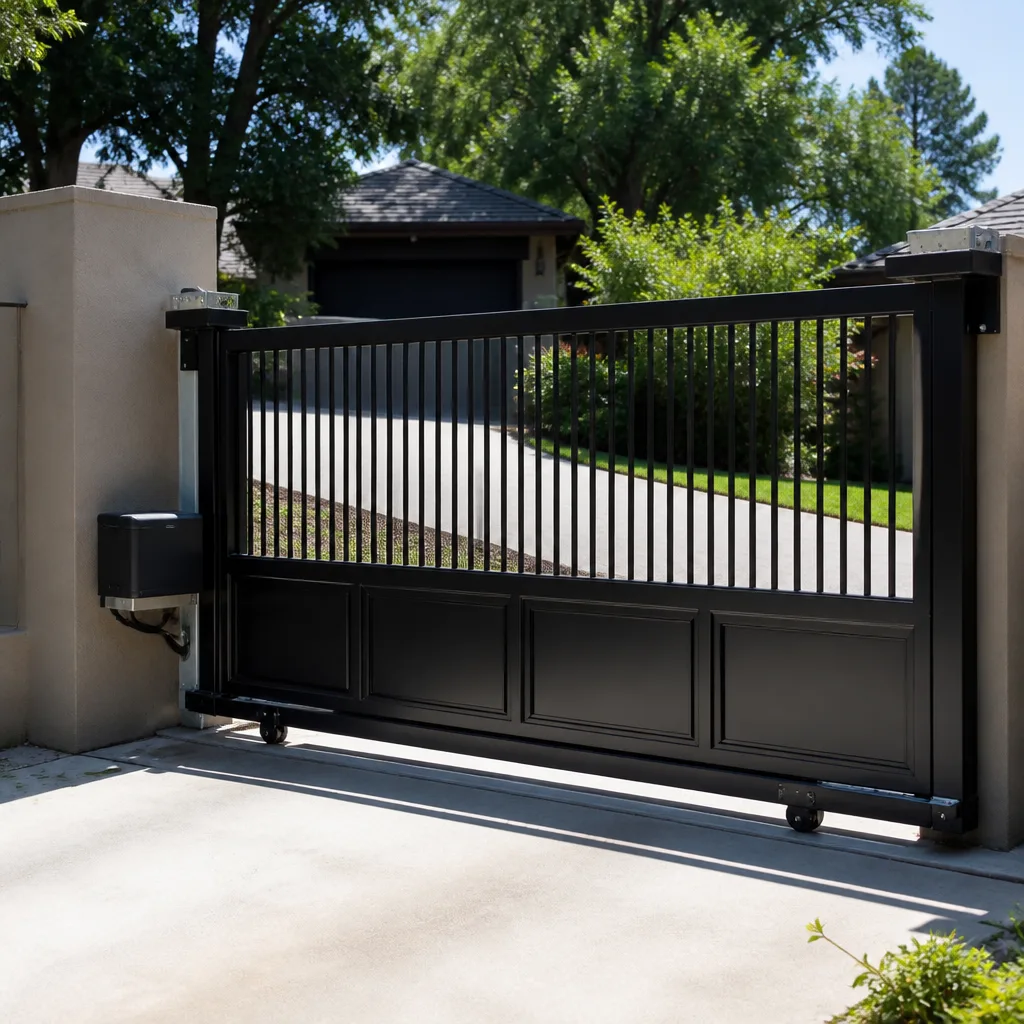
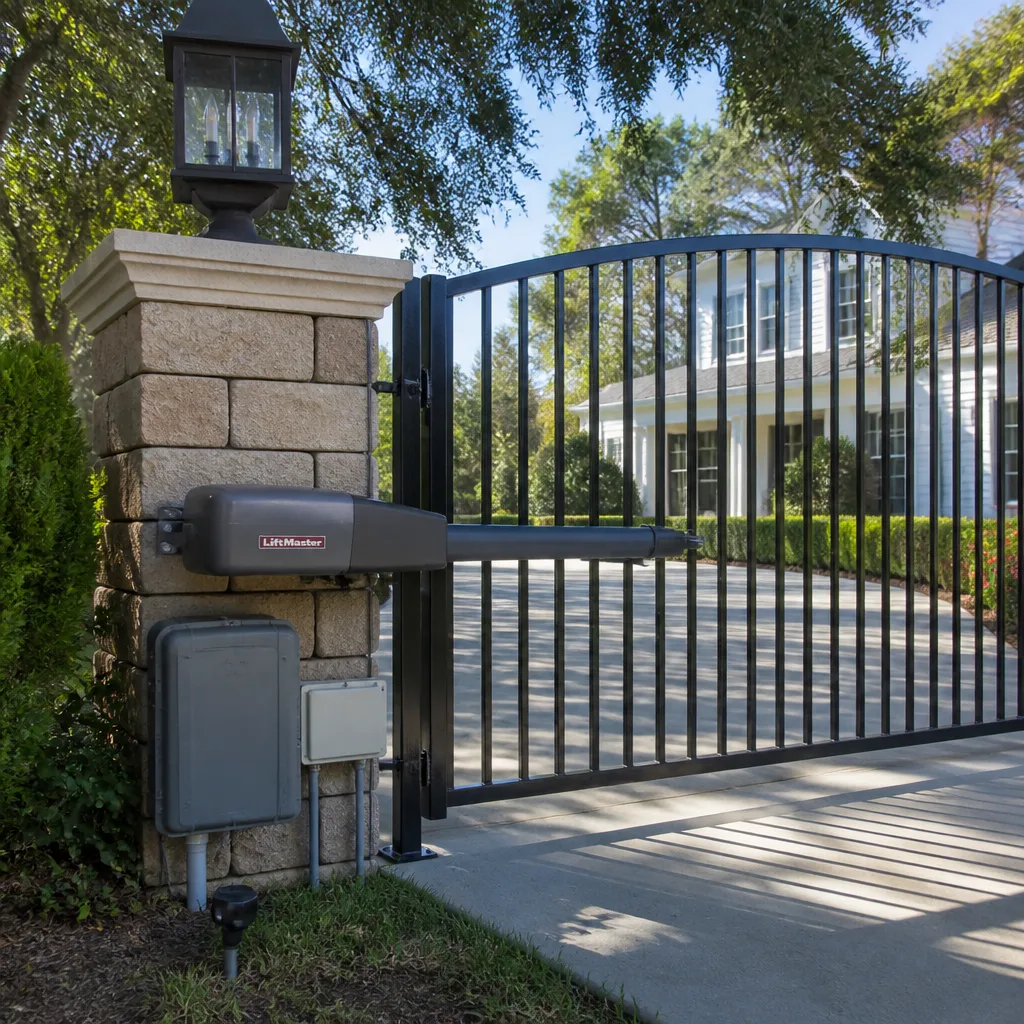
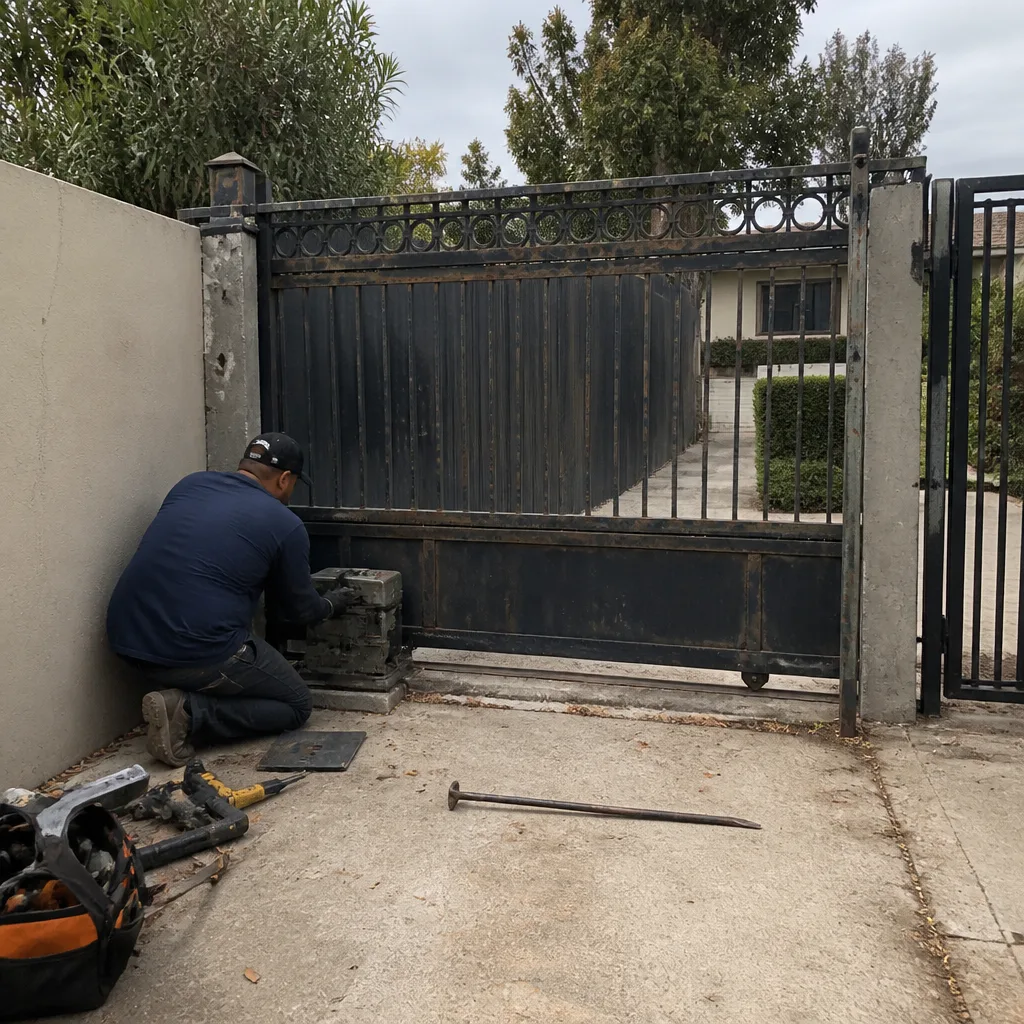 Before
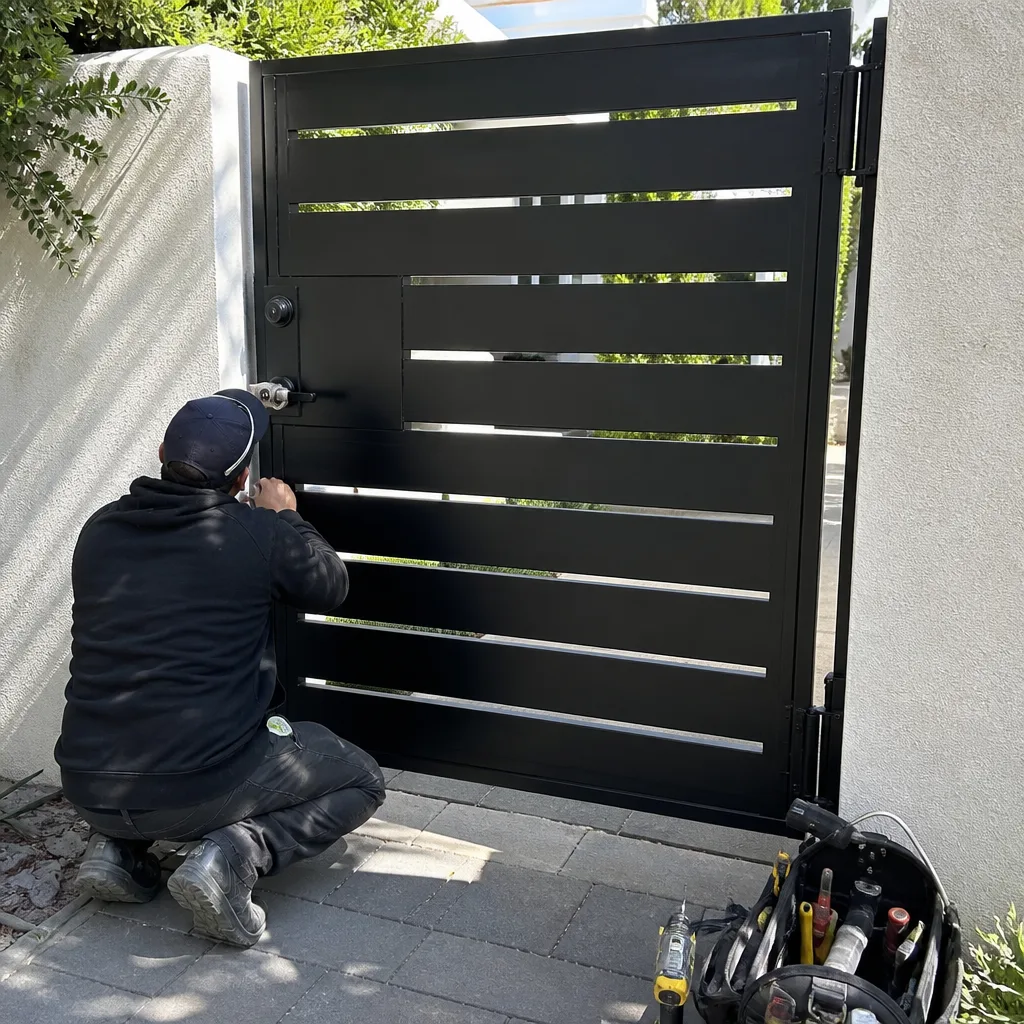 After
After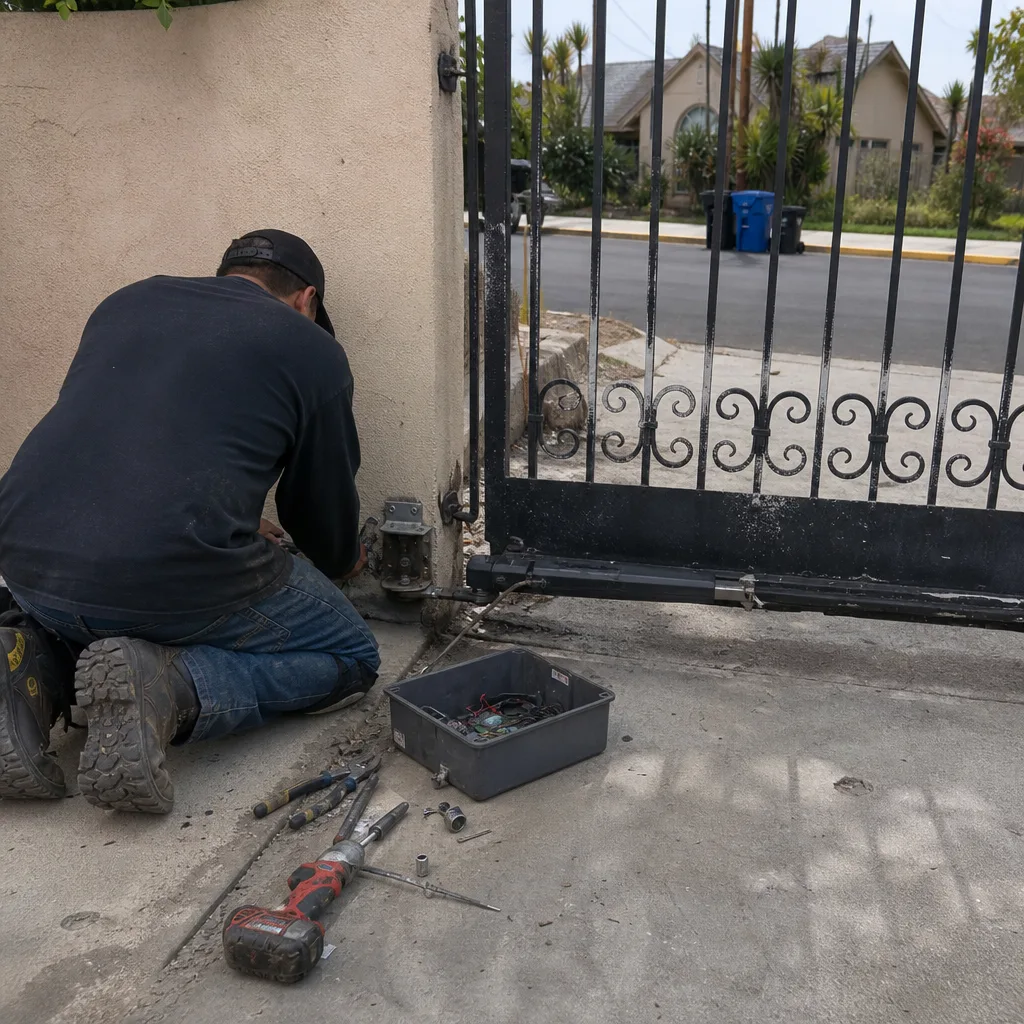 Before
 After
After Before
 After
AfterElectric Gate Repair Maintenance Schedule: What to Do and When
Gate operator chains stretch at a surprisingly predictable rate, about 1/4 inch of slack per 100,000 cycles. For a busy commercial gate in Los Angeles that opens 300 times a day, that means tension adjustment twice a year. For a residential gate that cycles 20 times daily, the same adjustment might only be needed every three years. Most maintenance guides ignore this distinction and treat every gate the same way. This guide breaks electric gate maintenance into three clocks: monthly owner checks, seasonal tasks, and annual professional service. By the end, you’ll know exactly what to inspect, when to inspect it, and which lubricants actually belong on each component.
Quick Answer
An electric gate needs maintenance on three schedules: monthly owner checks (visual inspection, manual release test, remote battery replacement), seasonal tasks (lubrication, weatherproofing, hinge and weld inspection, with October and March being the critical months in Los Angeles due to soil movement), and annual professional service (limit adjustment, board inspection, torque test, and battery load test). Expect to spend $150-$300 per year on professional maintenance, plus $20-$40 annually on lubricants and batteries. Skipping the monthly checks is what turns a $25 bearing replacement into a $1,200 operator swap.
Table of Contents
- Why Most Maintenance Schedules Fail Before They Start
- Monthly Owner Checks: The 10-Minute Routine
- Seasonal Maintenance: Lubrication, Weatherproofing, and Weld Inspection
- The Right Lubricant for Each Component (And Why WD-40 Is Wrong Everywhere)
- Battery Backup: The 2-3 Year Component Nobody Checks
- Annual Professional Service: What the Tech Actually Does
- Los Angeles Timing: Why October and March Matter Most
- Your Phone-Based Maintenance Log Template
- Common Mistakes to Avoid
- When to Call a Professional
- Frequently Asked Questions
- The Bottom Line
Why Most Maintenance Schedules Fail Before They Start
Here’s what we’ve learned from seventeen years of gate repair across Los Angeles: the problem isn’t that homeowners don’t care about maintenance. The problem is that every maintenance guide they’ve ever read lumps 25 tasks into one “annual checklist.” That checklist gets printed, pinned to the fridge, and ignored for eleven months. When the gate finally fails, the technician opens the operator and finds a chain with two inches of slack, a board covered in dust, and a battery that hasn’t held a charge since the second Obama administration.
The fix is simpler than you’d think. Break the work into three distinct clocks. Monthly tasks take ten minutes and require zero tools beyond a visual inspection and a manual release test. Seasonal tasks take about an hour, four times a year. Annual professional service is a single technician visit, usually $150 to $300 in the Los Angeles market, depending on whether your operator is a slide or swing model and which brand is installed. When each task sits on the right clock, the whole system becomes doable. When everything sits on one clock, nothing gets done.
Monthly Owner Checks: The 10-Minute Routine
The monthly check is the highest-leverage maintenance you can do, because it catches problems before they become failures. Here’s the exact routine we recommend to homeowners throughout Los Angeles, from Brentwood to Pasadena:
- Walk the full track or gate path. Clear away leaves, dirt, gravel, or anything that’s accumulated where the gate travels. A single pine cone jammed in a track can bind a wheel and strip a gear in one cycle.
- Listen while it opens and closes. A healthy gate is quiet. Grinding, squealing, or a rhythmic clicking means something is wearing. Note where the sound comes from: the operator, a hinge, or the track.
- Watch the gate’s speed. It should move at a consistent pace from start to finish. If it slows down midway, you’ve got mechanical drag or a failing capacitor. If it jerks, you’ve got a chain or belt tension issue.
- Test the manual release. Every operator has a release mechanism that disconnects the motor so you can push the gate by hand. Pull it once a month, push the gate open and closed, then re-engage it. This does two things: verifies the release works when you need it, and tells you whether the gate moves freely without the motor. If it’s heavy by hand, the motor is working overtime every day.
- Check the remote battery. When the remote’s range starts dropping, the battery is fading. Replace it before it dies completely. A dead remote at 11 PM with the gate closed and your car outside is an emergency call that costs more than a $3 battery.
- Look at the safety edges and photo eyes. These are the sensors that stop the gate if something’s in the way. Wipe the photo eye lenses clean. Check that the safety edge strip along the gate’s leading edge isn’t cracked or peeling. In our experience, safety edge failures in Los Angeles often trace back to sun damage, the rubber breaks down after a few years of direct UV exposure.
That’s the whole monthly routine. Ten minutes, no tools, and it will catch most problems a month or two before they turn into a no-start situation. For deeper issues, see our guide on Electric Gate Repair Warning Signs Every Homeowner Should Know.
Seasonal Maintenance: Lubrication, Weatherproofing, and Weld Inspection
Four times a year, the maintenance goes a little deeper. These seasonal tasks take about an hour and require a few basic supplies: the correct lubricant (covered in the next section), a clean rag, a socket set, and a visual inspection of every weld and hinge. Here’s the breakdown:
Lubrication
Lubricate every moving metal-on-metal contact point. For a slide gate, that’s the track wheels, the guide rollers, and the chain if it’s a chain-drive system. For a swing gate, that’s the hinge pins and the actuator arm pivot points. Apply lubricant sparingly, then wipe away the excess. Too much lubricant attracts dust, and in Los Angeles, that dust combines with the lubricant to form a grinding paste. That paste accelerates wear faster than no lubricant at all.
Weatherproofing Inspection
Walk the entire gate and operator. Look for rust spots on steel, especially at welds and at the bottom rail where sprinkler overspray hits. In Los Angeles, hard water from sprinkler systems leaves mineral deposits that trap moisture against the steel. Sand down any surface rust, hit the spot with a rust-inhibiting primer, and repaint. Check the operator housing for cracks or gaps where rain or irrigation water could get in. Check every wire connection you can see for corrosion, particularly at the operator’s terminal block.
Weld and Hinge Inspection
Weld cracks start small. A hairline crack in a hinge weld on a 400-pound gate becomes a full break eventually, and when a hinge breaks, the gate drops and can tear the operator off its mount. Look at every weld on the gate frame. Use a flashlight. Look at the hinge pins: if they’re worn, the gate sags, and a sagging gate puts constant lateral load on the actuator. That actuator, the motorized arm that physically pushes the gate open, is a $400 to $900 replacement on most swing gate systems we service in Los Angeles. A $15 hinge pin replacement is the alternative.
The Right Lubricant for Each Component (And Why WD-40 Is Wrong Everywhere)
WD-40 is not a lubricant. It’s a water displacer. The “WD” literally stands for that. It cleans, it loosens rust, and then it evaporates, leaving behind a thin film that does nothing to protect a chain running 300 cycles a day. Here’s what each component actually needs:
- Chain (chain-drive slide gates): Use a dedicated chain lubricant designed for motorcycle or industrial roller chains. These are tacky, so they stick to the chain instead of flinging off, and they have anti-wear additives. Apply a thin coat to the inside of the chain run, then wipe the outside clean. A properly lubricated chain should look wet, not dripping.
- Track and wheels: These are dry components. Do not grease the track. Grease on a track picks up every particle of Los Angeles dust and turns into abrasive sludge. Clean the track with a rag, and if a wheel bearing squeals, replace the bearing rather than lubricating it. Most track wheels on slide gates use sealed bearings that are not serviceable.
- Hinge pins: Use a white lithium grease or a synthetic grease with a high drop point. Hinge pins on swing gates carry enormous load, and a thin oil runs away from where the pressure is. Apply the grease directly to the pin, then cycle the gate a few times to work it into the bearing surfaces.
- Rack-and-pinion systems (common on FAAC and BFT slide gate operators): Use a light silicone spray or a dry PTFE lubricant. The rack and pinion is a steel gear rolling against a steel rack. Heavy grease here traps grit between the teeth, and that grit is what chews up the gear faces. A light PTFE spray reduces friction without building up.
- Actuator pivot points (swing gate operators from brands like Viking and Linear): Same as hinge pins: white lithium or synthetic grease. These pivot points move slowly but under high torque, and a dry pivot accelerates actuator wear dramatically.
What We See in the Field
A homeowner wipes down their gate chain with WD-40, feels satisfied, and the chain runs quiet for about a week. Then the WD-40 evaporates, leaves a sticky residue that attracts dirt, and the chain runs louder than before. We’ve opened operators in Beverly Hills and Sherman Oaks where the chain was so gummed up with a WD-40-dirt mixture that it had to be removed and soaked in solvent before it could be relubricated. That’s a $120 to $180 cleaning job that a $12 can of proper chain lubricant would have prevented.
Battery Backup: The 2-3 Year Component Nobody Checks
Inside your gate operator, there’s a sealed lead-acid battery. Its job is to power the gate when the grid goes down, which in Los Angeles happens during heatwaves, Santa Ana wind events, and earthquake aftershocks. What most homeowners don’t know is that this battery has a two to three year service life, and it degrades whether or not it’s ever used. A battery that sits on a trickle charger for three years can be just as dead as one that cycled daily.
The problem is that a visual check tells you almost nothing. A sealed lead-acid battery looks identical at 100% capacity and 20% capacity. The only way to know is a load test, where the technician puts a known load on the battery and measures how far the voltage sags. That’s an annual professional task. If your operator’s battery is older than three years, plan on replacing it preemptively. A replacement sealed lead-acid battery for a gate operator runs $40 to $100, depending on capacity and brand. It’s cheaper than discovering the battery is dead the next time a brownout leaves your gate locked in place.
Annual Professional Service: What the Tech Actually Does
Once a year, a trained gate technician should spend 45 to 90 minutes inside your operator. Here’s what a proper annual service includes, and what it should cost in the Los Angeles market, typically $150 to $300, depending on gate type and operator brand:
- Limit adjustment. The limit switches tell the operator where the gate should stop. Over time, the gate’s mechanical stops may shift slightly, or the operator may creep past its limit. A gate that slams into its mechanical stop at full force is wearing out every component faster. The tech adjusts the limits so the gate stops smoothly at the correct position.
- Board inspection. The control board is the operator’s brain. The tech looks for bulging capacitors, scorch marks, insect damage, and corrosion on the terminals. Ants are a surprisingly common cause of control board failure in Los Angeles; they crawl into the housing, bridge two terminals with their bodies, and short the board. The tech also checks for loose wire connections, which cause intermittent faults that are maddening to diagnose.
- Torque test. The torque limiter, sometimes called a clutch, is what stops the motor if the gate hits an obstruction. The tech tests that the torque limiter actually functions and is calibrated correctly. Too sensitive, and the gate reverses on a stiff breeze. Too stiff, and the gate will push through an obstruction instead of stopping, which is a serious safety issue, especially with a child or pet in the way.
- Battery load test. As covered above, the backup battery gets load-tested and replaced if it’s failing.
- Chain or belt tension check. For chain-drive systems, the tech measures the slack against manufacturer spec and adjusts tension. This is the adjustment interval that brought you to this guide: busy gates need it twice a year, residential gates may go three years between adjustments. The tech will tell you which camp your gate falls in.
- Lubrication of all moving points. Using the correct lubricants, not a single can that does everything badly.
- Safety system verification. The photo eyes, safety edges, and any vehicle detection loops get tested to confirm they reverse the gate when triggered.
Every service visit should end with a written summary of what was done, what was measured, and what’s likely to need attention in the next year. That written record is what makes the difference between a gate that lasts 8 years and one that lasts 20. This is exactly what the Portcullis Gate Repair home service standard is built around: you get the written summary before you pay the invoice.
Los Angeles Timing: Why October and March Matter Most
Los Angeles has a wet season and a dry season. The wet season runs roughly November through March, the dry season April through October. Soil moisture changes dramatically across those seasons, and that moisture cycle moves your gate posts and pier footings. That’s why we recommend our Gate Repair in Los Angeles customers time their seasonal maintenance to two specific windows:
October (pre-rainy-season): The soil is at its driest, which means your gate posts are sitting in their most settled position. Do your full seasonal maintenance now: lubricate, weatherproof, inspect welds and hinges. The gate will go into the wet season properly prepared, and any small crack or gap you seal now won’t become a water intrusion point when the rain arrives.
March (post-rainy-season): The soil has absorbed months of rain, and clay-heavy soils, common in parts of the San Fernando Valley and the foothills, expand when wet. That expansion can shift posts slightly, which misaligns hinges and puts new stress on welds and actuator mounts. Re-inspect everything. In particular, re-check hinge alignment and weld integrity. A weld crack that opened during the wet season is visible in March; if you wait until October, it’s had six more months to propagate.
This March-to-October rhythm is specific to Mediterranean climates. A guide written for Phoenix or Seattle would give you different months. The important thing is that you’re doing the full seasonal inspection four times a year, but your October and March inspections are the ones doing the heavy lifting against soil movement.
Your Phone-Based Maintenance Log Template
When a technician asks, “When was this gate last serviced?” and you can answer with a date, a description of work, and a dollar amount, you’ll get better service. You’ll also know when a part is wearing out faster than it should. Here’s a log template you can copy into your phone’s notes app. One entry per line, dated:
- Date | What was done | Cost | Notes
- 2025-03-15 | Annual professional service, BFT slide gate | $210 | Chain tension adjusted, battery load test passed at 85%, tech recommends battery replacement 2026
- 2025-06-01 | Lubricated chain and track wheels, wiped photo eyes | $0, owner | Chain lubricant applied, no unusual wear
That’s it. Three fields plus a date. Ten seconds per entry. After two years, you have a service history that tells a technician exactly how your gate has been treated, and it tells you whether your maintenance money is buying longevity or just buying silence.
Common Mistakes to Avoid
- Lubricating the track. Grease on a track becomes grinding paste in Los Angeles dust. Keep the track clean and dry.
- Using WD-40 as a lubricant. It’s a water displacer. It evaporates, leaves a tacky film, and attracts dirt. Use a proper chain lubricant, white lithium grease, or PTFE spray, depending on the component.
- Ignoring the manual release. If you never test the release, you won’t know whether it works until the power goes out and you need it. A seized manual release turns a minor power outage into a major inconvenience.
- Skipping the battery load test. The battery is a 2-3 year consumable, and visual inspection tells you nothing about its actual capacity. Replace it on schedule, not when it fails.
- Waiting until the gate stops moving to call. Gates almost always announce their failures weeks in advance: a new noise, a new vibration, a new hesitation. Those are the cheap repair windows. The no-start is the expensive one.
- Treating every gate the same. A busy commercial gate and a quiet residential gate have completely different wear timelines. Adjust maintenance frequency to match actual cycle count, not the calendar.
- Not documenting anything. If you can’t say when it was last serviced, every new technician starts from zero. A three-line log entry takes ten seconds and saves diagnostic time.
When to Call a Professional
Some tasks are owner-level maintenance. Others are not. Call a professional if the gate slams into its stops, if the operator makes a grinding noise during the motorized portion of travel, if the gate reverses for no obvious reason, if the circuit breaker for the operator keeps tripping, or if the gate moves at different speeds on different days. Any of these suggest an electrical or mechanical failure that will not improve on its own. Portcullis Gate Repair offers free estimates in Los Angeles, call (940) 412-7340 to schedule one. We also handle the full scope of Electric Gate Repair in Los Angeles, from operator swaps to board diagnostics, on nine major gate-operator brands.
Frequently Asked Questions
Lubricate every moving metal-on-metal contact point four times a year, as part of your seasonal maintenance. Use a chain lubricant on chains, white lithium grease on hinge pins and actuator pivots, and a light PTFE spray on rack-and-pinion systems. Never use WD-40 as a lubricant, and never grease a track. If your gate cycles more than 100 times per day, you may need to lubricate monthly. Call (940) 412-7340 for a specific recommendation based on your gate type and usage.
Annual professional service on an electric gate in Los Angeles typically runs $150 to $300 for the service visit, depending on gate type and operator brand. That includes limit adjustment, board inspection, torque testing, battery load test, and lubrication. Parts like a new backup battery ($40 to $100) or a worn hinge pin ($15 to $30) are additional if needed. The total is almost always less than a single emergency repair call.
A sealed lead-acid backup battery inside a gate operator lasts two to three years, regardless of whether it’s used. It degrades while sitting on the charger. The only reliable way to know its condition is a load test, which should be part of every annual professional service. Replace it every three years as a preventive measure.
Chain tension adjustment is straightforward on most operators, but the correct tension depends on the operator model, and over-tightening a chain destroys the drive sprocket and motor bearings. If you’re comfortable with mechanical work and have the manufacturer’s spec, it’s a doable DIY task. If not, it’s a ten-minute job for a technician during an annual service. For our customers in the Los Angeles area, we include tension checks in every professional service visit.
In Los Angeles, slower winter operation is usually caused by soil expansion from rain shifting the gate posts slightly, which misaligns the hinges or track and increases mechanical drag. It can also be a sign of a failing capacitor in the operator or a battery that’s no longer providing correct voltage. If the slowdown persists more than a few days, call for a diagnostic. Our team at Gate Installation in Los Angeles has seen this pattern hundreds of times, and it’s almost always a mechanical alignment issue rather than an operator failure.
An electric gate that opens without a remote signal usually has one of three causes: a failing control board sending ghost signals, a stuck remote button (sometimes a remote is sitting in a drawer with something pressing on it), or a power fluctuation triggering the board’s open command. Disconnect the operator, test the remotes, and if it continues with remotes removed, the board is the likely culprit. This is a diagnostic call, which Portcullis Gate Repair handles as part of our standard service. Reach us at (940) 412-7340 for an appointment.
The Bottom Line
Electric gate maintenance works when it runs on three clocks: a ten-minute monthly check you can do with no tools, a one-hour seasonal inspection four times a year, with October and March being the critical Los Angeles windows, and one professional service visit annually. Use the right lubricants from day one, replace the backup battery every two to three years, and keep a three-line log on your phone. Most gate failures we’ve seen in Los Angeles over seventeen years were announced by a noise, a vibration, or a hesitation that got ignored for six months. Fix the small things on schedule, and the big things keep running. Browse our more guides & resources for ongoing gate care.
Written by Dean Prescott, Owner at Portcullis Gate Repair, serving Los Angeles since 2008.